The Form of the Good: What Plato Meant by the Highest Form
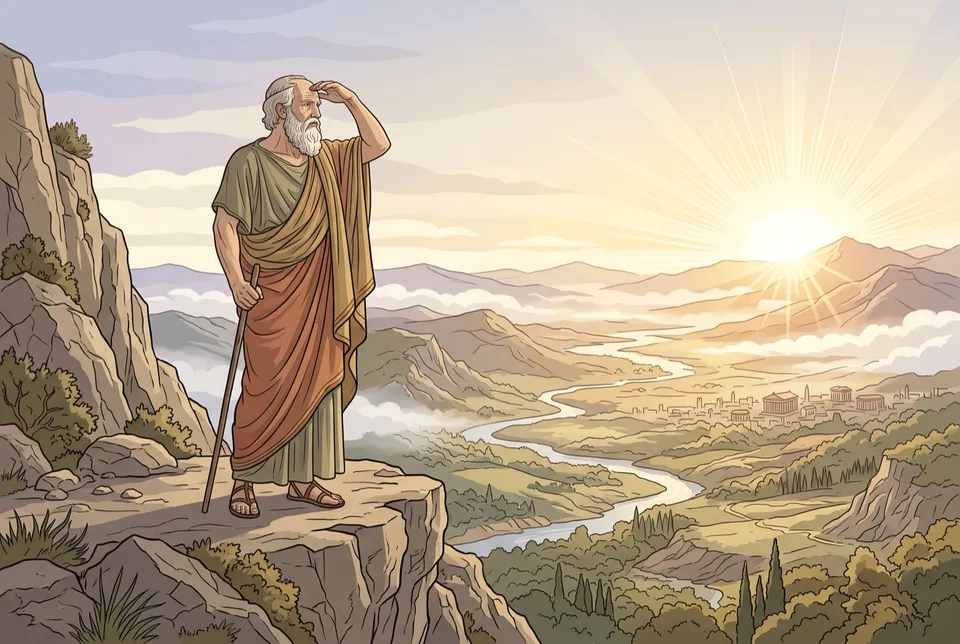
In short. The Form of the Good is the highest of Plato's Forms. Like the sun, it makes everything else knowable. What Plato meant by it in the Republic, explained.
The Form of the Good (in Greek hē tou agathou idea) is the top of Plato’s hierarchy of Forms. It is what makes the other Forms intelligible to a mind and what gives them their being in the first place, in the way that the sun both lights up visible things and makes them grow. Plato introduces it in Books 6 and 7 of the Republic, where Socrates calls it “the greatest thing to learn” (505a) and then admits that he cannot say directly what it is.
That admission shapes everything else about the idea. Plato never defines the Good. He approaches it through three images, the Sun, the Divided Line and the Cave, and the rest of this essay follows those images in order, before turning to why rulers need it, what Plato’s lost lecture on it seems to have said, and how later thinkers took it up or rejected it.
What is the Form of the Good?
Plato’s theory of Forms holds that behind the changing things we perceive there are single, unchanging realities: Justice itself, Beauty itself, Equality itself. (For the background, see our guide to Platonic idealism.) The Form of the Good is not simply one more item on that list. It stands above the others and explains them.
Three claims sum it up.
- It makes the Forms knowable. It gives truth to what is known and the power of knowing to the knower (508e).
- It makes the Forms be. Their existence and their essence come from it (509b).
- It is not itself a being in the ordinary sense. It is “beyond being” in dignity and power (509b).
It is also what makes anything else useful or worth having. Without knowledge of the Good, Socrates says, knowing everything else would be of no benefit to us (505a–b).
Why won’t Socrates say what the Good is?
The discussion begins at 505a. Glaucon and Adeimantus want Socrates to explain the Good, as he has explained justice and the other virtues. He first clears away two popular answers. Most people think the good is pleasure, and more refined people think it is knowledge (505b). Both fail: there are bad pleasures, and if you ask “knowledge of what?”, the answer turns out to be “knowledge of the good”, which goes in a circle.
He adds a telling observation. Many people are content with what merely seems just or beautiful, but nobody is satisfied with what merely seems good. When it comes to the good, everyone wants the real thing (505d). Every soul pursues it and does everything for its sake, while only dimly sensing what it is.
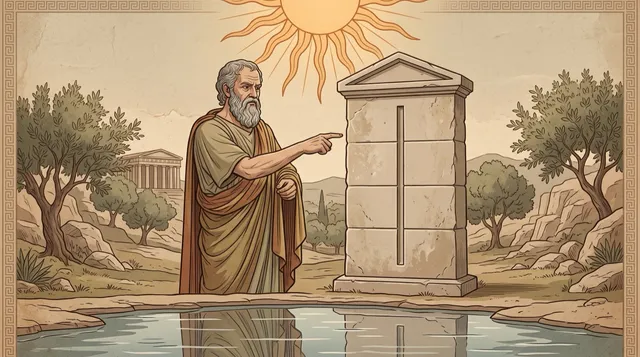
Then Socrates declines. He fears that an attempt to say what the Good itself is would make him ridiculous, so he offers instead to describe “the offspring of the Good”, the thing most like it (506d–e). He adds a pun. The Greek word tokos means both “offspring” and “interest” on a loan, and he says he is paying the interest now and still owes the capital (507a). The offspring is the sun.
What is the Sun analogy?
The analogy of the sun (507b–509c) is the first and most detailed of the three images. For a full walk-through, see our page on the analogy of the sun. In outline, it runs like this.
Sight is unusual among the senses. Hearing needs only a sound and an ear, but seeing needs a third thing as well: light. Eyes and colours can both be present and still nothing is seen in the dark. The source of that light is the sun. The eye is the “most sunlike” of the sense organs (508b), yet the eye is not the sun, and neither is sight.
Socrates then says that the sun is what the Good “begot in its own likeness” (508c): what the Good is in the intelligible world, in relation to understanding and what is understood, the sun is in the visible world, in relation to sight and what is seen. When the soul fixes on what truth and being light up, it understands. When it turns to what comes to be and passes away, it has only opinion and seems to lack understanding (508d).
Knowledge and truth are like the Good, he adds, just as light and sight are like the sun, but it would be wrong to think either of them is the Good itself (509a).
Then comes the decisive step (509b). The sun does more than make things visible. It also gives them coming-to-be, growth and nourishment, though it is not itself coming-to-be. In the same way, the objects of knowledge get from the Good not only their being known but their very being and essence, “though the Good is not being, but is still beyond being, surpassing it in dignity and power”.
Glaucon’s reply is comic: “Apollo, what a divine excess!” (509c). Plato seems to know how strange the claim sounds.
| The Sun (visible world) | The Good (intelligible world) | |
|---|---|---|
| The power involved | Sight | Understanding (nous) |
| The organ | The eye, “most sunlike” of the senses | The soul’s power to know |
| What is perceived | Colours and visible things | The Forms |
| The medium | Light | Truth |
| What the source gives the objects | Visibility | Knowability |
| What else it gives them | Coming-to-be, growth and nourishment | Being and essence |
| Its own status | Not itself coming-to-be | Not itself being, but “beyond being” |
| Things like it but not it | Light and sight | Truth and knowledge |
| Turning away from it | Eyes in the dark, seeing dimly | Soul turned to change, having only opinion |
What does “beyond being” mean?
The phrase “beyond being” (epekeina tēs ousias, 509b) is among the most debated in Plato. Scholars read it in two main ways.
On a modest reading, the Good is still a Form, but it is the highest one and the source of the others, so it outranks them. “Beyond” means superior in rank, not outside reality altogether.
On a strong reading, the Good really does transcend being: it is not a thing among things at all, and nothing we say of beings applies to it straightforwardly. This is the reading that Plotinus and the later Platonist tradition adopted.
The text supports both. Elsewhere in the same books Plato calls the Good “the brightest of what is” (518c), which pulls towards the modest reading. The phrase at 509b pulls the other way. What is certain is that Plato wanted a principle that explains why there is an intelligible order at all, and he was willing to strain language to point at it.
How does the Form of the Good fit the Divided Line and the Cave?
Straight after the Sun comes the Divided Line (509d–511e). It divides a line into four parts: images, physical things, mathematical objects and Forms, each with its own state of mind. In the lower part of the intelligible section, mathematicians reason down from assumptions they take as given. In the highest part, dialectic treats its assumptions as stepping stones and climbs up to “the unhypothetical first principle of everything” (511b). Most readers take that first principle to be the Good.
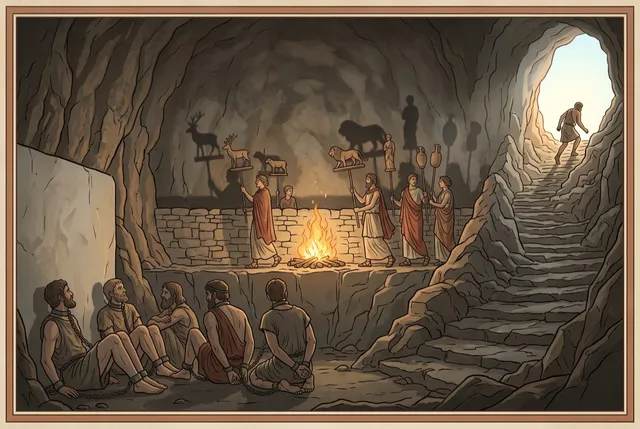
The allegory of the cave (514a–520a) then puts the whole scheme into a story. The freed prisoner climbs out, first looks at shadows and reflections, then at things themselves, then at the night sky, and last of all at the sun “in its own place” (516b). Socrates spells out the meaning at 517b–c: in the knowable realm the Form of the Good is seen last and with difficulty, but once seen it must be recognised as the cause of everything right and beautiful. In the visible realm it produces light and the sun, and in the intelligible realm it is itself in control, providing truth and understanding.
So the three images agree. The Good is the sun of the intelligible world, the top of the line, and the last thing seen on the way out of the cave.
Why must philosopher-rulers know the Form of the Good?
The discussion of the Good is not a detour from the politics of the Republic. It is the reason the rulers must be philosophers.
Socrates says the guardians of the city must know the Good, because someone who knows what is just and beautiful without knowing how they are good will be a poor guardian of them (506a). Justice and the other virtues become useful only when they are understood in the light of the Good (505a).
Later he sets out the education that gets them there: years of mathematics, then dialectic, then fifteen years of practical service back in the cave. At fifty, those who have come through it must lift their eyes to the Good itself and use it as a pattern for ordering the city, their fellow citizens and themselves (540a–b). That is what makes a philosopher-king different from any other ruler. The ruler governs by looking to a standard that does not change with opinion or interest.
What did Plato say in his lecture “On the Good”?
Plato seems to have given a public lecture, or a series of lectures, called On the Good. No text survives. Our main report comes from Aristoxenus, a music theorist and pupil of Aristotle, writing a generation later, who says Aristotle used to tell the story.
According to that report, many people came expecting to hear about one of the recognised human goods, such as wealth, health or strength, or some wonderful kind of happiness. Instead they heard about mathematics, numbers, geometry and astronomy, ending with the claim that the Good is One. Most, it seems, were baffled or left unimpressed.
The report is second-hand and late, so it should be handled with care. It fits with other ancient evidence that Plato’s teaching inside the Academy connected the Good with unity and with mathematics, and it matches the Republic’s insistence that the road to the Good runs through mathematical study. How far those “unwritten doctrines” went is still disputed.
How did later thinkers read the Form of the Good?
Plotinus (third century AD) took the phrase “beyond being” as the key to Plato. In his system the first principle is the One, also called the Good, which is beyond being and beyond thought. From it proceed Intellect, where the Forms live, and then Soul. These three levels are his three hypostases. See who was Plotinus and what hypostasis means for Plato and Aristotle. The identification of the Good with the One echoes the report of Plato’s lecture.
Christian thinkers read the Good in the light of God. Augustine, who came to Christianity partly through Platonist books, treated God as the highest good and placed the Forms in the divine mind. The writer known as Pseudo-Dionysius put “Good” first among the names of God. These readings made the Sun analogy a familiar image of divine illumination for centuries. They go beyond the Republic, which never calls the Good a god.
What was Aristotle’s objection to the Form of the Good?
Aristotle, who studied with Plato for about twenty years, attacks the idea in the Nicomachean Ethics (I.6). He introduces the criticism with a famous apology: the Forms were introduced by friends of his, but piety requires honouring truth above friends.
His main points are these.
- “Good” has many senses. We call a god good, a virtue good, a right amount good, the right moment good. “Good” is said in as many ways as “being”, so there cannot be one common Form of it.
- Even if there were one, it would be useless. A Good that exists apart from everything could never be achieved or possessed by a human being, and ethics is about goods we can achieve.
- Practice ignores it. A doctor does not study health in itself, but the health of this patient. No craft seems to gain anything from knowing the Good itself.
For Aristotle, the right question is “what is the good for us?”, and his answer, eudaimonia or flourishing, fills the rest of the Ethics. The disagreement between a single transcendent Good and many goods found in human lives runs through the whole later history of moral philosophy.
Is the Form of the Good the same as God?
Not in the Republic. Plato does not call the Good a god, does not describe it as a mind, and does not give it a will. It is a principle, not a person. The divine craftsman of the Timaeus is described as good and as looking to the eternal model, which suggests the Good sits above even him. The step of identifying the Good with God belongs to later Platonists and to Christian theology, not to Plato’s text.
Why does the Form of the Good still matter?
Plato’s claim is that knowing and valuing are not two separate things. To understand something fully is to understand what it is good for and why it is as it should be, and the same source that makes the world intelligible is the one that makes it worth caring about. Few philosophers now accept that in Plato’s form. But the question it answers, whether the order we find in the world and the goodness we look for in it have a common root, has never gone away.
A note on quotations: translations and paraphrases are our own. For academic work, cite a standard edition using the Stephanus numbers (such as Republic 509b), which are the same in every translation.
Keep reading