How did Socrates influence Plato's philosophy?
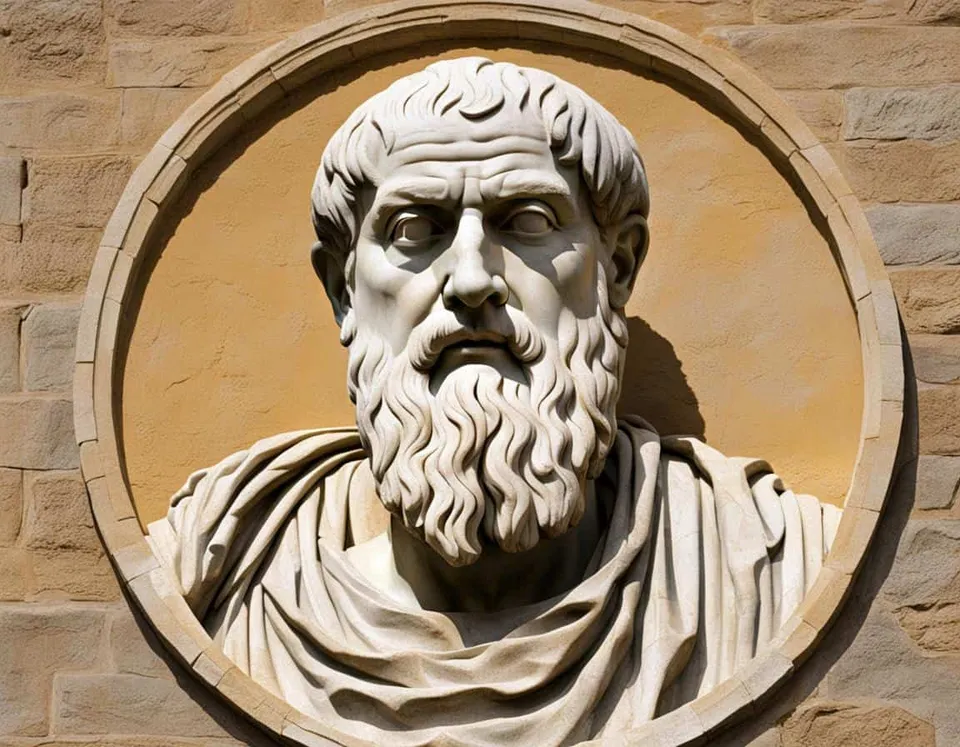
In short. Socrates gave Plato a method (relentless questioning), an ethics (virtue as knowledge) and an example (his own execution); Plato built the rest.
Socrates influenced Plato’s philosophy in four connected ways: he gave Plato a method of relentless questioning, an ethics built on the claim that virtue is a kind of knowledge, a preoccupation with the search for correct definitions, and a living example, in his own trial and execution, of a life spent testing beliefs rather than accepting them. Plato took each of these and pushed it further than Socrates ever did in the surviving evidence, building systems, such as the theory of Forms and the tripartite soul, that go well beyond anything the historical Socrates is likely to have argued.
Separating what Socrates actually thought from what Plato later put in his mouth is one of the oldest problems in the history of philosophy, and it never fully resolves. What follows sets out where the influence is clearest, and where scholars still draw the line differently. For the personal side of the relationship, how the two men actually met and studied together, see how Socrates mentored Plato.
What did Plato take from Socrates, and what did he add?
The table below sketches the main through-lines. Each row starts with something close to what Socrates is thought to have actually held, based on Aristotle’s testimony and the early dialogues, and ends with what Plato built on top of it.
| What Plato took from Socrates | What Plato added or changed |
|---|---|
| The search for correct definitions (“what is courage?”) | The Theory of Forms: definitions point to eternal, non-physical realities |
| Virtue is knowledge; wrongdoing is ignorance | The tripartite soul, allowing genuine inner conflict between reason, spirit and appetite |
| No one does wrong willingly | Systematic argument for this in Republic Book 4, tied to the soul’s structure |
| Care of the soul matters more than the body | Full arguments for the soul’s immortality (Phaedo) |
| Elenchus and aporia: refutation without a positive answer | Constructive systems built in the middle and late dialogues |
| Distance from conventional Athenian politics | The philosopher-king and a blueprint for an ideal state (Republic) |
Aristotle, who studied at Plato’s Academy and is the closest thing to an independent witness, makes the definitional point explicit. He credits Socrates with being the first to pursue universal definitions in ethics, and separately credits Plato with the further step of treating those definitions as pointing to separately existing Forms (Metaphysics I.6, 987b1–10, and XIII.4, 1078b12–32). That is about as clean a division of labor as the ancient sources give: Socrates asks “what is X?” and looks for an answer that holds in every case; Plato concludes that the answer must be a real, unchanging thing, existing apart from any of its particular instances. What that theory actually claims, and the problems it runs into, is covered in Plato’s theory of Forms.
Why did Socrates think no one does wrong on purpose?
This is the Socratic paradox: the claim, defended in several early dialogues, that no one knowingly does wrong, because everyone acts toward what they believe is good for them, and wrongdoing is really a failure of knowledge about what is truly good rather than a deliberate choice of evil. It follows from identifying virtue with knowledge. If being virtuous just is knowing what is good, then no one who genuinely knows the good would act against it; every wrong act reflects ignorance, however confident the wrongdoer feels. The idea is worked through in more detail in what is the Socratic paradox.
Plato inherited the claim but had to solve a problem it creates: everyday experience is full of people who seem to know better and do the wrong thing anyway, what the Greeks called akrasia, weakness of will. Socrates’ response, that this is impossible because it would require knowingly choosing the worse option, strains against common sense. Plato’s answer, developed at length in Republic Book 4, is to give the soul internal structure: reason, spirit and appetite, each capable of wanting different things at once, so that a person can know the better course with one part of the soul while a different part pulls against it. This is the tripartite soul, and it is Plato’s most direct philosophical response to a gap left open by Socratic ethics; see the tripartite soul in Plato’s philosophy for how the three parts are argued for and what each is responsible for.
What is the “Socratic problem”?
The Socratic problem is the difficulty of recovering what the historical Socrates actually thought, since he wrote nothing himself and is known only through other people’s portrayals of him, portrayals that do not agree. Plato is the fullest source, but Plato was a philosopher composing literary dialogues, often decades after Socrates’ death, and scholars generally accept that the Socrates of Plato’s later works is at least partly a mouthpiece for Plato’s own developing ideas rather than a transcript of anything the real man said.
Three other sources complicate the picture further. Xenophon, another student of Socrates, gives a plainer, more practical Socrates in his Memorabilia, concerned with household management and everyday virtue rather than abstract metaphysics. Aristophanes put a version of Socrates on the comic stage in the Clouds in 423 BC, portraying him as a natural philosopher and professional arguer for hire, a caricature Socrates himself refers to at his trial (Apology 18b–19c). And Aristotle, writing after Socrates’ death but with access to people who had known him, offers brief, comparatively sober reports, such as the definitions passage already cited, that scholars often treat as a useful check on Plato’s more elaborate picture.
The standard scholarly approach, though not universal, is to treat Plato’s early, shorter dialogues, the ones that end in aporia without a positive doctrine, as closer to the historical Socrates, and the longer middle dialogues, where metaphysical machinery like the Forms and the immortal soul appears, as more purely Platonic. That split is a working hypothesis rather than a proven fact, since there is no independent way to confirm it, and some scholars reject it altogether, but it remains the most common lens for asking “how much of this is Socrates and how much is Plato.” Whether a historical Socrates lay behind any of the portraits at all, rather than being partly invented by his students, is addressed directly in was Socrates a real person.
How did Socrates’ method shape Plato’s writing?
Socrates left no writings, so his method survives only through what his students chose to preserve of it, and Plato preserved it by making it the engine of his own dialogues. The elenchus, cross-examining an interlocutor’s claim until it contradicts itself, is the basic move of nearly every early dialogue Plato wrote, and it regularly ends in aporia, a state of puzzlement in which no definition has survived testing; see what is aporia for how the pattern plays out across the early dialogues.
Alongside it sits Socratic irony, the pose of feigned ignorance Socrates adopts before he starts questioning someone, claiming he knows nothing while steadily dismantling what his interlocutor thought he knew. Plato uses this technique as a literary device throughout his dialogues. Together, elenchus, aporia and irony gave Plato not just a set of conclusions to inherit but an entire mode of philosophical writing, one built around dramatized conversation and genuine uncertainty rather than treatise-style argument, and Plato kept using that form even in dialogues whose content had moved far beyond anything Socrates is likely to have said.
How did “care of the soul” become an argument for immortality?
Socrates repeatedly told his fellow Athenians that they were neglecting their souls in favor of wealth, reputation and bodily comfort, and that caring for the soul, making it as good and wise as possible, mattered more than any of that. At his trial he says his whole activity has been urging people not to care for their bodies or their money before caring “how their soul may be made as good as possible” (Apology 29d–30b). In the early dialogues this stays a moral claim: the soul is the part of a person responsible for character and choice, and its condition, virtuous or corrupted, is what a good life should be judged by.
Plato takes that moral claim and gives it a metaphysical foundation. If the soul’s condition is what ultimately matters, the question of what happens to it after death stops being incidental and becomes urgent, and the Phaedo devotes several extended arguments to showing that the soul is immortal, drawing on the theory of Forms, the idea that learning is really recollection of truths the soul already possesses, and the claim that the soul, being most like the unchanging Forms it studies, should share in their permanence. None of this appears in anything like developed form in the earlier, more purely Socratic dialogues. Socrates supplied the conviction that the soul’s state is what counts; Plato supplied the argument for why that conviction only makes full sense if the soul outlasts the body. The Phaedo’s full case, including the objections raised against it inside the dialogue itself, is set out in the Phaedo.
How did Socrates’ execution shape Plato’s politics?
Socrates’ death in 399 BC, condemned by an Athenian jury on charges of impiety and corrupting the young, left a permanent mark on Plato’s attitude to Athenian democracy and to political life generally. Plato’s own account of the effect, in the Seventh Letter (324b–326b), whose authorship is debated but whose account of his early life many scholars accept as broadly reliable, describes a young man who had expected to enter politics, was disillusioned first by the violence of the Thirty Tyrants and then by the restored democracy’s decision to execute Socrates, and concluded that no city would be well governed until philosophers became rulers or rulers became philosophers. That conclusion becomes the argument for the philosopher-king in the Republic: only those who have pursued knowledge of the good all the way, rather than those who are simply popular or ambitious, are fit to rule.
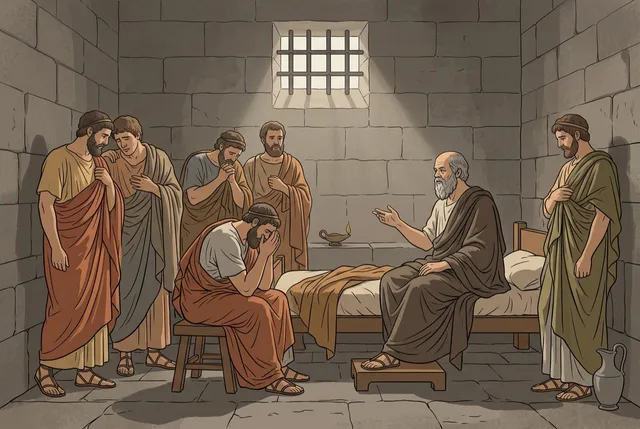
Socrates’ behavior at his own trial reinforced the lesson. Rather than plead for his life or propose a lenient counter-penalty, he defended his way of life and accepted the death sentence, a stance examined in Plato’s Apology, and his final hours and arguments for the soul’s immortality are the subject of the Phaedo, summarized in the Phaedo. For Plato, a democracy had killed the most just man he knew for the crime of asking questions, and the Republic’s deep suspicion of democratic politics, its preference for expert rule over majority rule, reads as a direct philosophical response to that fact.
Does Socrates disappear from Plato’s later work?
Largely, yes, and the pattern is itself evidence for how far Plato’s own thinking diverged from his teacher’s over time. In the earliest dialogues Socrates leads every conversation and rarely proposes positive doctrine. In the middle dialogues, including the Republic and Phaedo, he still leads but now argues at length for Forms, an immortal soul and a structured ideal state, well beyond the purely negative, question-only Socrates of the early works. By the latest dialogues, Socrates has largely stepped aside: an unnamed visitor from Elea leads the Sophist and Statesman, the character Timaeus delivers almost the entirety of the Timaeus, and in the Laws, Plato’s longest and final work, Socrates does not appear at all, replaced throughout by an unnamed Athenian.
Many scholars read this gradual withdrawal as Plato signaling, whether deliberately or not, that his philosophy had moved beyond what he could plausibly put in Socrates’ mouth. The teacher who taught him to question everything ends up absent from the work that spends the most time laying down detailed rules for how a real city should be governed, a fitting irony for a method whose most consistent feature was never to lecture anyone.
What is the short version?
Socrates gave Plato a method before he gave him any conclusions: keep asking what things are, keep testing every answer, and treat the state of one’s own soul as the thing that ultimately matters. Plato spent his career keeping that method alive in his dialogues while building, on top of Socratic ethics and Socratic questioning, a metaphysics, a psychology and a politics that Socrates himself, on the evidence that survives, never quite reached. Untangling exactly where the teacher ends and the student begins is not fully possible, and probably never will be, but the broad shape, method and ethics from Socrates, system and metaphysics from Plato, is about as much agreement as the sources allow.
Keep reading