Plato's Theory of Forms: What It Claims, Why He Held It, and Where It Breaks
In short. Plato's Theory of Forms says the things we see are copies of perfect, unchanging originals — Beauty itself, the Equal itself. Here are his arguments for it, the hierarchy of Forms, and the objections, including his own.
Plato’s Theory of Forms holds that the things we see, touch and count are imperfect copies of perfect originals that we never see at all. There are many beautiful things, and they fade; there is one Beauty itself, and it does not. There are countless roughly equal sticks; there is one Equal itself that no two sticks quite match. These originals — Plato’s word is eidos or idea, “Form” — are not in space or time, do not change, and can be grasped only by thought. Everything else borrows its character from them.
That is the doctrine in a paragraph. What is usually missing from summaries is the part that makes it philosophy rather than mysticism: Plato argues for it, in several different ways, and then — in his own late work — turns those arguments against himself.
The three arguments Plato actually gives
One over many. In the Republic (596a) Socrates states the method plainly: “we are in the habit of positing a single Form for each set of many things to which we give the same name.” There are many beds; we call them all “bed”; so there is something they share that makes the word apply — the Form of bed, which the carpenter looks to, and which no carpenter made. The argument is simple and has never gone away. It is the problem of universals: what does the word “red” name, given that no two red things are red in quite the same way?
Imperfection. The Phaedo (74a–75d) starts from equal sticks and stones. We say two sticks are equal, and we also know they are not perfectly equal — and to know that, we must already possess a standard of perfect equality that no stick supplies. The Equal itself is therefore not something we learned from sticks. Plato draws a startling conclusion: we must have known it before we had sensory experience at all, which is his doctrine of recollection. You can decline the immortal soul and keep the observation: our concepts outrun our examples.
Knowledge needs stable objects. At Republic 476a–480a Plato distinguishes knowledge from opinion by what they are of. Knowledge is of what fully is; opinion is of what is and is not — the beautiful thing that is also, from another angle or at another time, not beautiful. Aristotle reports (Metaphysics 987a32) that Plato had absorbed from Heraclitus the view that everything sensible is in flux, and concluded that if knowledge is possible at all, its objects must be something else. The Forms are that something else: the only things stable enough to be known.
How things relate to Forms
Plato’s answer is honest about being a metaphor. Things participate in (methexis) or imitate (mimesis) their Forms; in the Phaedo (100d) Socrates says beautiful things are beautiful “by the presence of, or communion with, or however it is” of Beauty itself — and adds that he will not insist on the mechanism. The Timaeus (28a–29a) gives the picture its grandest form: a divine craftsman fashions the sensible world while looking to the eternal Forms as a model, which is why the world is orderly and why it is also, being a copy, imperfect.
The hierarchy: why there is a Form of the Good
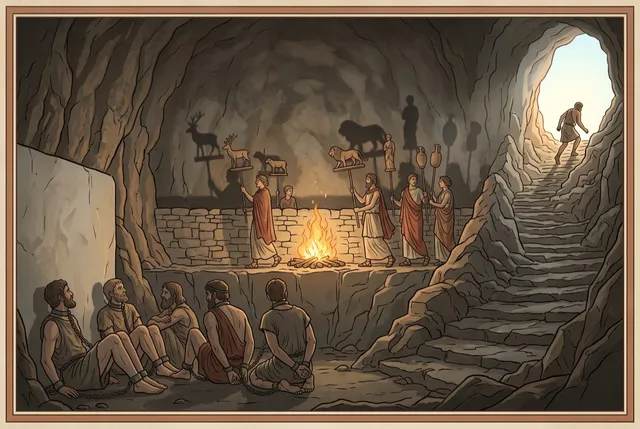
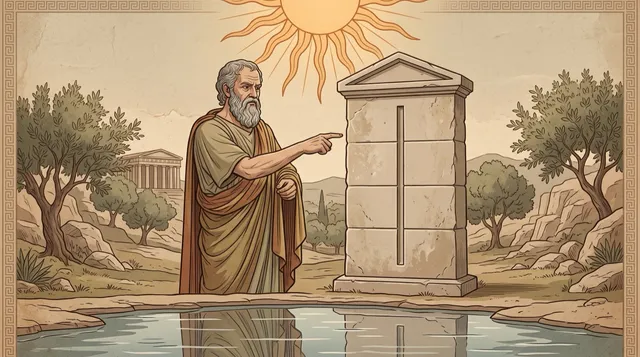
The Forms are not a flat catalogue. At the summit of the Republic’s metaphysics sits the Form of the Good, which Plato compares to the sun (508e–509b): as the sun gives visible things both their visibility and their growth, the Good gives the Forms both their knowability and their very being — it is, he says, “beyond being in dignity and power.” Three images carry this in sequence: the analogy of the sun, the divided line, and the allegory of the cave. The cave is the theory of Forms told as a story: the shadows are sensible things, the objects casting them are the Forms, and the sun outside is the Good.
Examples: what has a Form?
- Mathematical objects — the Equal, the Circle, Unity. The clearest cases; no drawn circle is a circle.
- Values — Justice, Beauty, Goodness. The cases Plato cares about most, because ethics needs a standard that opinion cannot supply.
- Natural kinds — Man, Fire. Plato is committed to these.
- Artefacts — Bed, Table, Shuttle (Republic 596b, Cratylus 389b). Surprising, but explicit.
- The unlovely — hair, mud, dirt? In the Parmenides (130c–d) the young Socrates admits he does not know whether these have Forms and is embarrassed to think so. Parmenides tells him he is young and philosophy has not yet gripped him; when it does, he will not despise any of them. Plato is signalling that the theory’s scope is unsettled.
Where it breaks — starting with Plato’s own objections
The most damaging critique of the Theory of Forms is in Plato. In the Parmenides (132a–b) the old Eleatic puts the Third Man to young Socrates: if large things and Largeness itself all share something that makes them large, then that shared feature is a further Form, over the first Form and the things together — and so on without end. The one-over-many argument, applied to its own conclusion, multiplies Forms forever. Parmenides adds the participation puzzle (131a–e): does each thing get the whole Form or a part of it? If the whole, one Form is in many places at once; if a part, the Form is divided and no longer one. Plato never answers these in the dialogue. He lets them stand.
Aristotle’s objection (Metaphysics A.9, 990a–991b) is the practical one: the Forms explain nothing. They do not cause motion or change; they merely duplicate the world, adding an eternal bed to every bed without saying how either comes to be. And “participation,” he says, is an empty word — a poetic metaphor where a mechanism was promised. Aristotle kept the forms and put them inside things, as the structure matter takes; that disagreement is the axis Western metaphysics has turned on ever since.
The separation problem underlies both: if the Forms are wholly apart from the world, how does anything here know or resemble them? The late dialogues (Sophist, Philebus) quietly rework the theory into a study of how kinds combine with one another, and stop talking about a separate realm.
Why the idea has lasted
Strip away the two-worlds picture and something remains that no one has managed to discard: we reason about perfect circles no compass draws, about justice no city achieves, about equality no pair of sticks exhibits. Plato was the first to notice that our knowledge has objects our senses never deliver, and to ask what those objects are. Every answer since — Aristotle’s immanent forms, the medieval debate over universals, Augustine’s Forms as ideas in the mind of God, the mathematical Platonism most working mathematicians quietly hold, contemporary questions about whether machines grasp universals — is a position on Plato’s question. The theory may be wrong. The problem it was built to solve is still open.
Keep reading