What Is a Philosopher King According to Plato?
In short. A philosopher king is Plato's ideal ruler in the Republic: someone who knows the Good, trained for decades, who rules only from duty, not ambition.
A philosopher king is Plato’s answer to the question of who should rule a city. In the Republic, Socrates argues that cities will have no rest from their troubles “until philosophers rule as kings, or those now called kings and rulers genuinely and adequately philosophize” (Republic 473c–d). Only someone who has spent decades learning to see the Good itself, rather than chasing wealth, popularity or power, is fit to govern well. It is one of the most quoted and most argued-over claims in the Republic, and Plato himself later doubted whether it could actually be put into practice.
Where does Plato introduce the idea?
The claim appears in Book 5 of the Republic as the last and most radical of three proposals Socrates calls “waves,” each expected to draw laughter or outrage from his audience. The first wave is that men and women should receive the same education and take on the same roles in the guardian class. The second is that guardians should hold property, spouses and children in common, so nothing pulls their loyalty away from the city. The third wave, the biggest, is that philosophers must rule (473c–d). Socrates predicts this claim will be met with disbelief, and it is Glaucon, Plato’s brother and Socrates’ main conversation partner through the middle books of the Republic, who presses him to defend it.
Why did Plato think philosophers should rule?
Plato’s argument rests on his theory of Forms: the idea that abstract realities like Justice, Beauty and the Good exist independently of the particular just or beautiful things we encounter day to day. Most people, Plato argues, only ever perceive particular things and mistake their opinions about them for knowledge. Only the philosopher, through the training described below, comes to know the Forms themselves, and above all the Form of the Good, which Socrates calls the source of all truth and value, “the sun” of the intelligible world. A ruler who does not know the Good, Plato reasons, is steering by guesswork, however confident he sounds.
Socrates makes the point with the image of a ship. On board is a ship-owner who is strong but shortsighted, deaf and not much of a sailor, and a crew of men squabbling over who should be captain, none of them trained in navigation, all of them convinced that steering a ship needs no special skill at all. They drug or overpower the ship-owner, seize the wheel, and call anyone who does understand real navigation, by the stars, the winds, the seasons, “useless” and a “stargazer” (488a–489a). The true navigator, in Plato’s analogy, is the philosopher, and the crew is the citizenry of a democracy, more interested in flattery than competence. The philosopher is not naturally inclined to fight for command, which is exactly why the city has to be built so as to compel the right people to take it.
What is the philosopher’s nature?
Before laying out the philosopher’s training, Socrates first describes the natural temperament the role requires (484a–487a). A genuine philosopher loves truth in every part of it, not just the parts that are pleasant or useful, and has no taste for falsehood. This love of truth, Plato argues, tends to come bundled with a cluster of other traits: a good memory, since a mind that cannot hold on to what it learns cannot build real understanding; a sense of proportion and moderation, since a soul truly absorbed in the grandest questions has little appetite for money or petty status; and courage, since gazing on the true scale of reality, human life included, makes a person unafraid of death. Vices like cowardice, love of money and pettiness, on Plato’s account, tend to crowd out philosophy rather than coexist with it.
How does Plato train a philosopher-king?
Book 7 lays out an education that runs across most of a lifetime, one of the most detailed curricula in ancient philosophy. Guardian children begin with the standard Greek education in music, poetry and physical training already described in the Republic’s early books, but a select group destined for rule then moves through a further sequence of study, chosen because each subject pulls the mind away from appearances and toward abstract reasoning: arithmetic, plane geometry, solid geometry, astronomy, and harmonics, the mathematical theory of musical intervals. None of these subjects is taught for its practical use. Astronomy, for instance, is not taught to read the stars more accurately, but because reasoning about the unchanging mathematical order behind the visible heavens trains the mind to reason about order it cannot see at all (529c–530c).
Only after all of this comes dialectic, the philosophical method of questioning assumptions until first principles are reached, which Plato treats as the highest and most dangerous subject, not to be taught to minds still too young and unstable to handle it responsibly. Socrates lays out an exact timetable (537b–540b):
| Stage | Age | Content |
|---|---|---|
| Early education | Childhood | Music, poetry, physical training |
| Mathematical sciences | To age 20 (selection at 20) | Arithmetic, geometry, astronomy, harmonics |
| Dialectic | 30 to 35 | Philosophical method, first principles, the Good |
| Practical service | 35 to 50 | Military and civic office, to test character against real affairs |
| Rule | From age 50 | Alternating philosophy with governing, until called to full-time rule |
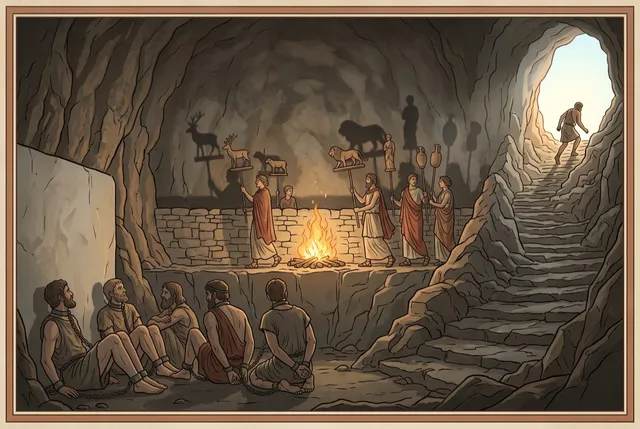
Even after reaching the top of this program, the newly qualified philosophers are not simply handed power. Plato has Socrates insist they must be compelled to return and rule, because a mind that has truly grasped the Good would rather stay in contemplation of it than descend again into the “cave” of ordinary political life (519c–520d). This is the same image developed at length in the Allegory of the Cave: the philosopher who has climbed out into the sunlight and seen reality clearly must be forced back down into the dark to lead the prisoners who never left, at real cost to his own preferred way of life.
Why don’t the best rulers want to rule?
Plato treats this reluctance as a feature, not a flaw, of his whole system. In most existing cities, he says, people fight over office because ruling brings wealth and honor. But in the ideal city guardians hold no private property and no families of their own, precisely so that ruling offers them nothing they actually want. The best rulers, Socrates argues, are exactly the ones who “do not desire to rule” (520d–521b), because a system that attracts power-hungry people to power is already corrupt at the root. Only duty, and the debt the city is owed for the philosopher’s own education, provides the motive.
The Republic also insists, notably for its time, that this path is not closed to women. Because sex, on Plato’s argument, is no more relevant to fitness for philosophy or rule than baldness is, women of the right natural ability go through the identical training and can become philosopher-rulers themselves (540c). The wider implications, and the tensions in how Plato actually treats women elsewhere in the dialogue, are discussed in the role of women in Plato’s Republic.
Table: what the philosopher-king needs
| What the philosopher-king needs | Why | Where in the Republic |
|---|---|---|
| Love of truth and a stable temperament | Without it, a ruler chases opinion, wealth or status instead of the Good | 484a–487a |
| Knowledge of the Good | Rule without it is steering blind, however confident the ruler seems | 505a–509c |
| Mathematical training | Trains the mind to reason about what cannot be seen | 521c–531c |
| Dialectic, from age 30 | The method for reaching first principles and real understanding | 531d–535a |
| Practical service, 35 to 50 | Tests character against real temptation and hardship before power is given | 539e–540a |
| No private property or family | Removes any personal motive to abuse power | 416d–417b, 457c–466d |
| Compulsion to rule | The best candidates would rather not rule at all, so the city must require it | 519c–521b |
What have critics said?
The philosopher-king has drawn sustained criticism since antiquity. Plato’s own student Aristotle took a more practical turn in his own political writing, arguing for rule by law and by a broad, educated middle class rather than concentrating authority in a narrow class of philosopher-experts, on the grounds that collective judgment, and the constraint of law, guard against error better than trusting any individual’s wisdom, however genuine.
The most sustained modern attack came from the philosopher Karl Popper, whose 1945 book The Open Society and Its Enemies charged Plato with laying the intellectual groundwork for totalitarianism: a caste of rulers claiming access to absolute truth, unaccountable to the people they govern, closed to change and hostile to open, piecemeal reform. Popper’s reading has itself been challenged by many Plato scholars as overstated and anachronistic, reading twentieth-century totalitarian movements back into a fourth-century BC text, but it fixed the philosopher-king in modern debate as a symbol of rule by unaccountable experts.
Plato’s own later work suggests he had doubts of his own. In the Laws, written in his old age, Plato designs a second-best city governed not by philosopher-rulers exercising personal judgment but by a detailed code of law that magistrates administer, a much more modest and constrained vision of good government. The shift between the two visions is examined in Plato’s Laws versus the Republic.
Plato also had a personal, and by most accounts unhappy, experiment with philosopher-kingship in practice. He reportedly traveled to Syracuse more than once to try to educate Dionysius II, the city’s ruler, in philosophy and shape him into something like a philosopher-king. The attempt collapsed, and Dionysius later expelled Plato’s friend Dion, the intended architect of the reform, from Syracuse entirely. The main source for this episode is the Seventh Letter, traditionally attributed to Plato, though its authenticity is disputed among scholars, and it should be read as a possibly later account rather than settled fact.
Does the idea echo in politics today?
The philosopher-king is sometimes invoked loosely in modern discussions of technocracy, the idea that complex problems are best handled by trained experts insulated from short-term political pressure, whether in central banks, regulatory agencies or international bodies. The comparison is worth treating carefully: Plato’s philosopher-rulers are not simply subject-matter experts appointed to a technical role, they are meant to have undergone a lifelong moral and philosophical transformation before being trusted with power at all, and Plato builds the entire surrounding city, with no private property for guardians and rule only by compulsion, specifically to keep that power from being sought or abused. Modern calls for expert governance rarely carry anything like that structure alongside them. A closer, more direct engagement with what the idea might offer leadership today is taken up in Plato’s philosopher-king in contemporary leadership theory.
Why the philosopher-king still matters
Whether or not Plato’s proposal was ever workable, and he seems to have had his own doubts by the time he wrote the Laws, the philosopher-king remains one of philosophy’s sharpest challenges to the assumption that anyone who wants power is fit to hold it. It asks a question that outlives its original context: should the people who govern us be chosen for their ability to win support, or for their capacity to actually understand what is good? Plato’s own answer, a rule so demanding that almost no one could meet it and the rare person who could would rather not, is less a practical blueprint than a standard held up against every system of government that has followed it.
Keep reading