Plato's Divided Line: The Four Levels of Knowledge Explained
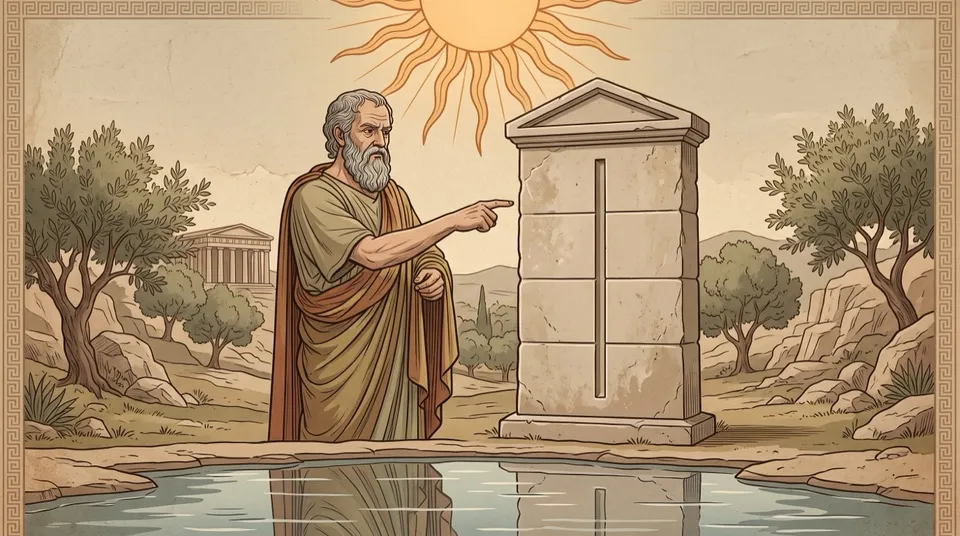
In short. Plato's Divided Line, from Republic Book VI, splits reality into four levels: images, physical things, mathematics and the Forms. Each one explained.
Plato’s Divided Line is an image Socrates draws for Glaucon near the end of Republic Book VI: a line cut into two unequal parts, then each part cut again in the same ratio, so that four distinct grades of thinking line up against four distinct kinds of object, from mistaking a shadow for the thing that casts it up to grasping first principles through pure reasoning (509d–511e). It is one of three connected images Plato uses in this part of the Republic, alongside the Sun and the Cave, to explain what he thinks knowledge is and why most people never reach it.
How is the line divided?
Socrates asks Glaucon to picture a line cut into two unequal sections, one for the visible world and one for the intelligible world, the world grasped by thought rather than sight. He then has each of those two sections cut again, in the same ratio as the first cut, giving four segments in total (509d–e). The line is not drawn to a specific numerical ratio Plato states outright; what matters is the pattern: the visible section is to the intelligible section as the least clear parts of each are to the clearer parts within them.
Reading from the bottom (least real, least knowable) to the top (most real, most knowable):
| Segment | Objects | State of mind | What it means |
|---|---|---|---|
| 1. Lowest (visible) | Shadows, reflections, images | Eikasia (imagining) | Awareness of mere likenesses, taken as if they were the real thing |
| 2. Second (visible) | Physical objects, plants, animals, artefacts | Pistis (belief) | Ordinary confidence in the world of things we can see and touch, the level most people live at |
| 3. Third (intelligible) | Mathematical objects: numbers, geometrical figures | Dianoia (thought, reasoning) | Reasoning from assumed starting points (hypotheses), using visible diagrams as aids while really thinking about the abstract figures they stand for |
| 4. Highest (intelligible) | The Forms, culminating in the Form of the Good | Noēsis (understanding, intelligence) | Dialectic: reasoning that examines its own starting points and works up to a first principle that needs no further hypothesis |
What is eikasia?
Eikasia is the lowest state on the line, the condition of taking images for realities: shadows, reflections in water or polished surfaces, paintings, or anything that is only a likeness of something else (509e–510a). Plato does not mean this is a rare mistake. He means it as a state of mind that mistakes appearance for substance generally, which is why the shadows on the wall in the allegory of the cave are usually read as a dramatisation of exactly this segment of the line.
What is pistis?
Pistis, usually translated as belief or confidence, is the state of mind directed at the physical objects that cast those shadows and reflections: the animals, plants and manufactured things of the visible world (510a). This is not a low or foolish state by everyday standards; it is ordinary, functional confidence in the world as we encounter it, the level at which most practical life is lived. But for Plato it still falls short of knowledge, because physical things are always changing, always slightly imperfect instances of whatever they are, and belief about them can be true without the believer being able to explain or justify why.
What is dianoia, and why does mathematics matter here?
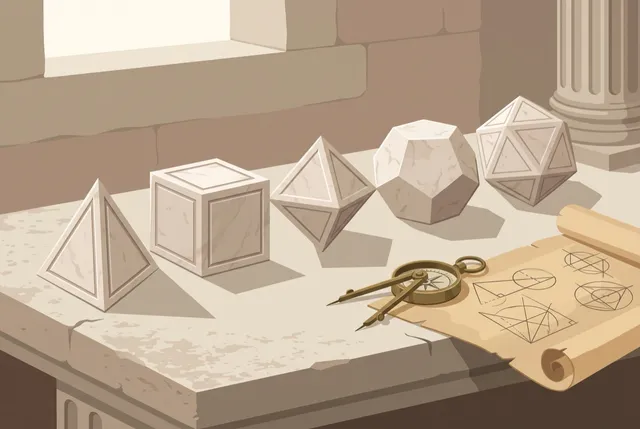
Dianoia is the first properly intelligible state, and Plato illustrates it with mathematics, especially geometry. A geometer draws a triangle or a circle on paper or in sand and reasons about it, but the reasoning is not really about that particular, slightly irregular drawing; it is about the perfect triangle or circle the drawing merely represents (510c–511a). Two features mark this segment out. First, mathematicians start from assumptions, or hypotheses, such as the definitions of odd and even or the properties of figures, which they take as given rather than prove. Second, they still lean on visible images, diagrams and models, as aids to thought even though the real object of their reasoning is abstract. The Platonic solids that Plato discusses elsewhere are a good example of objects that sit at exactly this level: geometrical forms reasoned about through drawings and physical models that are never quite perfect copies of the shapes themselves.
What is noēsis, and how is it different from dianoia?
Noēsis, the highest segment, is what Plato calls dialectic: reasoning that does not stop at its starting assumptions but treats them as genuine hypotheses to be examined, moving “not to a beginning but to an end,” upward toward an “unhypothetical first principle” of everything, and then back down again drawing out consequences, without leaning on any images at all (511b–c). Where the mathematician takes definitions for granted and reasons downward from them, the dialectician questions the definitions themselves and reasons all the way up to something that needs no further justification, which Plato identifies, elsewhere in the same books of the Republic, as the Form of the Good. Understanding the Forms in general, and the Good above all, is the aim of the philosopher’s education as the Republic describes it.
The puzzle of the equal middle sections
One detail of the Line has puzzled readers for a long time. If the line is cut so that the ratio of the first division (visible to intelligible) matches the ratio used within each half, a consequence of the geometry is that the second and third segments, the top of the visible world (physical objects) and the bottom of the intelligible world (mathematical objects), come out equal in length, however the overall line is drawn. Scholars disagree about whether Plato intended this as a meaningful claim, for instance that belief and mathematical reasoning are somehow on a par, or whether it is simply an artefact of the mathematics he used to describe the image, not something to read too much into. Both sides of that debate are taken seriously in the secondary literature, and Plato himself does not comment on it directly, so it is worth knowing about without treating it as settled either way.
How does the Line connect to the Sun and the Cave?
The Divided Line sits between two of the Republic’s other famous images. Just before it, Socrates offers the analogy of the sun: as the sun makes physical things visible and also gives them the power to grow, the Form of the Good makes the other Forms intelligible and gives them their being and reality. Just after it, in Book VII, comes the allegory of the cave, the story of prisoners chained before a wall of shadows who must be dragged, painfully, up toward the light outside.
Many readers map the Cave’s stages directly onto the Line’s four segments: the shadows on the cave wall as eikasia, the statues and puppets casting them as pistis, the ascent up out of the cave using reasoning about what is seen as dianoia, and the direct sight of the sun itself outside the cave as noēsis. This mapping is a genuinely useful way to hold the three images together in mind, and it is the traditional reading, but it should be taken as an interpretation rather than something Plato states outright; the text of the Republic does not explicitly align each stage of the Cave story with a specific segment of the Line, and commentators differ over exactly where the boundaries fall.
Why is mathematics only “second best” for Plato?
A detail that surprises many first-time readers is that mathematics, so often treated as the paradigm of exact knowledge, ranks below dialectic on Plato’s scale. The reason is that mathematicians work from unexamined hypotheses; they assume their definitions and axioms rather than justifying them, and they still depend on visible diagrams even while reasoning about something beyond the visible. Dialectic, by contrast, refuses to leave its starting points unexamined, pressing back and back until it reaches something that needs no further hypothesis to support it. Mathematics is genuine progress beyond mere belief about the physical world, which is why it occupies the lower half of the intelligible section rather than the visible one, but for Plato it remains a stepping stone toward philosophy proper rather than philosophy’s final destination.
Common questions about the Divided Line
What does eikasia mean? It is the Greek word for the lowest state on the line, usually translated “imagining” or “conjecture”: taking images, shadows and reflections as if they were the realities they merely resemble.
Why is the line unequal? Plato specifies that the initial cut is unequal, giving more of the line to one side than the other, though the text does not fix an exact numerical ratio; the point of the image is the layered structure of resemblance between levels, not a precise measurement.
Is the Divided Line the same as the theory of Forms? No, though they are closely linked. The theory of Forms, examined at greater length in a critical look at Plato’s theory of Forms, is the metaphysical claim that abstract, unchanging Forms are more real than changing physical particulars. The Divided Line builds a whole epistemology, an account of different kinds and grades of knowledge, on top of that metaphysical picture, showing how each type of object corresponds to a different state of mind capable of grasping it.
What is the Line’s relationship to education?
The Republic presents the Line not just as a map of reality but as a curriculum. Books VII and VIII of the dialogue describe how Plato’s prospective philosopher-rulers are to be trained: years of gymnastics and basic letters in childhood, then a long course in mathematics, arithmetic, plane and solid geometry, astronomy and harmonics, meant to drag the mind away from the changing world of the senses toward abstract reasoning, and only after that, in early middle age, formal training in dialectic itself. The order matters. Plato is explicit that dialectic given too early, to minds not yet steadied by years of mathematical discipline, tends to produce clever argument for its own sake rather than real philosophical understanding. The Divided Line is, among other things, a justification for that sequence: each segment has to be passed through properly before the next one can be reached on solid ground.
Why the Divided Line still matters
The Divided Line is often the clearest single diagram of what Plato actually thought knowledge was: not one thing, uniformly present or absent, but a graded series of states running from mistaking images for reality up to a hard-won grasp of first principles. Read alongside the Republic as a whole, it explains why Plato thought so few people, in his view, ever reach real philosophical understanding, and why the education of his philosopher-rulers has to move deliberately through mathematics on the way to dialectic rather than skipping straight to it. Whatever one makes of the metaphysics behind it, the Line remains a genuinely useful way to ask, of any claim to knowledge, which of its four levels it actually belongs to.
Keep reading