Who Was Xanthippe? Socrates’ Wife Beyond the Myth
In short. Xanthippe was Socrates’ wife and the mother of his three sons. Her reputation as a shrew rests on one joke in Xenophon. Here is the evidence.
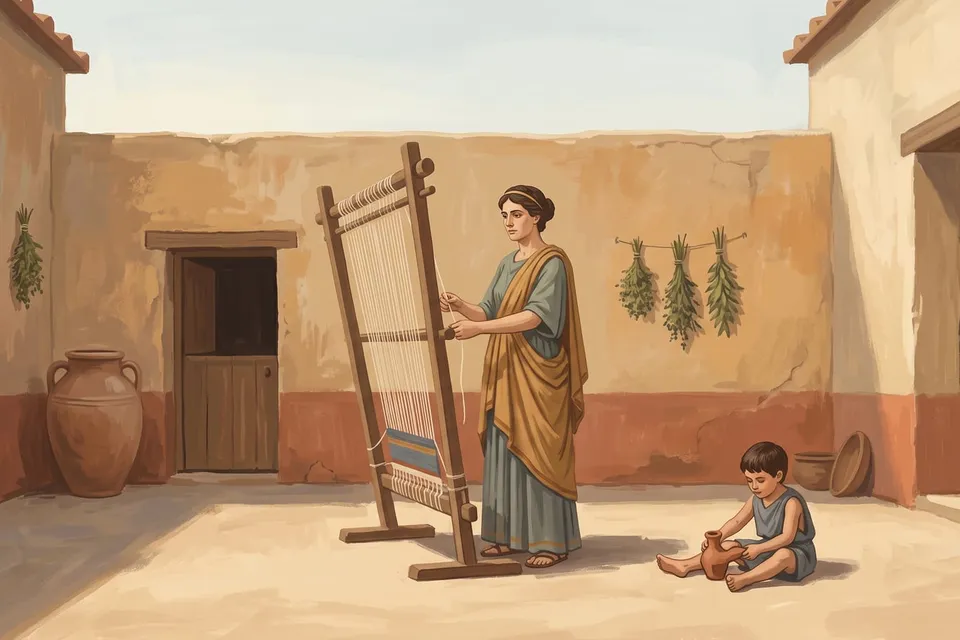
Xanthippe was the wife of Socrates and the mother of his three sons. For two thousand years her name has been a byword for a nagging wife — a reputation that rests on remarkably little evidence, most of it written by people who were not there and had reasons to find her inconvenient.
What the Reliable Sources Actually Say
The contemporary record is thin. Xanthippe was considerably younger than Socrates and bore him three sons: Lamprocles, the eldest, and Sophroniscus and Menexenus, who were still small children when their father died.
Her name is itself a small piece of evidence. Xanthippe combines xanthos (fair or tawny) with hippos (horse), and horse-names in Athens were characteristic of aristocratic families. It suggests she may have come from a better background than her husband’s stonemason father.
She appears in Plato’s Phaedo, in the prison on the last day. At 60a she is there holding their baby, and when the friends arrive she cries out that this is the last time they will speak; Socrates asks Crito to have her taken home. She returns later with the children to say goodbye. It is a brief appearance and, read plainly, a sympathetic one: a woman being removed from her husband’s death so that the men can finish their conversation.
Where the “Shrew” Reputation Comes From
Essentially all of it traces to a single passage in Xenophon’s Symposium. Antisthenes asks Socrates why, if he believes people can be trained, he lives with Xanthippe — the hardest woman to get along with there is. Socrates replies that horsemen who want to master horses practise on the most spirited ones, and that having learned to endure Xanthippe he can get along with anybody.
That is a joke told at a drinking party. It is repeated, embellished and gradually hardened into biography by much later writers — principally Diogenes Laertius, compiling gossip some six centuries after the fact, who supplies the famous anecdotes about her emptying water over Socrates and trampling on a cake.
None of these late stories has independent support. What they have is usefulness: a philosopher who transcends domestic irritation is a better parable with a difficult wife in it.
The Case for Xanthippe
Consider her actual situation. Socrates refused to charge fees for teaching, on principle. The family was poor as a direct result of his vocation. She was raising three children, including an infant, on nothing, while her husband spent his days in the agora questioning strangers about the definition of justice, accumulating powerful enemies.
Then he was tried, declined to propose a survivable penalty, refused his friends’ offer to help him escape, and was executed — leaving her with three fatherless boys and no income.
Read from her side, the record shows a woman with entirely rational grievances, whose recorded behaviour amounts to grief in a prison cell. The tradition that turned her into a comic harridan tells us more about its authors than about her.
The Second Wife Question
Some ancient sources claim Socrates also married, or had children with, a woman named Myrto, sometimes alleging that Athens permitted bigamy to restore the population after the war. The story appears in late authors and is generally rejected: there is no good evidence for such a law, and the sources contradict each other on basic points.
Conclusion
Xanthippe was a real Athenian woman who married a much older man, raised three sons in poverty produced by his principles, and watched him be executed. The shrew of legend is built from one symposium joke and centuries of retelling by men who found the caricature convenient.
For the ancient evidence about Socrates’ life and household, see the Stanford Encyclopedia of Philosophy entry on Socrates.
Keep reading