The Death of Socrates: Hemlock, His Last Words and the Phaedo
In short. How did Socrates die? He drank hemlock in an Athenian prison in 399 BC. Inside the delay, the poison, the Phaedo death scene and his puzzling last words.
Socrates died in an Athenian prison in 399 BC by drinking a cup of hemlock, roughly a month after a jury sentenced him to death. The scene that Plato wrote about that death became one of the most influential passages in Western literature — and one of the most disputed, because the man who wrote it was not in the room.
This article covers why the execution was delayed, what hemlock actually does to the body, what happened in the cell according to the Phaedo, and what Socrates’ famously strange last words might have meant.
Why Was the Execution Delayed by a Month?
Socrates was condemned but not killed immediately, because his trial fell during the annual sacred mission to Delos. Athens sent a ship each year to the island to commemorate Theseus’ legendary voyage, and no public executions could be carried out while it was away. Bad winds extended the trip, and Socrates spent around thirty days in prison waiting.
That delay is why we have the Crito. Plato’s dialogue of that name is set in the cell, where Socrates’ wealthy friend Crito arrives with a plan to bribe the guards and smuggle him out to Thessaly. Socrates refuses. His argument is that he has spent seventy years accepting the benefits of Athenian law, and that breaking it now, purely because the verdict went against him, would destroy the principle he had lived by.
What Hemlock Actually Does
The poison was almost certainly poison hemlock (Conium maculatum), a plant containing the alkaloid coniine. Coniine blocks transmission at the neuromuscular junction, producing an ascending paralysis: weakness and numbness begin in the legs and travel upward. Death comes from respiratory failure when the muscles of the diaphragm stop working.
The clinically important detail is that consciousness is typically preserved for much of this. The victim can keep talking while losing the ability to stand. That is precisely what Plato describes, which is one reason the account has been taken seriously as a record rather than pure invention.
It is not, however, a neutral report. Real coniine poisoning can involve vomiting, convulsions and considerable distress, none of which appear in Plato’s version. Scholars have argued since the 1970s about whether Plato cleaned up the death to serve his portrait of a philosopher dying well. The consensus position is that the account is broadly physiologically plausible but unmistakably idealised.
The Scene in the Phaedo
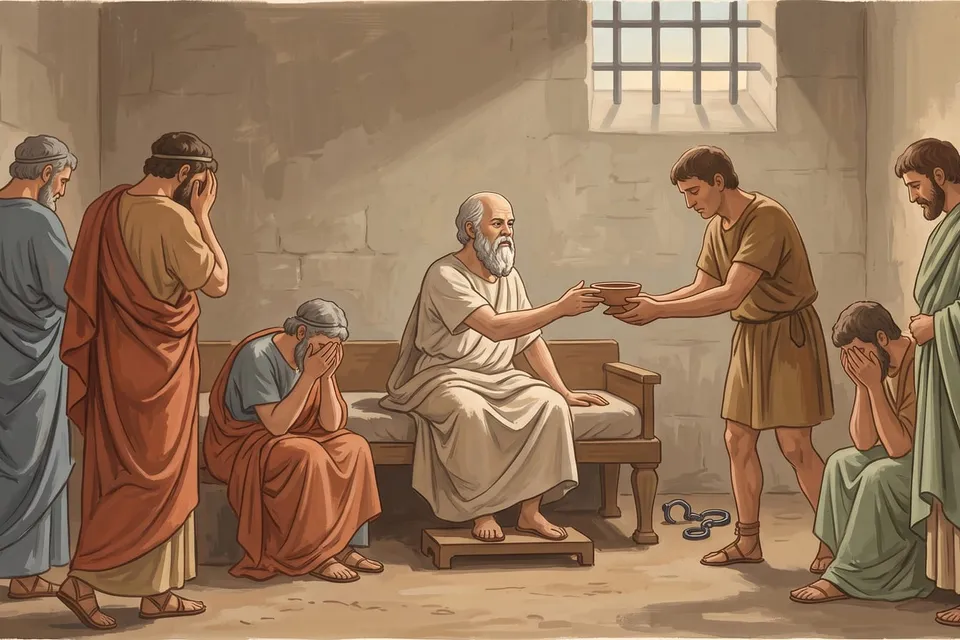
Plato’s Phaedo narrates the final day. Socrates spends it arguing with his friends about whether the soul survives the body — a conversation that produces several of the arguments for immortality that shaped later philosophy and theology. He sends his wife Xanthippe and their children away so the discussion can continue.
When the hour comes, the prison officer apologises to him; Socrates takes the cup, drinks it without hesitation, and rebukes his friends for weeping. He walks around until his legs grow heavy, lies down, and the numbness climbs. The jailer presses his feet and legs to test the progress of the paralysis.
One detail is easy to miss and important for how we read the whole thing. At Phaedo 59b, the narrator lists who was present and adds that Plato was absent, being ill. The most famous death scene in philosophy is written by a man who tells us plainly that he did not witness it.
“We Owe a Cock to Asclepius”
Socrates’ last words, at Phaedo 118a, are a request rather than a summation: “Crito, we owe a cock to Asclepius; pay it and do not neglect it.”
Asclepius was the god of healing, and a cockerel was the customary thank-offering from someone who had recovered from illness. The puzzle is what Socrates thought had been cured. Three readings dominate:
- Death as the cure. Life is the sickness and dying releases the soul from the body. Nietzsche took this reading and treated it as evidence that Socrates was, at bottom, weary of living.
- A literal debt. Someone Socrates knew had recovered from an illness, and he was simply settling an outstanding obligation — entirely in character for a man who had just refused to escape prison on the grounds that debts to the city must be honoured.
- The cure of philosophy. The offering thanks the god for the healing of the soul that the day’s argument had achieved.
No reading has won. The line survives as a genuinely open question, which is arguably the most Socratic ending available.
The Painting That Shaped the Image
Much of the modern mental picture of this scene comes from Jacques-Louis David’s “The Death of Socrates” (1787), now in the Metropolitan Museum of Art. David paints Socrates upright and lecturing, one hand reaching for the cup without looking at it, his followers collapsing around him.
It is superb propaganda for a certain idea of principled defiance — and it is not accurate. David places Plato at the foot of the bed as an old man, despite Plato’s own statement that he was not there, and despite the fact that he would have been in his late twenties in 399 BC.
Conclusion
Socrates died of respiratory paralysis brought on by hemlock, in a prison cell, after a month’s delay he could have used to escape and chose not to. What we know of the day comes almost entirely from a dialogue whose author admits he was absent, written years later, with philosophical work to do.
That does not make the Phaedo worthless as history, but it does mean the calm of the death scene should be read as an argument as much as a report. For the ancient evidence and the scholarly debate, see the Stanford Encyclopedia of Philosophy entry on Socrates. For why he was condemned in the first place, see why Socrates was executed.
Keep reading