Phaedo Summary: Plato's Dialogue on the Soul and Socrates' Death
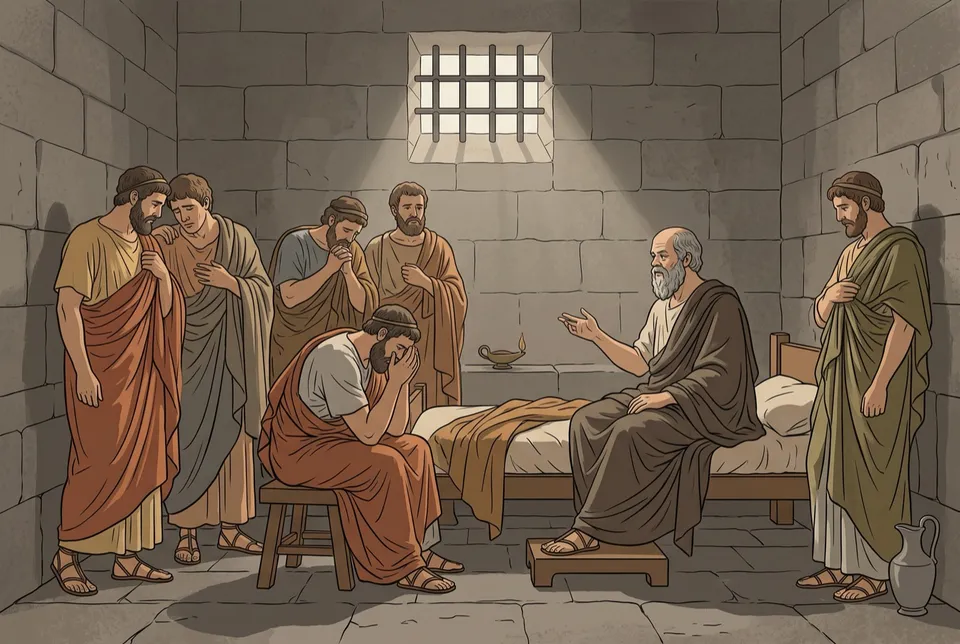
In short. A summary of Plato's Phaedo: the setting in Socrates' prison cell, his arguments for the soul's immortality, and the objections raised against them.
Plato’s Phaedo is the dialogue set on the day of Socrates’ execution in 399 BC, in which Socrates spends his last hours arguing that the soul is immortal and that a true philosopher should not fear death, since philosophy itself is a lifelong practice for dying. It is one of Plato’s richest works, combining the most detailed defence of the soul’s immortality in the dialogues with the most moving account of Socrates’ final hours and death.
This essay summarises the frame of the dialogue, walks through each of the main arguments in order, and sets out the objections that Socrates’ own companions raised against them. For the death scene itself, in full, see the death of Socrates: hemlock, last words and the Phaedo.
What is the frame of the dialogue?
The Phaedo is not narrated by Socrates but reported at second hand. Years after the event, a man named Echecrates meets Phaedo, who was present at Socrates’ death, in the town of Phlius and asks him to describe what happened and what was said. Phaedo’s retelling is the entire dialogue. This double distance, an eyewitness recalling the day for someone who was not there, gives the Phaedo a valedictory, almost liturgical tone that is different from Plato’s sharper, more argumentative dialogues.
The action takes place in the Athenian prison on the day appointed for Socrates’ execution by hemlock, the last day of a month-long delay caused by a religious mission to Delos (58a–c). Present are several of Socrates’ close companions, including Simmias and Cebes (both students of the Pythagorean philosopher Philolaus), Crito, and a number of others; Xanthippe, Socrates’ wife, is there at the start with their child but is sent away, weeping, so the conversation can proceed calmly (60a). Phaedo notes pointedly that Plato himself was not present, “I believe, because he was ill” (59b), which is why the Phaedo is reported rather than witnessed by its own author. The Crito, set a few days earlier in the same cell, is discussed on its own terms in Plato’s Crito: summary, arguments and why Socrates refused to escape.
Why does Socrates say philosophy is “practice for dying”?
Early in the dialogue Socrates surprises his friends by saying that anyone who has genuinely spent their life in philosophy should approach death with confidence, even eagerness, because “those who practise philosophy in the right way are practising dying” (64a). His reasoning is that the philosopher’s whole aim is to pursue truth by thought alone, as free as possible from the distractions and distortions of the body, its appetites, discomforts and illusions of the senses. Death, on this view, is simply the complete separation of soul from body, so a life spent trying to loosen that attachment is already a rehearsal for it. This claim sets the terms for everything that follows: if the soul can exist and think without the body, death is not the end of the person but a release.
What are the arguments for the immortality of the soul, in order?
Socrates offers several distinct arguments over the course of the dialogue, and Simmias and Cebes raise objections partway through that force him to go further.
1. The cyclical argument (opposites)
Socrates first argues that everything which has an opposite comes to be from that opposite: the greater comes from the smaller, waking from sleeping, and so, he argues, living comes from being dead just as dying comes from being alive (70c–72a). If this cycle only ran one way, from life to death, eventually everything would end up dead and the process would stop; since it plainly does not, souls in the underworld must somehow return to life. This is the weakest and most obviously flawed of the arguments, resting on a loose analogy between opposite states and opposite processes, and Plato has Socrates move on quickly to firmer ground.
2. The argument from recollection
Socrates then argues that learning is really recollection: when we judge two visible sticks or stones to be “equal,” we are measuring them against a standard of perfect Equality that no sense ever showed us, since no two physical things are ever perfectly equal (74a–75c). We must have known that standard before birth and be recollecting it now. This links directly to the theory of Forms and is argued at greater length in the Meno; see Plato’s theory of recollection for the fuller case. If the soul possessed knowledge before it entered the body, Socrates concludes, it must have existed before birth, which at least suggests it can exist after death too (76c–e).
3. The affinity argument
The third argument claims the soul is more like the invisible, unchanging Forms than like the visible, changing body, and that things resembling the unchanging tend to persist while things resembling the changing tend to fall apart (78b–80b). Since the soul resembles the divine and indissoluble more than the mortal and dissoluble, it is by nature the kind of thing that is not easily destroyed. Socrates himself treats this argument as suggestive rather than conclusive, likely rather than certain.
What objections do Simmias and Cebes raise?
At this point the dialogue takes its most honest turn: Socrates’ two main interlocutors say plainly that they are not convinced, and each offers a rival picture of the soul.
Simmias’s objection: the soul as attunement. Simmias suggests the soul might be like the tuning, or harmonia, of a lyre: an attunement produced by the body’s parts, which cannot survive when the instrument itself is broken (85e–86d). On this view the soul is real but entirely dependent on the body, exactly the opposite of what Socrates needs.
Cebes’s objection: the weaver and the cloak. Cebes grants that the soul might outlast one body, even many bodies, the way a weaver outlasts several cloaks he wears out. But the weaver himself eventually dies, and his last cloak survives him (87b–88b). Perhaps the soul, similarly, is longer-lived than the body but not indestructible, and could eventually wear out after many incarnations. This is a sharper worry than Simmias’s, because it accepts survival after death in principle while denying that the soul is immortal without qualification.
Phaedo reports that the room fell into a stunned silence at this point, everyone’s confidence in the earlier arguments shaken (88c). Socrates, after a pause, warns his friends against “misology,” a hatred of argument brought on by being burned by a bad argument, the philosophical equivalent of misanthropy brought on by being burned by a bad friend (89d–91c), and sets out to answer both objections properly.
What is Socrates’ “second sailing,” and the final argument?
Against Simmias, Socrates argues that an attunement cannot itself possess more or less virtue or vice, cannot oppose the elements that produced it, and is entirely determined by its instrument, none of which is true of the soul, which frequently resists and directs the body rather than merely reflecting it (91c–95a). Cebes’s objection is harder, and it leads Socrates into a long autobiographical digression.
Socrates recounts his youthful enthusiasm for natural science, his disappointment that it never explained why things are good rather than merely how they happen (96a–97b), and his adoption of a “second sailing,” a second-best method for a becalmed sailor: instead of looking directly at causes in physical things, he takes refuge in ideas, using the Forms as explanatory causes (99d–100b). On this method, a thing is beautiful because it participates in Beauty itself, and, crucially, a thing is odd because it participates in Oddness, which is incompatible with Evenness (102b–105c).
Socrates then argues that the soul, wherever it is present, always brings life with it, just as fire always brings heat and snow always brings cold: life is essential to the soul the way oddness is essential to the number three. And what cannot admit its opposite, he argues, cannot perish when that opposite (death) approaches; it must either withdraw or be destroyed, and since Socrates has been arguing the soul is imperishable in its nature, it withdraws rather than dying with the body (105c–107a). This final argument is more sophisticated than the first three, but it still depends on accepting the theory of Forms and the account of causation behind it; a critical look at that theory is given in Plato’s theory of Forms: a critical analysis. Even Socrates concedes the group’s premises deserve further examination (107b), a notably modest note to end an argument on.
Table: the arguments for immortality in the Phaedo
| Argument | Claim | Weakness critics point out |
|---|---|---|
| Cyclical (opposites) | Life and death generate each other in a cycle, so souls return to life | Loosely analogises processes to static opposites; proves at most that some souls return, not that any individual soul is immortal |
| Recollection | Knowledge of perfect standards (e.g. Equality) must predate birth, so the soul existed before the body | Shows prior existence at best, not survival after death; depends entirely on the theory of Forms |
| Affinity | The soul resembles the unchanging Forms more than the changing body, so it is not easily destroyed | Socrates himself calls it merely probable; resemblance is not identity |
| Attunement (Simmias’s objection) | The soul might just be a harmony produced by the body, ending when the body breaks | Not Socrates’ own argument, but a rival view he must refute; if true, it rules out immortality entirely |
| Weaver and cloak (Cebes’s objection) | The soul might outlast many bodies but still wear out eventually | Not fully answered by the final argument, which some readers think proves only that the soul cannot admit death while embodied, not that it is imperishable everywhere |
| Final argument (Forms as causes) | The soul, as the bringer of life, cannot admit death and so must withdraw rather than perish | Rests on the theory of Forms and a contested account of essential properties |
What is the myth of the true earth?
After the arguments close, Socrates tells a long myth describing the “true earth,” a purer world above the hollow, murky region humans actually inhabit, filled with brighter colours, clearer air and stones like gems, and an elaborate underground geography of rivers into which the dead are sorted according to how they lived (110b–114c). Like the Myth of Er that closes the Republic, Socrates presents it not as literal fact but as a story worth risking belief in, “a beautiful risk,” because of the kind of life it encourages (114d).
How does the dialogue end?
Socrates bathes, says goodbye to his family, and drinks the hemlock calmly as his friends weep around him, rebuking them gently for their lack of composure. His last words, a request that Crito make an offering of a rooster to the god Asclepius, have been debated ever since (118a). Phaedo closes his account by calling Socrates “the best, the wisest, and the most just man” he had ever known (118a). The scene itself, its details and the debates over what the last words meant, is covered in full in the death of Socrates, so this summary leaves it there rather than repeating it.
Why does the Phaedo still matter?
The Phaedo is often read as Plato’s fullest attempt to answer, philosophically rather than only through Socrates’ personal courage, the question raised by why Socrates was executed and the trial recounted in the Apology: why a man could face death without fear. Its honesty is part of its power. Plato does not let the arguments go unchallenged; Simmias and Cebes speak for the reader’s own doubts, and Socrates’ answers, while impressive, are offered with real philosophical humility rather than as a closed case. Whatever one makes of the arguments today, the Phaedo remains the clearest statement in the dialogues of why Plato thought the soul, not the body, is who we really are.
Keep reading