Plato's allegory of the cave
The allegory, its machinery, and what the fire and the shadows stand for.
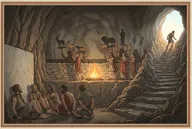
The allegory of the cave is the most famous image in Western philosophy: prisoners, fire, shadows, and one difficult walk up into the light. It is also routinely misread — as a parable about ignorance in general rather than the specific epistemology of the Republic, where it sits between the sun and the divided line.
The essays here take the image apart piece by piece: what the machinery stands for, how the ascent maps onto knowledge, and what the allegory demands of the one who gets out.
The allegory itself
The allegory opens Book 7 of the Republic, where Socrates describes prisoners who take shadows on a cave wall for reality. Start with our summary of the allegory of the cave, its meaning and its symbols. To see where it sits in the larger work, read the Republic summary, and for the listener in the story, who Glaucon was.
What the parts stand for
Each element of the cave has a job. Read what the fire means, then the two images that come just before the cave in Book 6: the analogy of the Sun and the Divided Line. The sun outside the cave is the Form of the Good.
The cave and education
For Plato the allegory is about education as a turning of the whole soul. See what education means in the allegory of the cave and how to interpret the allegory as a whole.
Why it still matters
The freed prisoner has to go back down, which is where the cave meets politics: read what a philosopher king is.
Common questions
Where is the allegory of the cave in the Republic?
It opens Book 7 (514a to about 520a), directly after the Sun and the Divided Line in Book 6.
Who tells the allegory of the cave?
Socrates tells it to Glaucon, Plato's brother. Plato is the author and Socrates is his character.
What is the main message of the allegory of the cave?
That most people take appearances and second-hand opinions for reality, that real understanding means turning the whole soul towards what truly is, and that anyone who makes the climb has a duty to come back and help.