Plato's Republic Summary: Book-by-Book Guide to the Dialogue
In short. A book-by-book summary of Plato's Republic: the setting, the question of justice, the Cave and Forms, the decline of constitutions, and the Myth of Er.
Plato’s Republic is a dialogue in ten books about the nature of justice, framed as a debate over whether a just life is better than an unjust one even for someone who could get away with injustice. Socrates answers by building an imaginary just city from the ground up, using it as a mirror for the human soul, and along the way he sets out his theory of Forms, the images of the Sun, Line and Cave, and a famous argument for why philosophers should rule.
It is Plato’s longest and most influential dialogue, and also his most demanding. What follows is a book-by-book summary, a table you can use as a quick reference, and a guide to the big ideas that make the Republic worth reading in full. For a shorter case on why it matters, see why the Republic is a key work in Plato’s philosophy.
Who is there, and how does it start?
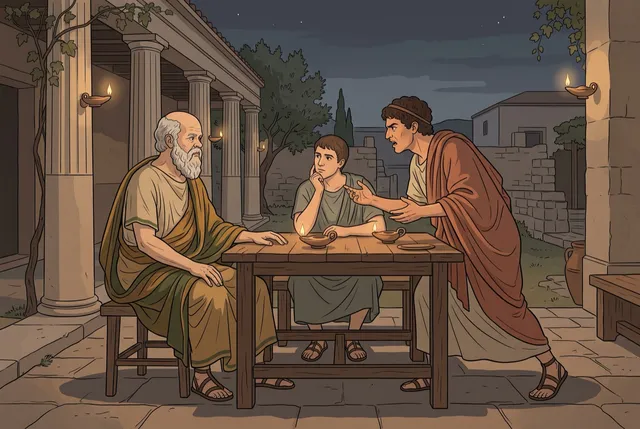
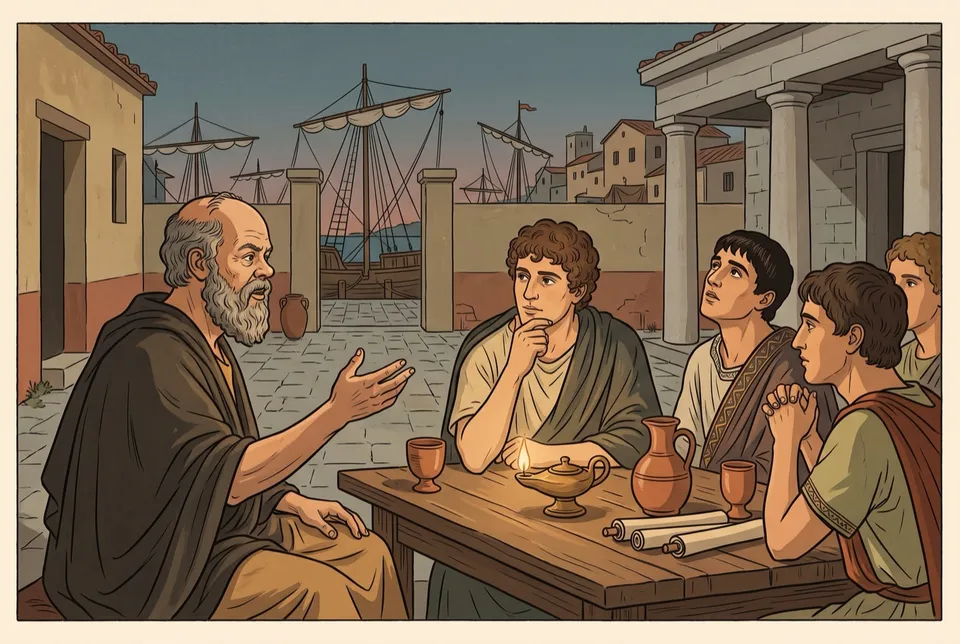
The dialogue is narrated by Socrates, who describes going down to the port of Piraeus with Glaucon, Plato’s brother, to watch a festival. On the way home they are stopped by Polemarchus and taken to the house of his elderly father, Cephalus (327a), a wealthy retired arms manufacturer. Also present over the course of the conversation are Polemarchus, Plato’s other brother Adeimantus, and the sophist Thrasymachus. The whole discussion, spanning what would be many hours, takes place that one evening.
What question is the Republic trying to answer?
The question that drives the whole work is put most sharply by Glaucon in Book 2: is justice good in itself, or only for its consequences, its reputation and rewards? He asks Socrates to defend justice by imagining a perfectly unjust man who nonetheless appears perfectly just to everyone around him, and a perfectly just man who is wrongly believed to be a monster of injustice. Which of the two actually lives the better life? Socrates spends the rest of the Republic answering that challenge.
Book-by-book summary of the Republic
| Book | What happens | Key idea |
|---|---|---|
| 1 | Socrates talks with Cephalus, then Polemarchus, then Thrasymachus about what justice is | Early definitions of justice (paying debts, helping friends and harming enemies, “the advantage of the stronger”) all fail under questioning (331c, 338c) |
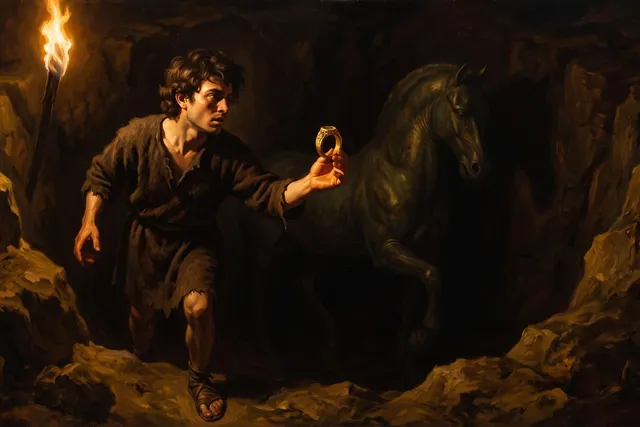
| 2 | Glaucon and Adeimantus restate the challenge; Glaucon tells the story of the Ring of Gyges | Is justice worth having for itself, even if you could act unjustly and never be caught? (359d). Socrates proposes building a just city to see justice “writ large” |
| 3 | The education of the guardians: stories, poetry, music and physical training | Censorship of poetry that shows the gods or heroes behaving badly, because early education shapes character |
| 4 | The city is finished; Socrates defines the four virtues and the three parts of the soul | The city, and the soul, are just when each part does its own job: reason rules, spirit supports it, appetite obeys (see what happens in Book 4) |
| 5 | The “three waves”: equal education for women, community of wives and children among guardians, and rule by philosophers | Philosophers must become kings, or kings philosophers, or the troubles of cities will never end (473c) |
| 6 | What makes someone fit to be a philosopher-king; the image of the Sun | The Form of the Good is to knowledge and truth what the sun is to sight and growth (508e–509b) |
| 7 | The Allegory of the Cave; the guardians’ course of higher education | Education is not putting knowledge into a blind eye but turning the whole soul toward the light (518c) |
| 8 | The decline of constitutions: timocracy, oligarchy, democracy, tyranny | Each regime decays into the next as the ruling class’s values corrupt it |
| 9 | The tyrant’s soul is examined directly; the three kinds of pleasure are compared | The just king’s life is reckoned 729 times more pleasant than the tyrant’s (587e), and the philosopher’s pleasure is judged truest |
| 10 | The attack on poetry is renewed; the Myth of Er | The soul is immortal and chooses its next life in the afterlife, so justice matters beyond this one lifetime (614b) |
What happens in Book 1?
Book 1 works through three attempts to define justice and knocks each one down. Cephalus, an old man near death, suggests justice is telling the truth and paying what you owe. Socrates points out that returning a weapon to a friend who has since gone mad would be wrong, so the definition needs refining. Polemarchus offers a version closer to “help your friends and harm your enemies,” which collapses once Socrates asks whether a just person should really try to make anyone, even an enemy, worse. Then Thrasymachus, a professional teacher of rhetoric, bursts in and declares that justice is simply “the advantage of the stronger” (338c): rulers make laws to suit themselves and call obedience to those laws just. Socrates argues that rulers can misjudge their own advantage, and that a ruler acting as a true craftsman of ruling aims at the good of the ruled, not himself. Thrasymachus is silenced but not persuaded, and the book ends without a definition, which sets up Glaucon’s challenge in Book 2.
Why does Socrates build an imaginary city?
Faced with Glaucon and Adeimantus’s demand for a real defence of justice, Socrates proposes a shortcut: since justice in a single person is hard to see clearly, look for it first in something larger, a city, where it will be “written in bigger letters” (368d). He then builds a city from scratch, starting from basic economic needs, farmers, builders, traders, and works up to a city that needs professional soldiers and rulers, the guardians. Book 4 defines the four cardinal virtues in that city: wisdom in its rulers, courage in its soldiers, moderation shared by all classes, and justice as each class doing its own job without interfering in the others’. The same structure is then read back onto the individual soul.
What are the tripartite soul and the philosopher-kings?
Plato argues the soul has three parts that mirror the three classes of the city: reason (which should rule), spirit (courage and ambition, which should support reason), and appetite (bodily desires, which should be governed, not indulged without limit). A just person is one in whom reason rules with the help of spirit and keeps appetite in check; an unjust person is ruled by appetite or runaway ambition instead. The full case for this division is set out in the tripartite soul in Plato’s philosophy.
Because reason should rule, Plato concludes in Book 5 that cities will never be well governed until philosophers become kings, or those currently called kings genuinely take up philosophy (473c). Only philosophers, trained for decades in mathematics and dialectic, can grasp the Form of the Good well enough to rule wisely rather than for private advantage. Book 5 also argues, startlingly for its time, that women of the guardian class should receive the same education and hold the same roles as men, since sex is not relevant to fitness for the job; this claim is examined in the role of women in Plato’s Republic. The guardian class also has no private property or family, sharing goods, spouses and children in common (462c), a proposal meant to remove any motive for guardians to rule for their own benefit rather than the city’s.
What are the Sun, Line and Cave?
Books 6 and 7 contain the three images Plato uses to explain his theory of Forms, the unchanging realities (such as Justice itself, Beauty itself, and above all the Good) that ordinary just or beautiful things only imperfectly resemble. Full treatments exist elsewhere on this site, so only the outline is needed here:
- The Sun (507a–509c): the Good is to the intelligible world what the sun is to the visible world, the source that makes both understanding and the objects of understanding possible (508e–509b).
- The Divided Line (509d–511): reality and knowledge are each split into two levels, the visible and the intelligible, and again in two, giving four states of mind from guesswork up to pure understanding. See Plato’s Divided Line for the full breakdown.
- The Cave (514a–521b): prisoners chained since childhood in an underground den mistake shadows on a wall for reality. One prisoner is freed, drags himself up into the sunlight, and eventually returns to tell the others the truth, only to be mocked and threatened. The allegory opens Book 7 (514a) and stands for the philosopher’s journey from illusion to understanding, and the difficulty of bringing that understanding back to people who have never left the cave. See how to interpret the Allegory of the Cave for a close reading.
Why do constitutions decline, from Books 8 to 9?
Having described the ideal city, Plato spends Books 8 and 9 describing its decay, mirrored step by step in the decline of the individual soul. Timocracy (rule by honour-lovers, modelled on Sparta) gives way to oligarchy (rule by the wealthy), which breeds resentment and collapses into democracy (rule by the many, prizing freedom above all), which in turn collapses into tyranny, as a demagogue who promises to protect the poor from the rich seizes total power and becomes a tyrant surrounded by bodyguards and fear. Plato is not neutral about democracy here; he treats it as a stage on the way to tyranny, driven by an excess of liberty that leaves no shared standard for what is worth choosing. The question of what Plato thought about democratic rule is taken up directly in what is democracy to Plato.
Book 9 closes the argument Glaucon opened in Book 2 by examining the tyrant’s soul directly: ruled entirely by lawless desire, frightened, friendless and enslaved to his own appetites, the tyrant is the unhappiest of all people, whatever his public power looks like (580c).
What is the point of the critique of poetry, and the Myth of Er?
Book 10 returns to a theme from Book 3 and argues that poetry which merely imitates appearances, without knowledge of the truth, is at two removes from reality and can corrupt the soul by feeding its emotional, unreasoning part. It is Plato’s most controversial argument, and it sits oddly with how much Plato himself writes like a dramatist and poet.
The dialogue then ends with the Myth of Er (614b), a story about a soldier who apparently dies in battle, sees the afterlife, and returns to report it. Souls are judged, rewarded or punished for a thousand years, and then choose a new life to be born into, a choice for which they alone are responsible, before drinking from the River of Unheeding, on the Plain of Forgetfulness, and starting again. It is Plato’s most detailed picture of an afterlife built on moral responsibility, a theme explored further in how Plato’s Myth of Er shapes views on free will and destiny.
How does Plato answer Glaucon’s challenge?
By the end of the Republic, Plato’s answer to “is the just life better than the unjust one” runs on three tracks at once. Structurally, only a soul in which reason rules, which is what justice means for an individual, can be at peace with itself; the unjust soul is a civil war of competing parts, whatever it looks like from outside. Psychologically, only the philosopher has tasted the truest kind of pleasure, the pleasure of learning, and so is best placed to judge which life is actually most pleasant; Book 9 argues the just life wins on this ground too. And mythically, the Myth of Er insists that the choice will not stop mattering at death: the soul’s condition follows it into its next life. None of these three arguments is a knockdown proof by modern standards, and each has been challenged by commentators since antiquity, but together they make the Republic’s case that injustice, however well it is concealed, corrupts the one thing a person cannot escape: their own soul.
Keep reading