Who Was Thrasymachus? The Sophist Who Attacks Socrates in Republic Book 1
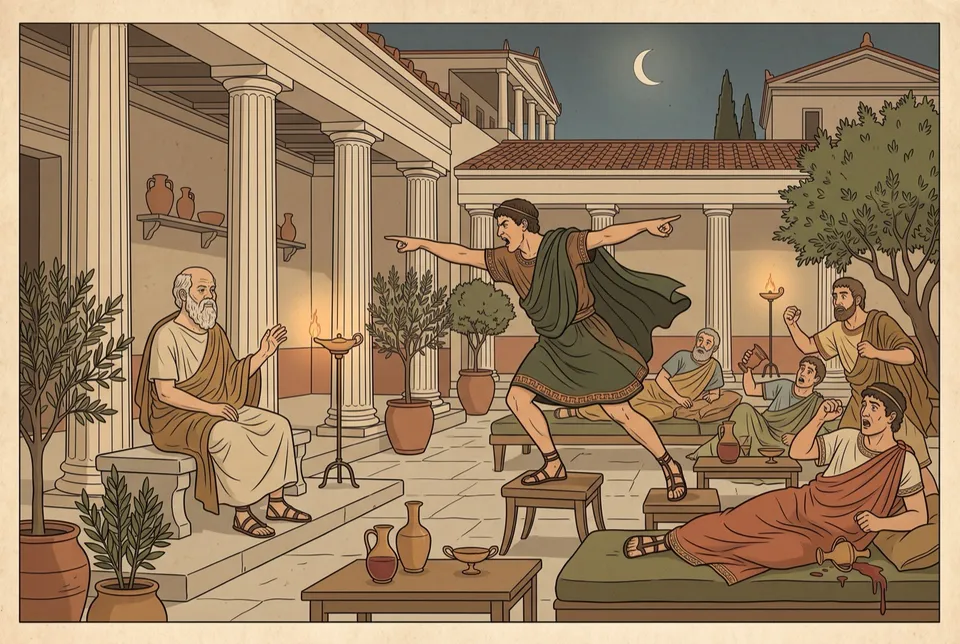
In short. Thrasymachus was a sophist and rhetorician who bursts into Plato's Republic Book 1 to argue that justice is nothing but the advantage of the stronger.
Thrasymachus of Chalcedon was a real sophist and rhetorician of the fifth century BC who appears in Book 1 of Plato’s Republic as Socrates’ fiercest opponent, the man who declares that justice is nothing but the advantage of the stronger. He arrives loudly, argues aggressively, and leaves the conversation early, but his challenge is the hinge on which the entire Republic turns: everything Socrates builds across the next nine books is, in some sense, an answer to what Thrasymachus says in this one.
Who was Thrasymachus in real life?
Very little about Thrasymachus is known with confidence outside Plato’s portrait of him. He came from Chalcedon, a Greek city on the Bosphorus, and ancient sources place him in Athens as a working teacher of rhetoric in the second half of the fifth century BC, roughly the same period as the sophists Protagoras and Gorgias. Aristotle mentions him in the Rhetoric as a figure of note in the history of prose style, crediting him with an interest in the emotional and rhythmic effects of speech, though Aristotle’s remarks are brief and do not amount to a biography. A handful of other ancient references to a rhetorician named Thrasymachus survive, but they add little beyond confirming that he had a real reputation as a teacher of oratory. Beyond that outline, it is safest to say only that he was known in antiquity for his rhetorical style, and to treat Plato’s character as a dramatic portrait rather than a transcript.
How does Thrasymachus enter the Republic?
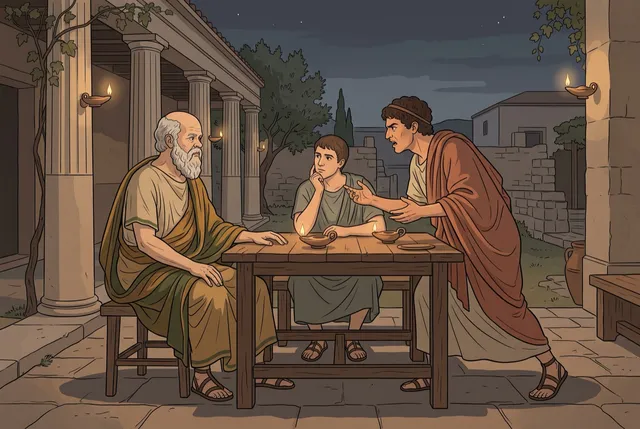
Thrasymachus has been sitting silently through the opening exchange between Socrates and the elderly Cephalus, and then Cephalus’s son Polemarchus, both of whom offer definitions of justice that Socrates picks apart. Plato stages Thrasymachus’s entrance as a small piece of theatre: he has been “many times eager to take part in the discussion” but held back by the others near him, and when he finally breaks in, Socrates says the other speakers “were terrified” and compares him to “a wild beast” crouching to spring (336b). It is one of the most vivid character entrances in any Platonic dialogue, and it sets the tone for everything that follows: Thrasymachus is impatient, contemptuous of the polite, meandering question-and-answer method Socrates has been using, and convinced he already knows the answer the others have been fumbling toward.
What is Thrasymachus’s argument that justice is the advantage of the stronger?
Once he has the floor, Thrasymachus states his thesis directly: “justice is nothing else than the advantage of the stronger” (338c). Socrates presses him to explain, and Thrasymachus clarifies across the next few pages of the dialogue.
His first move is essentially political: every city is ruled by some group, whether a democracy, an aristocracy, or a tyranny, and whoever rules makes laws to serve its own advantage. Once the laws are made, the rulers declare obedience to them “just” for their subjects, and punish disobedience as wrongdoing. So justice, in every actual city, simply is whatever serves the interest of whoever holds power (338e–339a).
Socrates immediately spots a weakness: rulers can be mistaken about their own advantage and pass laws that end up hurting themselves, in which case obeying the law would not serve the stronger party at all. Thrasymachus tightens his claim in response, introducing a distinction between a ruler in name and a ruler “in the precise sense” of the word: a craftsman, properly speaking, does not make mistakes in his craft, and a ruler, properly speaking, does not miscalculate his own advantage either. Any apparent error just shows the person was not ruling correctly in the first place (340c–341a). This move, insisting on a technically perfect version of a role to sidestep counterexamples, becomes exactly the opening Socrates exploits in his first reply.
What does Thrasymachus say later about injustice?
Having been pushed onto the defensive once already, Thrasymachus regroups and makes his boldest claim yet: injustice, practised on a large enough scale, is actually stronger, freer, and more profitable than justice, while justice is merely “high-minded simplicity” and injustice is “good judgement” (348c–d). He illustrates the point with the figure of the successful tyrant, a criminal on the largest possible scale, who ends up envied and called happy rather than punished, precisely because his wrongdoing was too total and too well organised to be called a mere crime.
To make the underlying picture vivid, Thrasymachus reaches for the shepherd analogy: a shepherd fattens and cares for his sheep, he says, not for the sheep’s own good but because he plans to shear and eventually eat them, and rulers who look after their subjects are, on his view, doing exactly the same thing, tending people for their own benefit rather than the people’s (343b). Justice, on this picture, is not a virtue at all; it is simply other people’s good, serving someone else’s advantage at the cost of your own.
How does Socrates answer Thrasymachus?
Socrates replies with three separate arguments, building across the rest of Book 1.
The craft argument (341c–342e) turns Thrasymachus’s own move against him. If a ruler, properly speaking, never errs, Socrates argues, then a ruler, properly speaking, is like any other craftsman: a doctor’s craft aims at the good of the patient, not the doctor’s own advantage, and a ship’s captain’s craft aims at the good of the sailors under him. By Thrasymachus’s own definition of a ruler “in the precise sense,” the ruler’s craft should aim at the good of the ruled, the opposite of what Thrasymachus wants to conclude.
The argument from pleonexia, or the desire to outdo others (349b–350c), asks whether an unjust person wants to outdo everyone, just and unjust alike, while a just person only wants to outdo the unjust, not fellow just people. Socrates compares this to expertise: a skilled person in any field, music or medicine, does not try to outdo other skilled practitioners, only the unskilled, whereas an unskilled person tries to outdo everyone indiscriminately. The comparison lets Socrates align justice with skill and knowledge, and injustice with ignorance, exactly the reversal of Thrasymachus’s picture. It is at this point in the exchange that Thrasymachus, pressed into an answer he does not want to give, blushes (350d), a small physical detail Plato uses to mark a real concession.
The function argument (352d–354a) closes Book 1. Socrates argues that everything with a characteristic function has a corresponding virtue that lets it perform that function well, an eye’s virtue is what lets it see well, a pruning knife’s virtue is what lets it cut well, and the soul’s function is to live, to manage, and to deliberate. If justice is the virtue of the soul, then a just soul manages and lives well, and an unjust soul manages and lives badly, which would make the just life the happier one regardless of reputation or reward, the opposite of Thrasymachus’s conclusion.
| Thrasymachus’s claim | Socrates’ reply | Where |
|---|---|---|
| Justice is the advantage of the stronger; rulers make laws for their own benefit | The craft argument: a ruler’s craft, properly defined, aims at the good of the ruled, like a doctor’s or captain’s craft | 338c–339a; reply at 341c–342e |
| The ruler “in the precise sense” never errs | Then by that same definition his craft cannot serve only himself | 340c–341a |
| Injustice is stronger, freer, and more profitable than justice; justice is naive simplicity | The pleonexia argument: the unjust person wants to outdo everyone, just and unjust alike, which looks like ignorance, not skill | 348c–d; reply at 349b–350c |
| Rulers treat subjects the way a shepherd treats sheep, for their own gain | Implicit in the craft and function arguments: a shepherd’s craft, precisely defined, aims at the sheep’s welfare | 343b |
| (Concedes ground under pressure) | The blush | 350d |
| Justice is not a virtue of the soul at all | The function argument: the soul’s function is to live and deliberate; justice is the virtue that lets it do this well, so the just soul lives better | 352d–354a |
Why was Glaucon unsatisfied with Socrates’ victory?
Book 1 ends with Thrasymachus, by Socrates’ own account, agreeing to conclusions he does not really believe, worn down more than persuaded, and the argument as a whole feels unfinished even to the participants. Socrates himself admits he has moved too fast, establishing what justice is not without ever pinning down what it actually is. Glaucon, Plato’s brother and the dialogue’s next major interlocutor, says exactly this at the start of Book 2: he is not convinced that Socrates has proven anything, only that he has out-argued Thrasymachus in the moment, and he restates Thrasymachus’s challenge in a stronger, more honest form precisely because he wants a real answer rather than a debating win (357a–358b). That dissatisfaction is what launches the rest of the Republic, nine more books built to answer the question Thrasymachus raised and Book 1 never actually settled.
How is Thrasymachus read today?
Thrasymachus is often treated as the ancient ancestor of legal realism, the modern view that law is simply whatever those with power enact and enforce, stripped of any built-in connection to morality, and of a broader political realism that treats “might makes right” as a description of how power actually works rather than a moral claim about how it should. His name is also often invoked, sometimes loosely, alongside Friedrich Nietzsche’s later writing on power and conventional morality; the two thinkers are separated by more than two thousand years and very different projects, but the comparison is common enough in modern commentary that it is worth naming, with the usual caution that “often compared” does not mean “the same view.” Whatever the fairness of those later readings, Thrasymachus remains the sharpest early statement of a question political philosophy has never fully closed: whether justice is a real good, worth having for its own sake, or only ever the interest of whoever happens to be in charge.
Keep reading