Who Was Glaucon? Plato's Brother and the Republic's Great Questioner
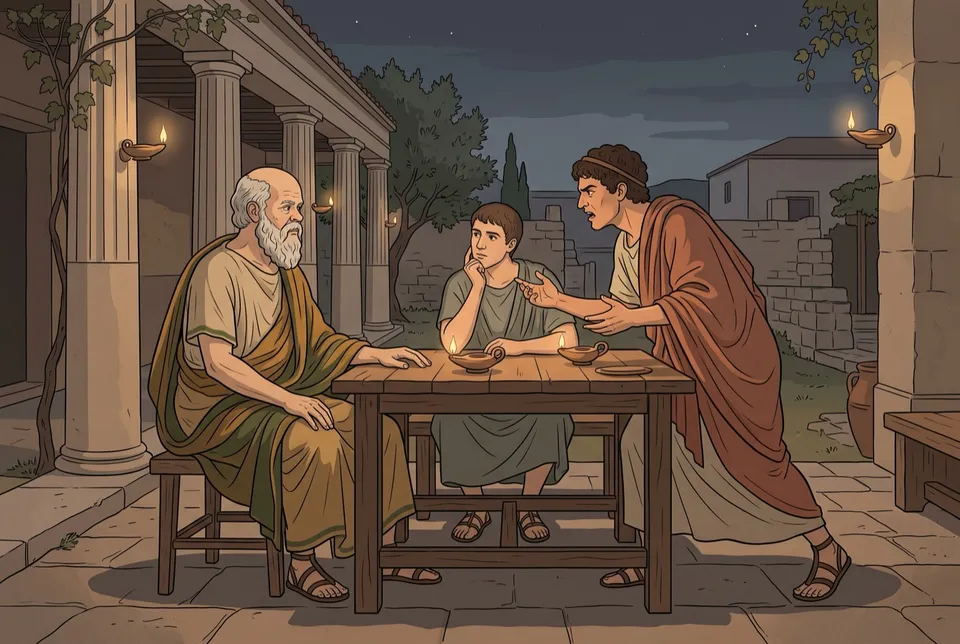
In short. Glaucon was Plato's older brother, the main interlocutor of the Republic, who challenges Socrates to prove that justice is worth having for its own sake.
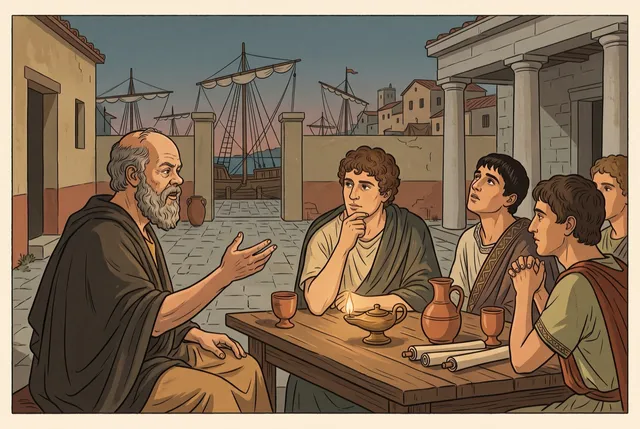
Glaucon was Plato’s older brother and the main person Socrates talks to for most of the Republic, from Book 2 through to the dialogue’s end in Book 10. He is not a minor sounding board. It is Glaucon who forces the whole inquiry into being, by demanding, in one of the most famous challenges in philosophy, that Socrates prove justice is worth having for its own sake and not just for its rewards (357a–362c). Everything that follows in the Republic, including the city built in speech and the theory of the soul, is Socrates’ answer to Glaucon.
Very little is known about Glaucon as a historical person outside Plato’s own writing. What we have instead is a vivid literary portrait: an intelligent, competitive, honour-loving young man, brave in battle, drawn to poetry and a wide range of loves, and impatient with easy answers. This essay separates what Plato tells us about Glaucon the character from the thinner evidence for Glaucon the historical figure.
Who was Glaucon in real life?
Glaucon was the son of Ariston and Perictione, and the older brother of Plato and of Adeimantus, who joins him as the other main questioner in the Republic. That makes the dialogue, in part, a conversation Plato imagined between his own two brothers and his teacher Socrates. Beyond the family connection and what the dialogues show us, almost nothing else about Glaucon’s life is independently recorded. He left no writings of his own, and no other ancient historian gives a biography of him the way Plutarch gives one for a public figure like Alcibiades. What we know of Glaucon is almost entirely what Plato chose to show us of him in conversation.
What does the Republic tell us about Glaucon’s character?
Socrates describes Glaucon with real warmth and specific detail, not as a generic interlocutor. He tells Glaucon that everyone remembers how he and his brother distinguished themselves in battle at Megara, and that the men who fought beside them praised their courage there (368a). Later in the dialogue, sketching the character of a man dominated by love of honour rather than by reason, Socrates’ companion Adeimantus says the description sounds exactly like Glaucon, who has always been fiercely competitive and eager to be first (548d–e). Glaucon is also shown as someone drawn to music, poetry, and erotic love: at one point Socrates teases him about his taste in male beauty as they discuss what makes a face attractive (474d). Taken together, the picture is of a young aristocrat with real physical courage, sharp intelligence, a competitive streak, and a taste for the good things in life, exactly the kind of person who would resist an argument for justice that asked him to give any of that up.
What is Glaucon’s challenge in Book 2 of the Republic?
At the end of Book 1, Socrates has argued down Thrasymachus, who claimed that justice is simply whatever benefits the stronger party. The refutation leaves Glaucon unsatisfied, not because he agrees with Thrasymachus but because he thinks Socrates has won the argument without actually showing that justice is good in itself. So he restates the toughest possible version of the challenge himself, playing devil’s advocate on purpose.
Glaucon opens by dividing goods into three kinds (357b–d):
| Type of good | Example Glaucon gives | Why we want it |
|---|---|---|
| Good only for its consequences | Physical training, medical treatment | We endure the unpleasant thing for the benefit it brings |
| Good only in itself | Harmless pleasures | We want it purely for its own sake, with no further payoff |
| Good both in itself and for its consequences | Knowledge, sight, health | The best kind of good, wanted both ways at once |
Socrates says justice belongs in the third, highest class. Glaucon says most people, if they are honest, actually think justice belongs only in the first class, something we put up with for its rewards and reputation, not because we would want it if we could get away with injustice instead. To make the popular view as strong as possible, Glaucon presents three linked arguments he does not personally endorse but wants answered properly.
First, he sketches justice as a kind of social contract: people are, by nature, capable of both doing and suffering wrongdoing, and having tried both, they conclude that suffering injustice is worse than the trouble of doing it, so they agree with one another to make laws and call obedience to them “just”, not from any love of justice itself but to avoid the greater evil of being wronged with no protection (358e–359b).
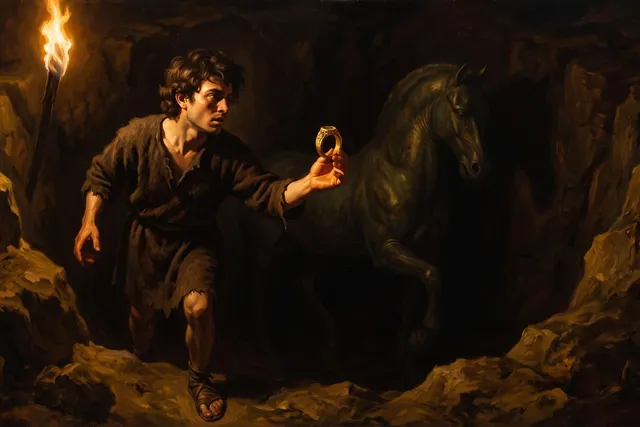
Second, he tells the story of the Ring of Gyges, a shepherd who finds a ring that makes him invisible and uses it to seduce the queen, murder the king, and seize the throne. Glaucon’s point is that if a perfectly just man and a perfectly unjust man both had such a ring, neither would behave any differently: no one is just willingly, only because they are watched (359d–360d).
Third, Glaucon asks Socrates to compare the two men at their most extreme, stripped of every misleading external sign. Imagine a perfectly unjust man clever enough to seem just to everyone around him, gaining every reward that reputation brings, against a perfectly just man who does nothing wrong yet is stripped of all reputation, disbelieved, and punished as though he were wicked. Which life is happier? Unless Socrates can show that the just life wins even in that extreme case, Glaucon says, no one has actually defended justice in itself at all (360e–362a).
How does the rest of the Republic answer Glaucon?
The remaining nine books of the Republic are Socrates’ response (our book-by-book Republic summary follows the whole route). He proposes building a just city in speech, on the reasoning that justice will be easier to see written large in a whole community than in one person, and Glaucon stays as his main partner through the project. Early on, Glaucon rejects Socrates’ first sketch of a simple, modest community, a city meeting only basic needs, mocking it as fit for pigs rather than people, and it is this objection at 372d, sometimes called the “city of pigs” moment, that pushes Socrates to design the larger, more luxurious city whose desires require the guardian class, the warriors and rulers, that the rest of the dialogue is built around. Glaucon later listens as the principal audience for the dialogue’s most famous image, the Allegory of the Cave, which Socrates narrates directly to him in Book 7 as a picture of what education does and does not do for the soul (514a). By the end, Socrates argues that the just soul, one properly ordered by reason, is happier than the unjust soul regardless of reputation or reward, answering Glaucon’s challenge on its own terms.
Is this the same Glaucon who appears in the Symposium?
A man named Glaucon appears briefly in the frame of the Symposium, asking Apollodorus to retell the story of the famous party at Agathon’s house (172a–173a). Because the name and the philosophical circle match, this is often assumed to be the same Glaucon, Plato’s brother. It is a reasonable guess, not a certainty: Glaucon was a common Athenian name, and Plato does not use the framing scene to confirm the identification the way he sometimes signals family connections elsewhere. It is best treated as probable rather than proven.
What does Xenophon say about Glaucon?
Xenophon’s Memorabilia, a collection of recollections of Socrates written by another of his followers, includes a story in Book III, chapter 6, about a young, ambitious Glaucon who is determined to address the Athenian assembly and guide the city’s policy despite having no real grasp of public finance, military strength, or the sources of Athens’ income and expenses. Socrates, Xenophon says, talks him through a series of questions that expose how little he actually knows, and gently talks him out of speaking until he has learned more, noting that Glaucon was not yet twenty years old at the time. Xenophon identifies this Glaucon as the son of Ariston, which is generally taken to mean Plato’s own brother, caught here at an earlier, brasher stage of the same ambition and confidence the Republic shows him channelling into philosophy instead.
Why does Glaucon’s challenge still matter?
Glaucon’s opening argument in Book 2 is often treated as the first clear statement of what later philosophy would call a social contract theory of justice: the idea that just behaviour is not natural or intrinsically good but a bargain people strike to protect themselves from one another. Centuries later, the English philosopher Thomas Hobbes built an entire political theory on a strikingly similar picture of human nature, of people agreeing to submit to law only because the alternative, a state of open conflict, is worse for everyone. Whether or not Hobbes had Plato specifically in mind, Glaucon’s version is the oldest fully worked example of that argument in Western philosophy, and it is why his challenge is still assigned and argued over today, not as a historical curiosity but as a live question about why anyone should be just when injustice pays.
Keep reading