Who Was Alcibiades? The Brilliant, Reckless Student Socrates Couldn't Save
In short. Alcibiades (c. 450-404 BC) was a brilliant, reckless Athenian statesman and general, and one of Socrates' closest companions. Who he was and why he mattered.
Alcibiades (c. 450 to 404 BC) was an Athenian statesman and general, famous in his own lifetime for his good looks, his wealth, his brilliance as a speaker and soldier, and his sheer recklessness. He was also one of Socrates’ closest companions, the man who bursts in drunk near the end of Plato’s Symposium to deliver a speech not about love in general but about Socrates himself (212c onward). Alcibiades led Athens into its most disastrous military venture, the Sicilian Expedition of 415 BC, changed sides between Athens, Sparta and Persia more than once, and was killed in exile in 404 BC. He is also, by most accounts in later antiquity, the reason many Athenians came to believe Socrates corrupted the young.
Alcibiades is not a peripheral figure in Plato. He appears by name in the Symposium and the Protagoras, and two dialogues carry his name as their title, though only one is generally accepted as genuinely Plato’s. Understanding Alcibiades helps explain something that puzzles many first-time readers of the Apology: why an Athenian jury in 399 BC, years after Alcibiades was dead, might still have heard the charge against Socrates and thought of him.
Who was Alcibiades before he met Socrates?
Alcibiades was born into one of Athens’ most prominent families around 450 BC. His father, Cleinias, died fighting at the battle of Coronea in 447 BC, when Alcibiades was a small child. After that he became the ward of his mother’s relative Pericles, the leading statesman of Athens for much of the mid-fifth century. Growing up in Pericles’ household gave Alcibiades wealth, connections and an early, close view of Athenian power at its height.
Ancient writers agree on the outline of his character even when they disagree about almost everything else: he was extraordinarily good-looking, gifted with words, ambitious to the point of vanity, and utterly unpredictable. Plutarch’s Life of Alcibiades, written around five hundred years later, is the fullest ancient account of his life, but it is a biography written well after the fact and mixes solid historical material with anecdotes that had grown in the telling. This essay treats Plutarch as a source for later tradition and flags anecdotal material as such, leaning on Thucydides, an eyewitness-era historian of the war Alcibiades helped shape, and on Plato and Xenophon for his relationship with Socrates.
What was Alcibiades’ relationship with Socrates?
Socrates and Alcibiades appear to have known each other from Alcibiades’ youth, and the clearest evidence for the bond between them comes from Alcibiades’ own speech in the Symposium, where he describes two moments from their shared military service.
At the siege of Potidaea, a campaign in the early 430s BC, Alcibiades says Socrates saved his life in battle, standing over him when he was wounded and driving off the enemy, then insisting that Alcibiades, not himself, receive the prize for bravery (219e–220e). At the battle of Delium in 424 BC, during the retreat of the defeated Athenian army, Alcibiades says the reverse happened: he was on horseback and better placed to escape, and he stayed close to Socrates as the older man withdrew on foot, calm and unhurried even under attack, doing more to protect himself than most soldiers in full retreat (220d–221c). Between them, the two stories describe a real bond of mutual protection built under fire, not just conversation in the Athenian agora.
What happens in the Symposium’s Alcibiades scene?
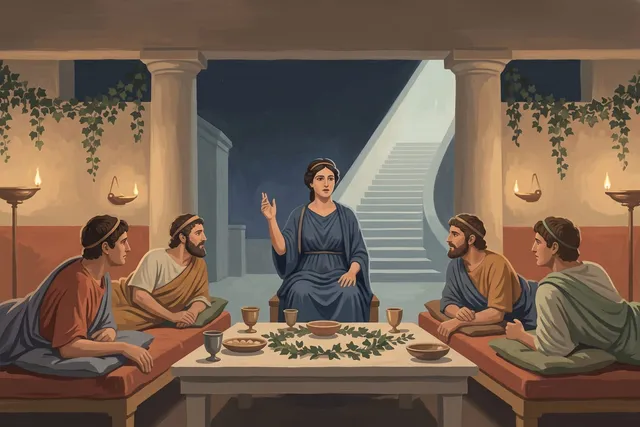
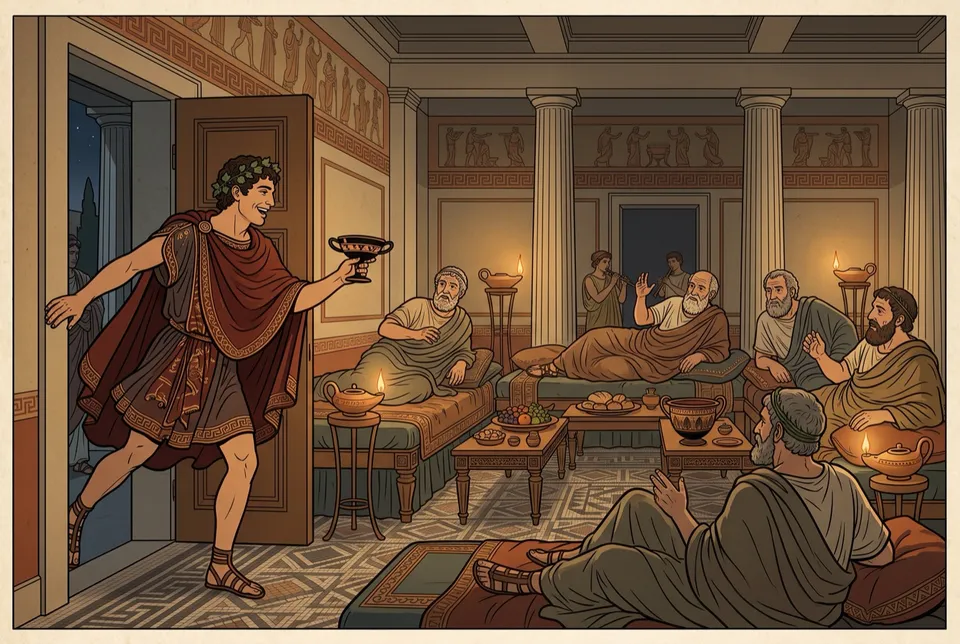
The Symposium stages a drinking party at which each guest gives a speech in praise of Eros, the god of love. Diotima’s speech, reported by Socrates, closes the formal round with an account of love as a ladder from desire for one beautiful body up to the philosophical vision of Beauty itself, part of what later readers call platonic love. Just as the group begins to discuss it, Alcibiades arrives uninvited, drunk, crowned with ivy, and loud (212c–d). Asked to give a speech of his own, he refuses to praise love in the abstract and instead praises Socrates the man.
His speech (215a onward) is built around a striking image: he compares Socrates to a statue of Silenus, one of the carved figurines sold in Athenian workshops that were ugly and grotesque on the outside but opened up to reveal golden images of the gods within (215a–b). Socrates, Alcibiades says, is exactly like this: plain-faced, snub-nosed, dressed however he pleases, and yet filled inside with a wisdom and self-command that puts every other man to shame.
He then tells the story of his own failed seduction of Socrates (217a–219d). Confident that his famous beauty could win over anyone, Alcibiades manoeuvred to be alone with Socrates, even sharing a cloak with him overnight, expecting the older man to make advances. Nothing happened. Socrates treated the whole episode with the same untroubled self-control he showed everywhere else, leaving Alcibiades humiliated, in his own telling, “as if he had been bitten by a snake” (217e–218a), unable to resist Socrates and unable to have him either. The speech is often read alongside Socratic irony: Socrates’ famous claim to know nothing, and to desire what he does not have, sits oddly beside a man who is, on this evidence, the most self-possessed person in the room.
What did Alcibiades do in Athenian politics and the war?
By his twenties Alcibiades was already a major figure in Athenian public life, and by his thirties one of the most powerful and controversial men in the city. He opposed the Peace of Nicias, the uneasy truce Athens made with Sparta in 421 BC partway through the Peloponnesian War, and worked to draw Athens back into the conflict, helping engineer the alliance that led to the Athenian defeat at Mantinea in 418 BC.
His most consequential political act was pushing Athens toward the Sicilian Expedition of 415 BC, a huge naval campaign against the city of Syracuse that Alcibiades himself argued for and was appointed to help command. The historian Thucydides, writing as a near-contemporary, gives Alcibiades a long speech defending the expedition and describes him as a man whose private extravagance made ordinary Athenians suspicious of his public ambitions, even though his abilities as a commander were real (Thucydides 6.15).
Before the fleet had even left Athens, two religious scandals struck the city: the mutilation of the herms, in which the stone protective markers standing outside houses across Athens were vandalised overnight, and accusations that private mock performances of the Eleusinian Mysteries, a major state religious rite, had been staged as parody. Alcibiades was accused of involvement in the second scandal. Rather than let him answer the charge at home, his political enemies waited until the fleet had sailed, then recalled him to stand trial. Alcibiades chose not to return. He defected to Sparta, Athens’ enemy in the war, and gave the Spartans advice that helped them fight Athens more effectively.
His time in Sparta ended in another falling-out (later sources say he had an affair with a Spartan king’s wife, though this belongs to the anecdotal rather than the well-documented layer of the story), and he moved on to the court of Tissaphernes, the Persian satrap, or regional governor, of western Anatolia, playing Sparta and Persia against each other and against Athens. He eventually negotiated his way back into Athenian favour and returned to Athens in 407 BC to a triumphant welcome, commanding Athenian forces again for a time. That success did not last. After a subordinate commander lost a naval engagement at Notium in 406 BC while Alcibiades was away, Athens turned on him once more, and he went into exile in Thrace. He was killed in Phrygia, in Asia Minor, in 404 BC. Plutarch reports that his assassination was arranged at the instigation of the Spartan commander Lysander, possibly working with the new Athenian regime of the Thirty Tyrants, but later sources give differing and sometimes contradictory accounts of exactly how and by whom he died, so the precise circumstances are less certain than the fact of his death itself.
Timeline of Alcibiades’ life
| Date | Event |
|---|---|
| c. 450 BC | Born into a leading Athenian family |
| 447 BC | Father Cleinias killed at the battle of Coronea; Alcibiades becomes ward of Pericles |
| Early 430s BC | Serves with Socrates at the siege of Potidaea; Socrates saves his life |
| 424 BC | Serves with Socrates at the battle of Delium |
| 421 BC | Opposes the Peace of Nicias |
| 418 BC | Helps draw Athens into the battle of Mantinea |
| 415 BC | Champions and is appointed to command the Sicilian Expedition; recalled over the Mysteries scandal; defects to Sparta |
| c. 412-411 BC | Moves to the court of the Persian satrap Tissaphernes |
| 407 BC | Returns to Athens in triumph and resumes command |
| 406 BC | Defeat at Notium under a subordinate; Alcibiades loses command again |
| 404 BC | Killed in exile in Phrygia |
| 399 BC | Socrates tried and executed at Athens, in a climate shaped partly by Alcibiades’ record |
Why did Alcibiades matter to Socrates’ trial?
Socrates was tried in 399 BC, five years after Alcibiades’ death, on charges of impiety and of corrupting the young men of Athens. Plato’s Apology does not name Alcibiades, but the historian and fellow student of Socrates, Xenophon, addresses the connection directly. In his Memorabilia, a defence of Socrates’ character written after the trial, Xenophon says plainly that Socrates’ accusers pointed to two men who had spent time with him and gone on to do great harm to Athens: Critias, who became the most violent of the Thirty Tyrants that briefly ruled Athens after its defeat in the war, and Alcibiades, whose defection and political recklessness had helped bring Athens to the edge of ruin (Xenophon, Memorabilia I.2.12). Xenophon goes on to argue that this reasoning was unfair, that Alcibiades and Critias behaved as they did in spite of what Socrates taught them, not because of it. Whether or not the jury accepted that defence, the association was clearly alive in the public mind, and Alcibiades’ career is one of the clearest examples of why the question why was Socrates executed cannot be answered by the formal charges alone. The general Socratic habit of relentless questioning had, in Alcibiades’ case, produced a student who questioned everything and settled for nothing, including loyalty to his own city.
Did Plato write dialogues named after Alcibiades?
Two dialogues bearing Alcibiades’ name survive from antiquity as part of the traditional Plato corpus. Alcibiades I portrays a young, ambitious Alcibiades being led by Socrates to see how little he actually knows about justice and the good, despite his confidence that he is ready to advise the Athenian assembly. Many scholars in the last two centuries have doubted that Plato wrote it, though it was accepted as genuine throughout antiquity and was even used in later Platonist schools as an introductory text to the whole of Plato’s philosophy; its authorship remains disputed rather than settled. Alcibiades II, a much shorter dialogue on the danger of praying for things without understanding whether they are good for us, is generally considered not to be Plato’s work, and is usually classed among the dialogues written by a later member of the Academy in Plato’s style.
What should we make of Alcibiades?
Alcibiades resists a simple verdict, and the ancient sources do not offer one either. Thucydides presents a man of real talent undone as much by the suspicion of his fellow citizens as by his own faults. Plato presents a man who came closer than almost anyone to Socrates, admired him more than he admired any other person, and still could not be changed by him. Xenophon presents him as proof that a teacher is not responsible for what a brilliant, wilful student later chooses to do. What all three agree on is that Alcibiades was impossible to ignore, in Athens or in the history of Socrates’ circle, and that his story is inseparable from the tragedy that closes in on Socrates himself.
Keep reading