Who Was Xenophon? Soldier, Historian, and Fellow Student of Socrates
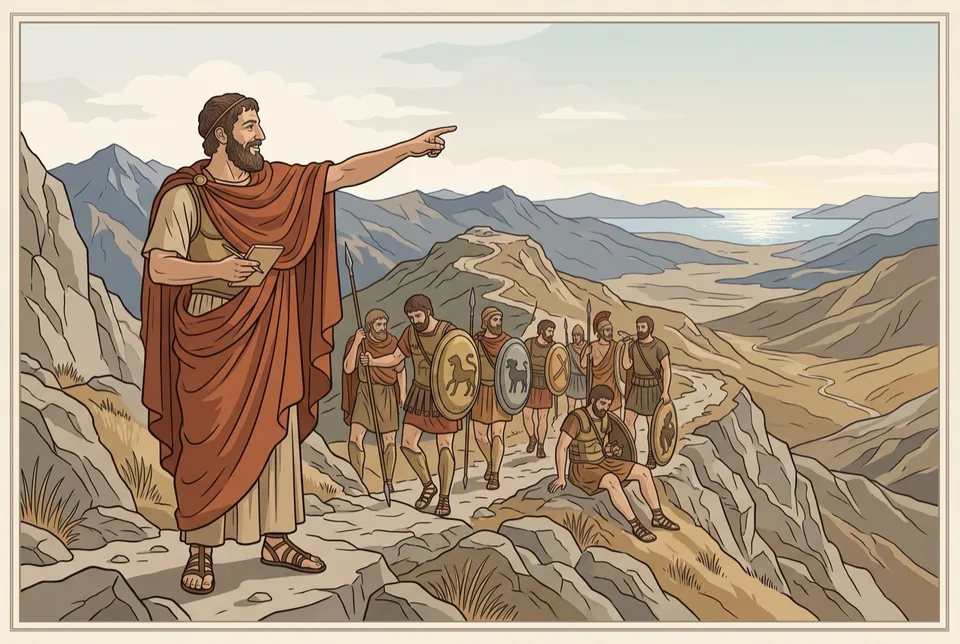
In short. Xenophon of Athens (c. 430-c. 354 BC) was a soldier, historian, and student of Socrates whose Anabasis and Memorabilia are our other main source for Socrates.
Xenophon of Athens (c. 430 to c. 354 BC) was a soldier, historian, and student of Socrates whose own writings are, alongside Plato’s, the main surviving source for what Socrates was actually like. He is best known for two very different achievements: leading a Greek mercenary army out of the heart of the Persian empire after its employer was killed, an ordeal he told in the Anabasis, and writing several works defending and recording Socrates, most importantly the Memorabilia. Where Plato gives readers a Socrates who pushes abstract questions about Forms and the good to their limits, Xenophon gives a plainer, more practical Socrates, and historians read the two writers side by side rather than trusting either one alone.
Who was Xenophon?
Xenophon was born into a wealthy Athenian family around 430 BC, at the start of the Peloponnesian War, and grew up during the long conflict between Athens and Sparta that shaped his entire generation. As a young man in Athens he was part of the circle of young men who spent time around Socrates, alongside figures such as Alcibiades and Glaucon, though Xenophon was probably younger than both and his own writing suggests he came to Socrates a little later in that circle’s life. Beyond that, almost nothing about his early life is independently confirmed; most of what is reported comes from his own later writing or from biographers working centuries afterward.
What happened on the march of the Ten Thousand?
In 401 BC, Xenophon joined a Greek mercenary army of roughly ten thousand men hired by Cyrus the Younger, a Persian prince, to help him seize the throne from his brother, the Persian king Artaxerxes II. The army marched deep into the Persian empire and met the king’s forces at the Battle of Cunaxa, near Babylon. Cyrus was killed in the fighting, and his death instantly turned the Greek mercenaries from an invading army with a patron into a stranded force, thousands of kilometres from home, in hostile territory, with no employer and no safe route back.
Soon afterward the Persians treacherously seized and executed most of the Greek generals under a truce. With the army’s leadership gone, Xenophon, not a professional soldier and holding no formal command, stepped forward as one of the new generals chosen to lead the retreat. What followed was a fighting march of roughly a thousand miles north through hostile Persian territory, Kurdish mountains, and Armenian highlands, harassed by local forces and Persian cavalry, through a brutal winter, until the exhausted army finally reached the Black Sea coast at Trapezus.
Xenophon later wrote the whole episode up as the Anabasis (“the march up-country”), one of the best firsthand accounts of ancient warfare to survive. Its most famous moment comes when the advance guard, cresting a hill, begins shouting and Xenophon, fearing an ambush, rides ahead to find the men crying “Thalatta! Thalatta!”, “The sea! The sea!” (Anabasis 4.7.24). After months of marching through enemy country, the sight of the Black Sea meant they had reached territory with Greek cities and a route home. It remains one of the most quoted lines in Greek prose.
Why was Xenophon exiled from Athens?
Xenophon’s relationship with his own city grew complicated after the march. He joined Spartan forces in Asia Minor and, over the following years, fought alongside Sparta, including at the Battle of Coronea in 394 BC, on the Spartan side against an alliance that included Athens itself. Athens formally exiled him for this, and whatever the exact legal grounds, fighting for Sparta against an Athenian-backed coalition made a return to Athens impossible for a long stretch of his life.
The Spartans compensated him with an estate at Scillus, near Olympia in the Peloponnese, where Xenophon lived for roughly two decades as a country gentleman: hunting, farming, writing, and raising his sons in the Spartan manner he admired. This settled, comfortable period is when most of his major works were written. When Sparta’s power collapsed after its defeat at Leuctra in 371 BC, Scillus was no longer safe, and Xenophon moved to Corinth. Athens eventually lifted his exile, and there is evidence his sons served in the Athenian cavalry, but Xenophon himself seems to have lived out his last years away from the city, dying around 354 BC.
What else did Xenophon write?
Xenophon was an unusually versatile writer. Beyond the Anabasis and his Socratic works, he wrote history, a philosophical novel about the ideal ruler, and practical manuals.
| Work | What it is |
|---|---|
| Anabasis | Firsthand account of the march of the Ten Thousand after Cunaxa (401 BC) |
| Hellenica | History of Greece picking up where Thucydides breaks off in 411 BC, running to 362 BC |
| Cyropaedia | A part-fictional account of the education and rule of Cyrus the Great, exploring ideal leadership |
| Memorabilia | Recollections defending Socrates’ character and teaching against the charges that led to his execution |
| Apology of Socrates | A short account of Socrates’ defence speech and reasoning at his trial |
| Symposium | A dinner-party dialogue featuring Socrates, distinct from Plato’s work of the same name |
| Oeconomicus | A dialogue on household management and estate farming, with Socrates as a speaker |
| Hiero | A dialogue on tyranny and whether a tyrant can be happy |
| Constitution of the Lacedaemonians | A description and defence of the Spartan political and social system |
| On Horsemanship | A practical manual on buying, training, and riding horses |
The Hellenica is especially useful to historians because it is the closest thing that survives to a continuous narrative of Greek affairs across the end of the Peloponnesian War and the decades after, even though Xenophon is a far less careful, more openly partisan historian than Thucydides, whose account he picks up.
How does Xenophon’s Socrates compare to Plato’s?
Both men knew Socrates personally, both wrote after his death in 399 BC, and both present themselves as defending him, yet the two portraits differ sharply. Xenophon’s Socrates in the Memorabilia is practical, pious, and concerned with everyday ethical questions: how to manage a household, how to be a good friend, how to control one’s appetites, why the gods deserve respect. He is a teacher of sound conventional values, useful to know and easy to defend against the charge of corrupting the young. Plato’s Socrates, especially in the dialogues usually read as later and more distinctively Platonic, pushes far past everyday ethics into abstract questions about the Forms, the nature of the soul, and what knowledge itself is, questions that made him harder to defend and, on one reading, closer to what actually put him on trial.
Neither writer offers a neutral transcript. Xenophon was not present for most of what he reports and was away on campaign in Persia and Asia Minor for much of the period he covers, so his Socratic works draw on memory, secondhand report, and a clear wish to rehabilitate his teacher’s reputation. Plato was a philosopher composing literary dialogues years or decades after the events they depict, using Socrates as a mouthpiece for arguments that plausibly go well beyond anything the historical man said. This gap between the two accounts is often called the Socratic problem: the question of how much of either portrait, or of the portraits left by other students such as Aeschines and Antisthenes whose works survive only in fragments, reflects the real Socrates rather than each author’s own concerns. Most historians treat both Xenophon and Plato as partial and motivated witnesses, useful mainly where they agree, and are cautious about building conclusions on either one alone; the question of whether a historical Socrates lay behind both portraits at all is addressed in was Socrates a real person.
Why didn’t Socrates try harder to be acquitted?
Xenophon’s own Apology of Socrates raises a question that puzzles many first-time readers of the trial: why did Socrates, by most accounts, make so little effort to win over the jury, when a more conciliatory defence might have saved his life? Xenophon’s answer, stated plainly rather than left to inference, is that Socrates had concluded death was, for him, the better outcome at that point in his life. Xenophon reports that Socrates believed old age would soon bring failing eyesight, failing hearing, and a decline in the very mental sharpness that had defined him, and that dying while still fully himself, at a moment of his own choosing in effect, was preferable to a long decline followed by death under worse circumstances. This is a more pragmatic, less philosophically loaded explanation than the one that emerges from Plato’s Apology and Crito, where Socrates’ refusal to plead for his life or to escape is tied to arguments about justice, the soul, and his lifelong commitment to philosophical inquiry; see why was Socrates executed for how the formal charges and the trial itself unfolded, and did Socrates write anything for why we depend on students like Xenophon and Plato for his words at all.
How did Xenophon meet Socrates?
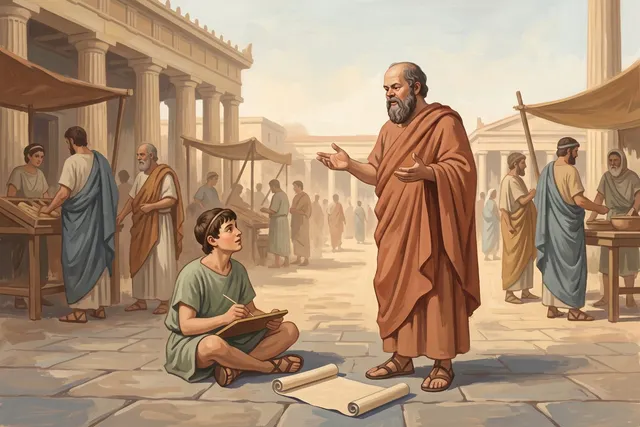
A well-known story about their first meeting comes not from Xenophon himself but from Diogenes Laertius, a biographer writing more than five centuries later, and should be read as later anecdote rather than established fact. In this telling, Socrates encountered the young Xenophon in a narrow Athenian alleyway, blocked his path with his walking stick, and asked him where various goods could be bought. Xenophon answered each question. Then Socrates asked where men were made good and noble. When Xenophon had no answer, Socrates said, “Follow me, then, and learn,” and Xenophon did (Diogenes Laertius II.48). The story is charming and widely repeated, but it appears only in a much later source with no earlier corroboration, in a genre that liked to dramatise how famous pairs first met, so it belongs with the anecdotal material about Xenophon rather than with the securely dated facts of his life.
What was Xenophon’s later influence?
Xenophon’s practical, unphilosophical style made him widely read for reasons that had little to do with Plato’s kind of philosophy. The Anabasis became a standard text for teaching Greek prose composition for centuries, and its narrative of leadership under extreme pressure has been read by soldiers ever since, most famously as an influence on military leaders looking for lessons in command, discipline, and morale on the march. The Cyropaedia, his study of Cyrus the Great as an ideal ruler, was read closely by Machiavelli and other later writers on statecraft as an early and serious treatment of what makes a ruler effective, distinct from what makes him virtuous in the abstract sense Plato cared about. That split in Xenophon’s own reputation, admired as a guide to action more than as a guide to metaphysics, mirrors the split between his Socrates and Plato’s: practical usefulness on one side, philosophical depth on the other, with Xenophon consistently landing on the practical side.
Why does Xenophon matter for reading Plato?
Xenophon matters to readers of Plato mainly as a check and a counterweight. When the two writers agree on some detail of Socrates’ character, such as his poverty, his physical courage, or his habit of questioning everyone he met, that agreement carries more weight than either account alone. When they diverge, as over how philosophical Socrates’ actual conversation was, the gap is itself informative about how the two students understood their teacher differently, and about how much room ancient biography left for a subject’s students to shape his memory. Xenophon’s Memorabilia also preserves details Plato leaves out, including its own account of Socrates’ relationship with Alcibiades (Memorabilia I.2.12) and with Glaucon, Plato’s own brother, whom Socrates is shown gently talking out of entering politics before he was ready for it (Memorabilia III.6). Read together with the ethics of dissent that Plato’s Socrates embodies at his trial, Xenophon’s more down-to-earth Socrates is a reminder that the historical man behind both portraits was, in the end, only partly recoverable, and that the disagreement between his two most devoted students is part of the evidence, not a problem to be explained away.
Keep reading