Plato's Apology: Summary of Socrates' Defense Speech
In short. Plato's Apology is Socrates' defense speech at his 399 BC trial: the charges, the three speeches, the verdict, and his execution. Full summary.
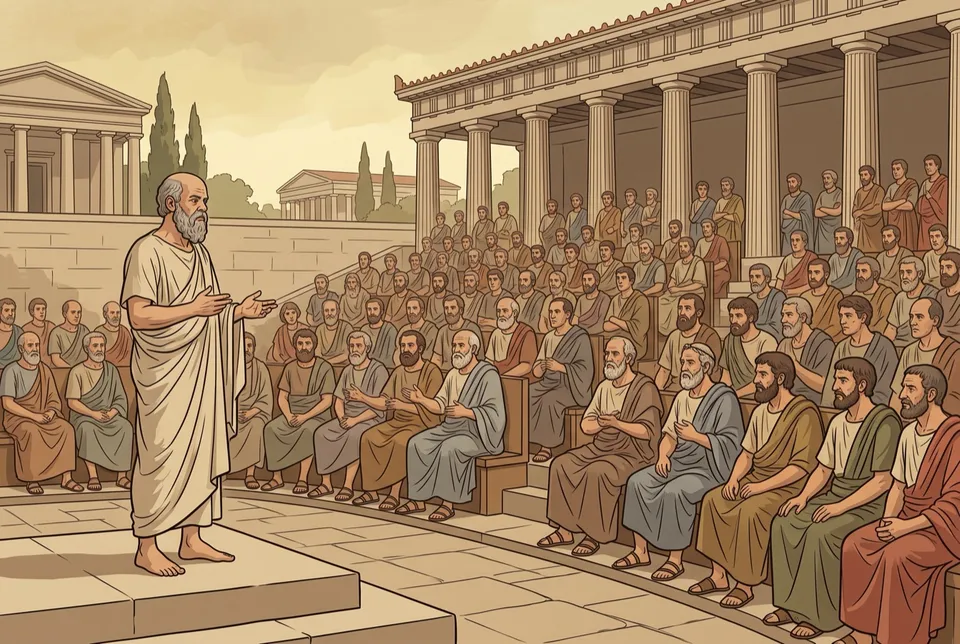
An apology, in Plato’s sense, is not an expression of regret. It comes from the Greek apologia, meaning a defense speech, the kind a defendant gave in his own voice before an Athenian jury. Plato’s Apology is his account of the defense speech Socrates gave at his trial in 399 BC, when he was charged with impiety and corrupting the young, convicted, and sentenced to death.
It is usually the first Platonic dialogue people read, and for good reason. It is short, it needs no background in Plato’s other arguments, and it lays out, in Socrates’ own words, the mission and the convictions that everything else Plato wrote can be read as defending or working out in more detail.
What was Socrates actually charged with?
The formal charge, as Socrates himself states it, was that he was “guilty of corrupting the youth, and of not believing in the gods in whom the city believes, but in other new spiritual things” (Apology 24b–c). Three men brought the case: Meletus, a young and largely unknown poet who filed the indictment and speaks for it in court; Anytus, a prominent and influential democratic politician who was the real driving force behind the prosecution; and Lycon, an orator about whom little else is known. The trial was held before a jury of 501 male citizens, chosen by lot, which also served as the judge of both guilt and penalty.
Socrates tells the jury early on that the formal charge is not really what he is fighting. He says he has “old accusers,” a reputation built up over decades by people who never faced him directly, that he is a thinker who “studies things in the sky and below the earth” and “makes the weaker argument the stronger” (18a–19c). He names the source directly: Aristophanes’ comedy The Clouds, which had staged him years earlier as a sophist running a “thinking-shop.” Against a slander like that, Socrates says, there is no one to cross-examine and no real defense to mount, only an attempt to explain where it came from.
How is the speech structured?
Because the Athenian jury voted twice, once on guilt and once on the penalty, the Apology falls naturally into three speeches, each responding to a different result.
| Speech | Stephanus range | What it does |
|---|---|---|
| Main defense | 17a–35d | Answers the old slander and the formal charge, before the guilty verdict |
| Counter-penalty speech | 35e–38b | Proposes a penalty of his own, after the jury finds him guilty |
| Final words | 38c–42a | Addresses the jury one last time, after the death sentence is passed |
Why does Socrates bring up the Delphic oracle?
The centerpiece of the main defense is a story Socrates says explains why he provoked so much resentment in the first place. His friend Chaerephon once went to the oracle at Delphi and asked whether anyone was wiser than Socrates. The priestess answered that no one was (20e–21a). Socrates says he found this baffling, since he was conscious of having no wisdom at all, so he set out to test the god by finding someone wiser than himself.
He questioned a politician reputed to be wise, and found the man believed he knew things he did not actually know. He went to the poets and found they could not explain the very poems they had written, producing them by inspiration rather than understanding. He went to the craftsmen, who did know real things about their own trades, but concluded from this that they must also be wise about everything else, which they were not (21b–22e). Each encounter made him an enemy, and each one confirmed the oracle. Socrates concludes that his advantage over these men is narrow but real: they think they know things they do not know, while he is aware of his own ignorance. This, he says, is “human wisdom,” and the oracle’s riddle really means that the wisest person is the one who, like Socrates, “knows that his wisdom is worth nothing” (23a–b). The idea is explored on its own terms in what did Socrates mean by “I know that I know nothing”, and the interrogation method behind it in what is Socratic irony.
How does Socrates cross-examine Meletus?
Socrates gets a rare chance in an Athenian trial to question his own accuser directly, and he uses it to expose a contradiction in the indictment (24c–28a). He gets Meletus to agree that the charge accuses him of believing in no gods at all, and then reminds the jury that the same indictment also accuses him of introducing new spiritual things, daimonia. But anyone who believes in spiritual things of that kind must believe in some kind of divine beings, since a daimonion is a divine or semi-divine being. So the indictment, on Meletus’s own words, accuses Socrates of believing in no gods and some gods in the same breath. It is a real logical trap, though it sidesteps the more serious worry underneath the formal charge: that Socrates’ private divine sign, his daimonion (see below), was not sanctioned by the city’s own religious practice.
What is the gadfly, and what is the daimonion?
Two images from the main defense have outlasted the trial itself. Socrates compares Athens to “a great and noble horse, which is somewhat sluggish because of its size, so that it needs to be stirred up,” and himself to a gadfly that the god fixed on the city to sting it awake, “arousing and persuading and reproaching each one of you” (30e). He warns the jury that killing him will be easy, but finding another gadfly will not.
Second, Socrates describes a private “divine sign,” a voice he has heard since childhood that never tells him what to do but always stops him before he does something wrong (31c–d). He mentions it while explaining why he never entered politics: the sign warned him off, correctly, because a genuinely just man could not survive long in Athenian public life without being destroyed by it.
Why won’t Socrates stop philosophizing?
Socrates tells the jury that even if they offered to acquit him on the condition that he give up philosophy, he would refuse. “Men of Athens, I honor and love you, but I will obey the god rather than you, and while I live and am able to continue, I will never give up philosophy” (29c–d). He says an unexamined pursuit of wealth, reputation and honor while neglecting wisdom, truth and the soul is a kind of shame, and that his role is to go about “persuading and reproaching” everyone he meets, young or old, not to care for their bodies or money before they care for the best possible state of their soul (29c–30c). This refusal is the moral center of the whole speech: he is not being defiant for its own sake, he is describing a service to the city he genuinely believes he is not permitted to abandon.
What was the verdict, and how close was it?
The jury found Socrates guilty by a margin Socrates himself estimates at 30 votes switching sides would have acquitted him (36a), which on a jury of 501 works out to roughly 280 votes for conviction against 221 for acquittal, a margin of about 60. It was close enough that Socrates tells the jury he is not surprised or greatly troubled by the result, only mildly surprised the vote was as close as it was, since he expected a much larger majority against him.
What penalty did Socrates propose, and what happened?
Athenian procedure required the prosecution to propose a penalty, Meletus proposed death, and then the defendant to propose an alternative, with the jury choosing between the two. Socrates’ counter-proposal is, on its face, one of the most provocative gestures in Greek literature. Rather than proposing exile or a serious fine, he first suggests that what he actually deserves, given the service he believes he has done Athens, is free meals for life in the Prytaneum, the honor Athens gave to Olympic victors and other public benefactors (36d–37a).
He then relents, somewhat, and offers a fine of one mina, before his friends, including Plato, urge him to propose something larger which they will guarantee. He settles on 30 minae, guaranteed by Plato, Crito, Critobulus and Apollodorus (38b). It is worth noting that this line, where Socrates names Plato as one of his guarantors, is one of only a handful of places in the whole Platonic corpus where Plato mentions himself. The jury, unmoved or angered by the free-meals proposal, voted for death by a larger margin than they had voted for guilt.
Between the two speeches sits the single line the Apology is most quoted for. Socrates tells the jury that a quiet, compliant life, one that simply avoids further trouble, is not a life he could accept: “the unexamined life is not worth living for a human being” (38a). It is worth reading in context, since taken alone it can sound like a slogan. Socrates means it as an explanation of why he refused to propose exile or silence as his penalty: a life without the kind of daily self-examination he has spent the whole speech describing is not, to him, a life worth choosing over death.
What does Socrates say about death?
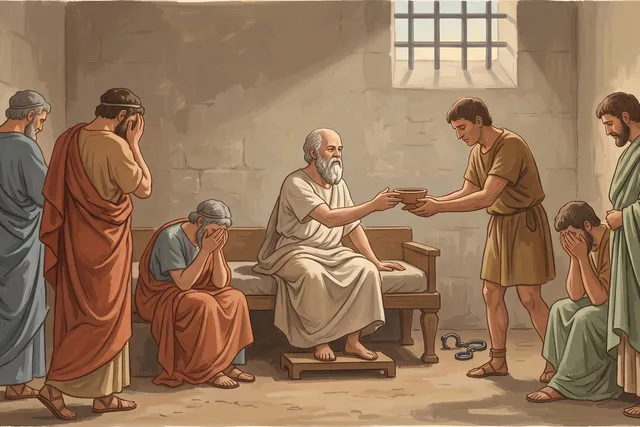
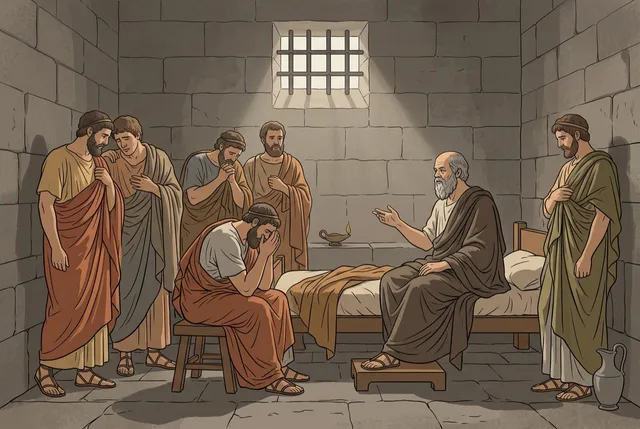
In his final address to the jury, Socrates turns to the question of what death actually is, and argues it cannot be a bad thing for a good man, in life or in death (40c–41c). He reasons that death is one of two things. Either it is like a dreamless, undisturbed sleep, in which case it is a net gain, since he doubts anyone could name many days or nights in their life better than a night of untroubled sleep. Or it is, as some say, a migration of the soul to another place, where he could meet the great figures of the past, Homer, Hesiod, Orpheus, and continue his mission of questioning people, this time without fear of being put to death for it. Either way, he tells the jury, no evil can happen to a good man, in life or after death. His view of death is treated at much greater length, and with a very different argumentative apparatus, in the Phaedo and its account of the day of his actual execution, in the death of Socrates.
The dialogue closes on a note of resignation rather than defiance: the hour has come to part, Socrates to die and the jury to live, and which of the two goes to the better thing is known to no one except the god (42a).
How does Plato’s Apology compare with Xenophon’s?
Plato was not the only student of Socrates to write an Apology. Xenophon, a soldier and historian who was not present at the trial and relied on secondhand reports, wrote his own, shorter version. Xenophon’s Socrates is notably more confrontational: he frames Socrates as having deliberately courted a death sentence because he was old, in declining health, and preferred a quick execution to a slow decline, and he has Socrates boast more openly about his own virtue. Plato’s Socrates, by contrast, presents his refusal to beg or grovel as a matter of principle and consistency, not fatigue with life, and his tone throughout is closer to patient irony than defiance. Scholars generally treat Plato’s version as the more philosophically serious of the two, though both are shaped by their authors’ own purposes rather than being court transcripts, and neither should be read as a word-for-word record.
Why the trial happened, and what followed
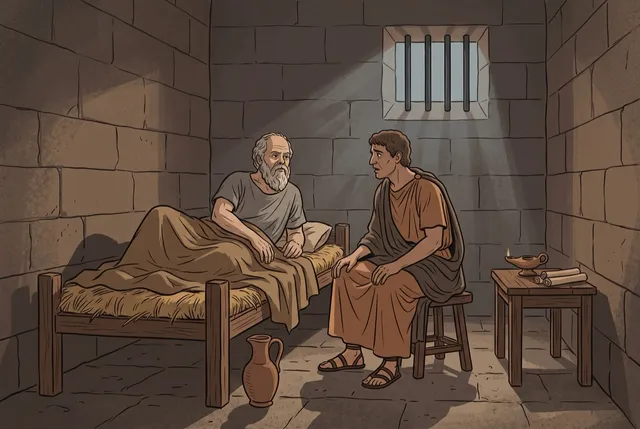
The Apology only reports Socrates’ side of the case, and it leaves the political backdrop mostly implicit: Athens had just gone through the trauma of the Thirty Tyrants and its own bloody civil conflict, and Socrates’ known association with some of the regime’s members made him politically suspect even though the amnesty that followed technically barred prosecutions for anything connected to that period, which is part of why the formal charge was framed in religious rather than political terms. The wider context for why the charge took the shape it did, and why the city was willing to act on it, is covered in why Socrates was executed. What Socrates argued about a citizen’s obligations to the city that had just condemned him, including why he refused a chance to escape prison before the sentence was carried out, is the subject of Plato’s Crito. And for a broader collection of the lines from across his life that keep getting quoted in his own words, see Socrates quotes.
Keep reading