Why Was Socrates Executed? The Charges, the Trial and the Verdict
In short. Socrates was executed in 399 BC for impiety and corrupting the youth. Here are the real charges, who prosecuted him, and why the jury chose death.
Socrates was executed in Athens in 399 BC, condemned by a jury of his fellow citizens on charges of impiety and corrupting the young. He was not, as is sometimes assumed, killed by a tyrant or a foreign power — he was sentenced to death by a democratic court, in the city he had spent his life serving. That fact is what has made his trial one of the most argued-over events in Western history.
This article sets out exactly what Socrates was accused of, who brought the case, why it came when it did, and how a trial that began over religion ended in a death sentence that even his prosecutors may not have wanted.
What Was Socrates Accused Of?
The indictment, preserved in slightly different wording by Plato and Xenophon, contained two charges:
- Impiety (asebeia) — specifically, not acknowledging the gods the city acknowledged, and introducing new divinities of his own.
- Corrupting the youth of Athens.
The charge of introducing new divinities pointed at something Socrates openly admitted: he claimed to experience a daimonion, an inner divine sign that warned him away from certain actions. To his accusers this was an unauthorised private religion. To Socrates it was simply the truth about his own experience, and he refused to disown it.
The second charge was vaguer and, in practice, more dangerous. “Corrupting the youth” had no fixed legal definition. It allowed the jury to hear the charge as a summary of everything they disliked about the company Socrates kept and the questions he encouraged young Athenians to ask.
Who Prosecuted Socrates?
Three men brought the case. Meletus, a minor poet, was the nominal prosecutor whose name appeared on the indictment. Lycon, an orator, joined them. But the figure historians treat as the driving force was Anytus, a wealthy tanner and a prominent democratic politician who had helped restore the democracy after the oligarchic coup of 404 BC.
Anytus matters because he makes the trial legible as politics rather than theology. He was a establishment democrat, and Socrates was publicly associated with men who had betrayed the democracy.
The Political Background: Athens After the War
Athens in 399 BC was a defeated, humiliated and frightened city. It had lost the Peloponnesian War to Sparta in 404 BC. Its empire was gone, its walls had been pulled down, and it had just endured the brutal eight-month rule of the Thirty Tyrants, a Spartan-backed oligarchy that executed and expropriated Athenians on a large scale.
Two of the most notorious of the Thirty — Critias and Charmides — had been in Socrates’ circle. So had Alcibiades, the brilliant general who defected to Sparta. A jury looking at Socrates could see a man whose most famous students had done enormous damage to Athens, and who had spent decades questioning whether ordinary citizens were competent to govern.
There was, however, a legal obstacle. The amnesty agreed in 403 BC when democracy was restored forbade prosecuting people for political acts committed before that date. Many historians therefore read the religious charges as the only available vehicle for a political grievance that could not be stated openly.
The Trial: A Jury of 500
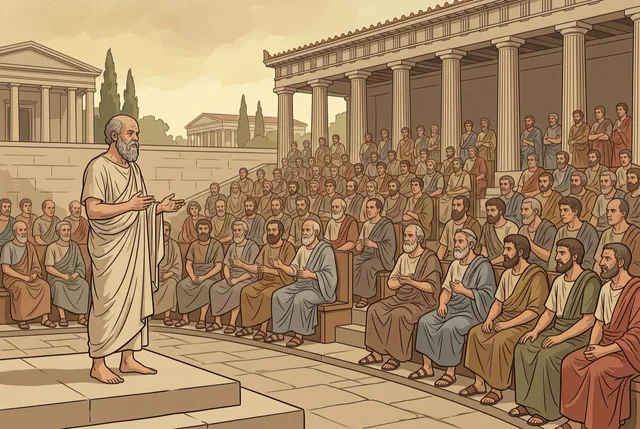
Athenian trials were not conducted before judges. Socrates faced a jury of around 500 ordinary citizens, chosen by lot, who heard both sides in a single day and voted immediately without deliberating together. There was no judge to instruct them on the law and no appeal.
Socrates did not attempt the sort of defence the court expected. Athenian defendants routinely appealed for pity, produced weeping relatives, and stressed their service to the city. According to Plato’s Apology, Socrates refused all of it. He cross-examined Meletus, restated his mission to examine the lives of his fellow citizens, and told the jury he would not stop philosophising even if they ordered him to.
He was convicted, but not overwhelmingly. Plato reports that a swing of only thirty votes would have acquitted him — suggesting a split in the region of 280 to 220.
The Penalty Phase and a Fatal Miscalculation
Athenian law in this kind of case had no fixed sentence. After conviction, prosecution and defendant each proposed a penalty and the jury chose between them. Meletus proposed death. The expected move was for Socrates to counter-propose something serious enough to look like an admission — exile, or a heavy fine.
Instead, Socrates proposed that the city reward him with free meals at public expense in the Prytaneum, an honour reserved for Olympic victors and public benefactors. Only afterwards did he offer a token fine of one mina, which his friends — Plato among them — raised to thirty.
The jury voted for death by a wider margin than it had voted to convict. Some jurors who thought him innocent appear to have been sufficiently insulted to condemn him. Whether this was principled defiance or catastrophic misjudgement is still debated; Socrates himself framed it as a refusal to beg for a life that would no longer be worth living.
Why the Verdict Still Divides Historians
Two readings compete. The traditional one, shaped by Plato, treats the trial as a moral scandal: a city in decline killing the one man honest enough to question it. The revisionist reading, argued most forcefully by I. F. Stone and developed by later scholars, treats it as an intelligible act of political self-defence by a democracy that had twice been overthrown with the help of Socrates’ associates.
Both readings agree on the uncomfortable core fact: a democratic assembly used a religious charge to remove a persistent critic. That is why the trial has never settled into history as a closed question. For the ancient sources and the scholarly debate, the Stanford Encyclopedia of Philosophy entry on Socrates is the standard starting point.
Conclusion
Socrates was executed because a jury of Athenians found him guilty of impiety and corrupting the young — charges that carried real religious weight but that almost certainly also carried the unstated political resentment of a city recovering from defeat and tyranny. His refusal to plead, and his decision to propose a public honour instead of a punishment, turned a narrow conviction into a death sentence.
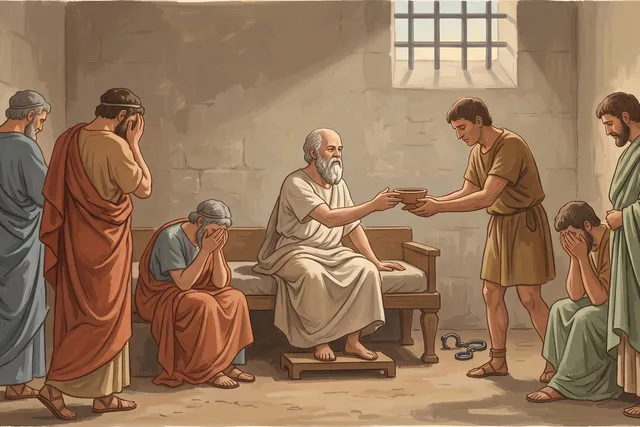
What happened next — the month-long delay, the hemlock, and the death scene that Plato made famous — is covered in our account of the death of Socrates.
Keep reading