Plato's philosophy: the main ideas
The Forms, the soul, knowledge and virtue — the arguments Plato is read for.
Plato is read, twenty-four centuries on, for a handful of arguments that refuse to die. The tripartite soul — reason, spirit and the appetitive part — is still the shape most accounts of self-control take. The Theory of Forms is still the first serious answer to what universals are, and Platonic idealism still names a live position.
The essays here take the arguments one at a time: what each claims, how Plato argues for it, and where it bends or breaks under pressure.
Where to start
If you are new to Plato, begin with who Plato was and what he wrote, then ten of his big ideas explained simply. For a single overview, read the main concepts of Plato's philosophy. To check a line you have seen attributed to him, see what Plato actually said, and what he didn't.
The Forms and reality
Plato's best-known claim is that the things we see are copies of unchanging Forms. Start with what the theory of Forms claims and where it breaks, then the Form of the Good, the highest of them. Related essays cover Platonic idealism, the Divided Line and its four levels of knowledge, what Plato thought reality is and what he meant by being.
The soul
In the Republic Plato divides the soul into three parts. Read the tripartite soul first, then each part on its own: the rational soul, the spirited soul and the appetitive soul. See also Platonic dualism of soul and body and how Plato's three parts compare with Freud's id, ego and superego.
Knowledge and belief
Plato separates knowledge from mere opinion. The essays here cover Plato's epistemology, whether knowledge is justified true belief in the Theaetetus, dialectic, aporia, the puzzlement many dialogues end in and why Plato is counted as a rationalist.
Virtue and the good life
For Plato, ethics starts with the health of the soul. Read the four cardinal virtues, what courage is, what a good life is according to Plato and eudaimonia. The Ring of Gyges asks whether anyone would stay just if they could not be caught, and the essay on evil covers the view that wrongdoing comes from ignorance.
Love, beauty and art
Platonic love as Plato described it in the Symposium is not the modern phrase. Alongside it, read what beauty is for Plato and his critique of poetry.
The cosmos
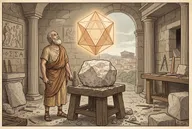
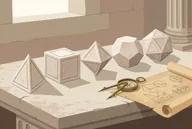
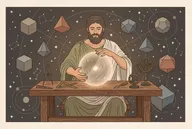
Plato's account of the physical world is in the Timaeus. Read the Demiurge, his divine craftsman, the cosmology of the Timaeus and the five Platonic solids.
Common questions
What is Plato's theory of Forms?
It is the claim that the many things we see, such as beautiful objects or just acts, are imperfect copies of single, unchanging Forms, such as Beauty itself and Justice itself. The Forms are grasped by thought, not by the senses.
What are the three parts of the soul in Plato?
Reason, spirit and appetite. In the Republic a person is just when reason rules, spirit supports it, and the appetites are kept in order.
What are the four cardinal virtues?
Wisdom, courage, temperance and justice. Plato sets them out in Book 4 of the Republic, for the city and for the individual soul.
All 82 essays in Core Ideas