The Spirited Soul in Plato: Definition, Argument and Examples
In short. The spirited soul (thymoeides) is the part of us that feels anger, shame and the love of honour. Here is how Plato argues for it, with examples.
The spirited soul is the part of us that gets angry — at injustice, at insults, and above all at ourselves. In Plato’s Republic it is one of the three parts of the soul, alongside reason and appetite. Its Greek name is to thymoeides (τὸ θυμοειδές), from thymos — the surge of anger, pride and indignation that Homer’s warriors felt in their chests.
If a summary tells you the spirited part is just “emotion”, it has undersold it. Plato’s claim is more specific: spirit is the part that loves honour, feels shame, and supplies the heat that reason on its own does not have.
Why Plato thinks spirit is a separate part
Plato has already split the soul in two by the time spirit arrives. The thirsty man who refuses to drink shows that desire and calculation can pull against each other, so appetite and reason must be different parts. The question is why anger is not simply one of the appetites, or a mood of reason.
His answer is the story of Leontius (439e–440a). Walking up from the Piraeus, Leontius saw corpses lying beside the executioner. He craved the sight, was revolted by his own craving, struggled, lost, and ran to the bodies shouting at his own eyes to take their fill.
The anger in that story cannot be appetite, because it is directed at appetite. And it cannot be reason, because it arrives hot and unbidden, without calculating anything. Something third is doing the raging. That is spirit.
Plato adds a second observation (440a–b): the more decent a person is, the less angry they get when they suffer justly — a man who knows he is in the wrong finds it hard to resent his punishment. Anger tracks a sense of justice, not raw frustration. That is why it belongs to a distinct, honour-sensitive part.
What the spirited part wants
Each part of the soul, Plato says at 580d–581a, has its own object and its own pleasure. Appetite loves money, because money buys whatever it craves next. Reason loves learning. Spirit he calls philonikon and philotimon — victory-loving and honour-loving.
So the spirited part covers more than temper:
- Indignation — the flash of anger at unfairness, to yourself or others.
- Shame — anger at yourself, when you fail your own standard.
- Ambition and competitiveness — the drive to win and be seen to win.
- The sense of dignity — the refusal to be treated as less than you are.
The common thread is standing. Spirit measures where you rank — against others, and against your own idea of yourself — and erupts when the measurement comes out wrong.
Thumos: the word before the theory
Plato did not coin thymos (often transliterated thumos); he domesticated it. In Homer, thymos is the surge in a warrior’s chest — the seat of battle-fury, grief and appetite for glory, the thing Achilles consults when deciding whether to draw his sword. It is not yet a “part” of anything; it is closer to a weather system.
Plato’s move in the Republic is to give the storm a job. The thymoeides — “the thymos-like part” — keeps Homer’s heat but is assigned a station: below reason, above appetite, and answerable to the first. Aristotle kept the term; the Stoics tried to abolish the thing itself; and when modern writers reach for “thumos” to name the politics of anger and recognition, it is Plato’s disciplined version, not Homer’s storm, they are usually reaching for.
Reason’s natural ally
Spirit’s job in the well-ordered soul is defined at 441e: it is the ally of reason. Reason decides what should be done; spirit supplies the force to hold the line when appetite argues back. Plato compares the arrangement to a shepherd and his dog (440d) — the dog is not wise, but it is loyal, brave, and fierce toward the right things.
This is why courage, in the Republic’s scheme, is the virtue of the spirited part: courage is spirit preserving, under pressure, the judgments reason has made about what is and is not to be feared (442b).
But the alliance is not guaranteed. Spirit is trainable, and it takes the side it has been trained to take. In a corrupt soul, appetite recruits it — and then you get anger in defence of greed, pride in the service of consumption, honour measured in money. Plato’s timocratic man (548c–549b) is the portrait of spirit ruling alone: a lover of victory and reputation, contemptuous of argument, secretly drifting toward wealth as he ages.
Examples of the spirited part at work
- Leontius at the corpses (439e) — spirit raging at an appetite that wins anyway.
- The wronged man who cannot let it go — indignation keeping him on the field, as Plato puts it, until he wins, dies, or is called off by reason like a dog by its shepherd (440c–d).
- Blushing at being caught — shame is spirit judging you by your own standard.
- The athlete or soldier who despises comfort — spirit overriding appetite for the sake of standing.
- A child’s tantrum at “that’s not fair” — spirit is visible in children long before reasoning matures, which Plato notes at 441a as evidence it is a distinct part.
The parallel with the city
The three parts of the soul answer to the three classes of Plato’s city. Spirit corresponds to the auxiliaries — the soldier class that enforces what the guardians decide.
| Part of the soul | Class in the city | Virtue when it does its job |
|---|---|---|
| Reason — logistikon | Guardians | Wisdom |
| Spirit — thymoeides | Auxiliaries | Courage |
| Appetite — epithymetikon | Producers | Moderation |
The politics mirror the psychology exactly: auxiliaries who serve the rulers make the city brave; auxiliaries who serve their own ambition make it a junta. Education in the Republic — the long programme of music and gymnastics in Books II–III — is aimed principally at spirit, tuning it so that it is fierce toward enemies and gentle toward its own (410d–e). Too much gymnastic and no music makes it savage; too much music makes it soft. The dog must be trained before it can be trusted.
The white horse of the Phaedrus
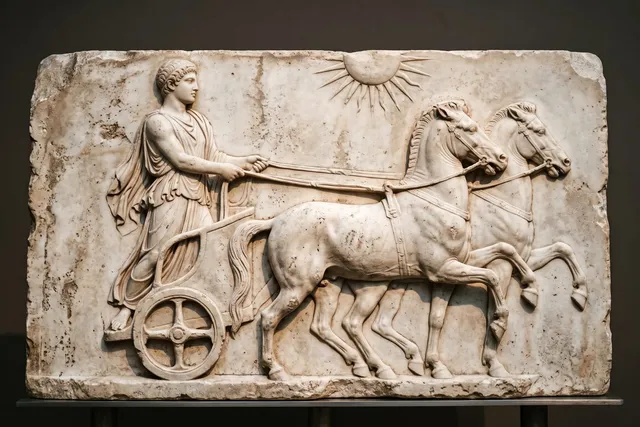
In the Phaedrus myth (253d–254e), the soul is a charioteer driving two horses. The noble white horse — “a lover of honour with modesty and self-restraint” — is spirit; the unruly black horse is appetite. It is the white horse that obeys the driver’s word alone, without the whip.
The image agrees with the Republic on the essential point: spirit is the tractable one, the part that wants to be governed by something better than itself. But the two texts do different work — the Phaedrus is a myth about love and the soul’s ascent, the Republic a formal argument about psychological conflict — and they are best not blended.
Why the idea has lasted
Strip away the chariot and the city, and Plato’s observation stands on its own: there is a motivation in us that is neither calculation nor craving — the need to count for something. Later writers keep rediscovering it under other names: honour, self-respect, dignity, recognition, status anxiety. Freud’s comparison maps it, roughly, onto the superego’s capacity for shame, though Plato’s spirit is prouder than that — it can be right when society is wrong.
What modern retellings tend to drop is Plato’s warning about training. Spirit is the swing vote of the soul. Aligned with reason it is courage; captured by appetite it is vanity with a temper. It is the one part whose allegiance is genuinely up for grabs — which is why, for Plato, education is mostly the education of spirit.
Keep reading