The Rational Soul in Plato: Definition, Argument and Examples
In short. The rational soul (logistikon) is the calculating, truth-loving part of Plato's tripartite soul — and the part meant to rule. Here is his argument, with examples.
The rational soul is the part of us that calculates, weighs, and judges — and, in Plato’s view, the part that ought to rule the rest. In the Republic it is one of the three parts of the soul, alongside spirit and appetite. Its Greek name is to logistikon (τὸ λογιστικόν), from logismos, “calculation” or “reasoning”.
Two things about Plato’s account surprise people. First, reason is not a neutral calculator: it has a desire of its own. Second, its claim to rule is an argument, not an assumption — and the argument starts with a man who is thirsty.
Where the rational part shows itself
Plato’s case for dividing the soul begins at 439c with a familiar experience: a thirsty man who refuses to drink, because the water is foul or forbidden. Something in him reaches for the water. Something else — weighing consequences, counting costs — holds him back. Since one thing cannot push and pull in the same respect at once, these must be different parts.
The part that holds back is the rational part. Notice what it is doing in the example: not contemplating eternal truths, just calculating — this water, this risk, this outcome. That is the logistikon’s day job, and it is why Plato names it after arithmetic rather than wisdom. Reasoning about what to do is the same faculty, for Plato, as reasoning about what is true.
Reason has its own desire
The tidy version of the tripartite soul makes reason the referee between two rival desires. Plato’s version is stranger and better: at 580d–581a he says each part has its own object and its own pleasure. Appetite is money-loving. Spirit is honour-loving. Reason is philomathes and philosophon — learning-loving and wisdom-loving.
Reason, in other words, is not the absence of desire but a third desire: the craving to know how things actually are. The philosopher is simply the person in whom this appetite is the strongest one. This is why Plato was a rationalist of a peculiarly erotic kind — in his account, truth is not merely assented to; it is wanted.
That desire has an object worthy of it: the unchanging realities Plato calls the Forms. In the Phaedo (79d) he says that when the soul investigates through the senses it is dragged about and dizzy, but when it examines the invariable by itself, it steadies. Calculation, pursued far enough, turns into contemplation.
Why reason should rule
Plato’s argument for reason’s rule (441e–442c) is not that reason is strongest — it plainly is not; it is the smallest force in most souls, as the smallest class rules his city. The argument is about competence and scope:
- Reason is the only part that can consider the good of the whole soul. Appetite wants its object; spirit wants its standing; only reason can ask what is good for all three together.
- Reason is the only part that can be right or wrong. Desires can be stronger or weaker; only judgments can be true or false. A soul steered by anything else is steered by something that cannot even in principle know where it is going.
Rule, here, does not mean suppression. The just soul is a settlement, not an occupation: appetite fed what it needs, spirit enlisted as reason’s ally, and each part doing its own work. Wisdom is the virtue of the rational part precisely when it governs on behalf of the others (442c).
The political mirror is exact: reason answers to the guardians, and its rule in the soul is what the philosopher king is in the city — the knowing minority governing for the good of the whole.
Examples of the rational part at work
- The thirsty man who does not drink (439c) — calculation overriding craving.
- Sleeping on a decision — at 571d–572a Plato describes the man who settles his appetites and his temper before sleep so that the reasoning part, alone and undisturbed, can reach out toward what it does not yet know. Even our dreams, he thinks, are better when reason has been put in charge of the evening.
- Wanting the argument to be sound more than you want to win it — the moment truth-love outweighs honour-love, reason is ruling spirit.
- The budget, the diet, the training plan — small acts of legislation by the part that can see the whole.
The charioteer of the Phaedrus
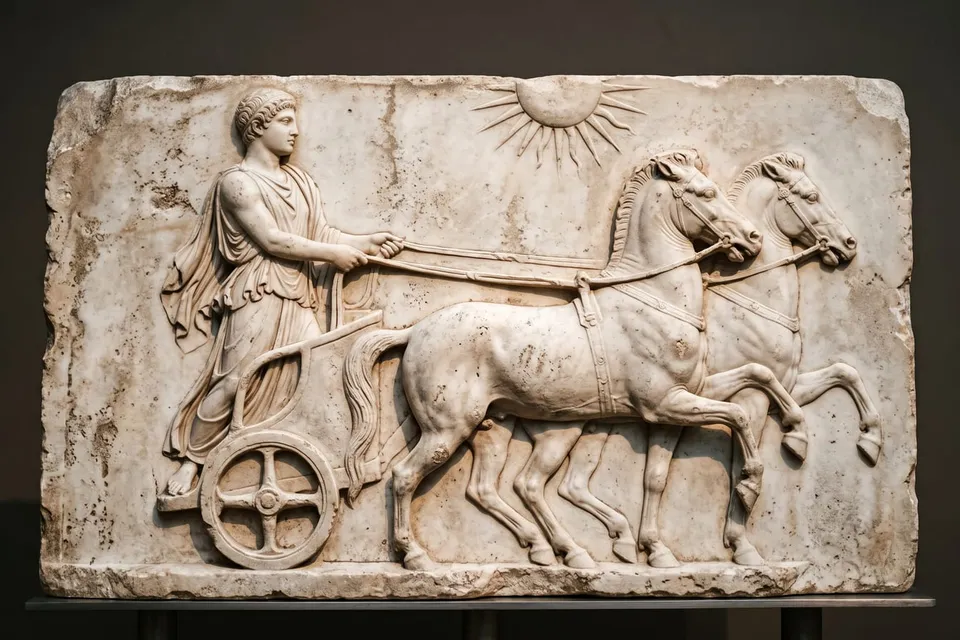
In the Phaedrus myth (246a, 253d–254e) the soul is a charioteer driving a noble white horse and an unruly black one. The charioteer is reason; the horses are spirit and appetite. The image adds something the Republic’s argument keeps quiet: the driver does not merely manage the horses — he is trying to get somewhere, upward, toward a vision of the real. Rule and aspiration are the same activity seen from two sides.
The myth and the argument should still be kept distinct. The Phaedrus is about love and the soul’s flight; the Republic’s tripartition is the conclusion of a formal argument about inner conflict. But on reason they agree: it is the part with the destination.
Is the rational soul immortal?
Plato hints, at 611e–612a, that tripartition may be the soul’s condition only in this life — that the soul as it truly is, seen “like the sea-god Glaucus” beneath the barnacles, may be simple rather than composite. In the Timaeus the rational part alone is made immortal by the craftsman god, and housed in the head. The suggestion is consistent across the dialogues: what is deathless in us, if anything is, is the part that knows.
Why the idea has lasted
Every later picture of self-governance keeps Plato’s shape: a part that sees furthest placed in charge of parts that push harder. What the modern versions usually drop is his most distinctive claim — that reason is itself a passion. Cool deliberation and the hunger to understand are, for Plato, one faculty. A person is well-ordered not when they have subdued their desires but when their strongest desire is for the truth; everything else in his psychology, and most of his politics, follows from that.
Keep reading