Plato's Philosophy for Beginners: 10 Big Ideas, Explained Simply
In short. New to Plato? The ten ideas that matter most — the Forms, the Cave, the soul, Platonic love and more — each explained in plain language, with links to go deeper.
You do not need a philosophy degree to read Plato. He wrote dialogues — conversations, arguments, the occasional insult — precisely because he wanted his ideas tested in public rather than filed away for specialists. But twenty-four centuries of commentary have buried the entrance, and most beginners meet Plato as a list of intimidating technical terms.
This guide is the entrance. Ten ideas, each explained simply, each with a link to a fuller treatment when you want more. If you’d like the life story first — Athens, Socrates, the failed adventures in Sicily — start with our complete introduction to Plato and come back.
1. The Theory of Forms
Plato’s central idea is that the world you can see is not the most real thing there is. Every beautiful thing fades; beauty itself does not. Every drawn triangle is slightly crooked; the triangle of geometry is perfect. Plato concluded that these perfect versions — the Forms — are the true objects of knowledge, and the changing world around us is something closer to their shadow.
That sounds mystical until you notice you already believe a version of it every time you do mathematics. For the full argument, its strengths and its famous problems, see how to understand Plato’s Theory of Forms.
2. The Allegory of the Cave
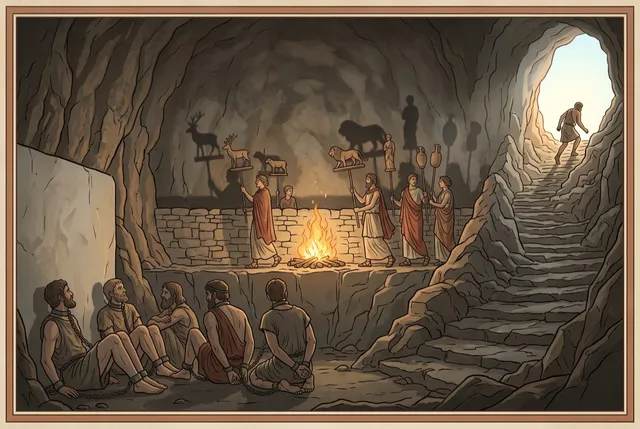
Plato’s most famous image. Prisoners are chained in a cave, watching shadows on a wall, convinced the shadows are the whole of reality. One prisoner is freed, drags himself into daylight, and discovers the world the shadows were only copies of. When he returns to tell the others, they think he has gone mad.
It is a story about education, about ignorance, and about what it costs to know better than the people around you. We walk through the whole allegory — the fire, the shadows, the painful ascent — in how to interpret the Allegory of the Cave, and its machinery repays close attention: even the fire has a specific meaning.
3. The Tripartite Soul
Why do you want the second slice of cake and simultaneously want not to want it? Plato’s answer: the soul is not one thing. It has three parts — reason, which calculates and seeks truth; spirit, which feels anger, pride and shame; and appetite, which wants food, drink, money and pleasure. A good life is one where reason governs, spirit backs it up, and appetite is kept on a sensible leash.
It is the West’s first serious psychology, and it maps surprisingly well onto arguments people still have about the mind. Start with the key concepts of the tripartite soul, and see the appetitive soul for the part that wants the cake.
4. The Socratic Method
Plato’s teacher Socrates wrote nothing. What he did instead was ask questions — patiently, relentlessly, in the marketplace, until the person who claimed to know what courage or justice was discovered they could not say. That questioning technique, preserved in Plato’s dialogues, is the Socratic method: truth pursued by examination rather than lecture.
It is still how good law schools, good therapists and good editors work. See the Socratic method in Plato’s dialogues.
5. Platonic Love
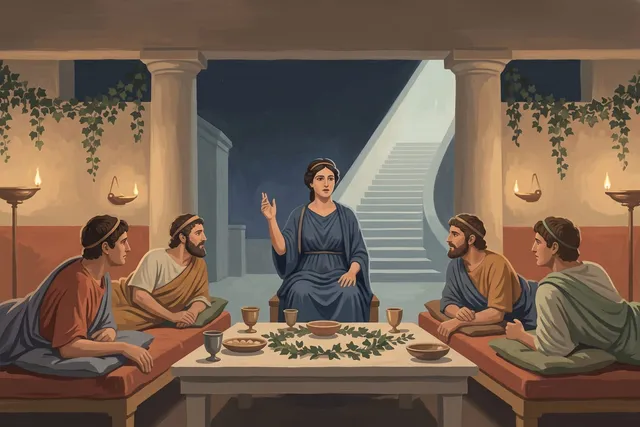
The phrase has come to mean “friendship without romance,” which would have surprised Plato. In the Symposium, love is a ladder: it begins with attraction to one beautiful person and climbs — rung by rung — toward love of beauty itself, the Form. Desire is not the enemy of wisdom; properly aimed, it is the engine of it.
What Plato actually said is stranger and better than the modern phrase. See Platonic love: what Plato actually said in the Symposium, and for the full drama of that famous dinner party, all seven speeches of the Symposium.
6. Knowledge as Recollection
In the Meno, Socrates takes an uneducated enslaved boy and, by questions alone, leads him to a geometric proof. Plato’s startling conclusion: the boy did not learn the answer — he remembered it. On this view the soul already knows the deepest truths, and education is not filling a bucket but turning the soul around so it can recollect what it knew.
Whatever you make of the metaphysics, the pedagogical idea — that understanding must be drawn out, not poured in — never went away. See Plato’s theory of recollection in the Meno.
7. The Philosopher King
Plato’s most provocative political claim: cities will not be well governed until rulers become philosophers or philosophers become rulers. Not because philosophers are pleasant company, but because ruling well requires knowing what justice actually is — and that knowledge, like all knowledge, is hard-won and rare.
Democracies have been arguing with him ever since. See what is a philosopher king, and for Plato’s uncomfortable verdict on rule by the people, what democracy meant to Plato.
8. Justice and the Just City
The Republic — Plato’s masterpiece — opens with a simple question: why be just, if injustice pays? To answer it, Plato builds an entire imaginary city, on the theory that justice is easier to read in large letters. The city has three classes; the soul has three parts; justice, in both, is each part doing its own work in harmony.
It is the most influential thought experiment in Western political philosophy. See why the Republic is a key work — and when you’re ready to read it yourself, here is why you should.
9. The Euthyphro Dilemma
A young man prosecuting his own father for murder assures Socrates he knows exactly what piety is: what the gods love. Socrates asks the question that has never stopped echoing: do the gods love it because it is good, or is it good because the gods love it? If the first, goodness stands above the gods. If the second, goodness is arbitrary.
Every philosophy of religion course still starts here. See Plato’s Euthyphro dilemma.
10. The Immortal Soul and the Myth of Er
Plato closes the Republic not with an argument but with a story: a soldier named Er dies in battle, tours the afterlife, and returns to report. Souls are judged, rewarded or punished — and then choose their next lives, with all the wisdom or foolishness they accumulated last time. The choice, Plato says, is where everything is at stake.
It is his final answer to why justice matters even when no one is watching. See how the Myth of Er shapes views on free will and destiny.
Where to Go Next
Ten ideas are a map, not the territory. If this has made you want to read Plato himself — and it should — the dialogues are more readable than their reputation suggests, provided you start in the right place. We’ve laid out exactly that path in what to read first: Plato’s dialogues in order for beginners.
And if you want the ideas surveyed more fully before committing to the books, see our roundup of Plato’s key philosophical ideas.
Keep reading