The Four Cardinal Virtues: Wisdom, Courage, Temperance and Justice
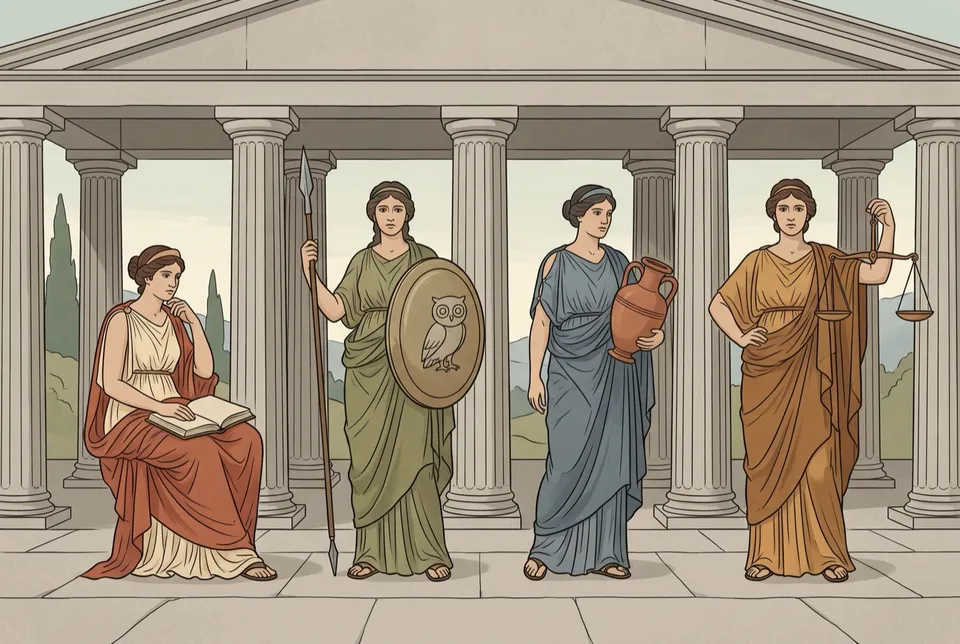
In short. The four cardinal virtues are prudence (wisdom), courage, temperance and justice. They come from Plato's Republic and were later adopted by Christian thought.
The four cardinal virtues are prudence (or wisdom), courage (or fortitude), temperance (or moderation) and justice. They are called “cardinal” from the Latin cardo, meaning hinge, because every other moral virtue was thought to turn on them.
The name is Latin and Christian, but the list is Greek. It first appears as a complete set in Plato’s Republic, Book 4, written around 375 BC, where Socrates uses the four to define a good city and a good soul. From Plato the list passed to the Stoics, to Cicero, to the Church Fathers and to Thomas Aquinas, and it still appears in the Catechism of the Catholic Church today.
What are the four cardinal virtues?
| Virtue | Greek | Plato’s definition | Part of the soul | Class in the city |
|---|---|---|---|---|
| Wisdom (prudence) | sophia (later phronēsis) | Knowledge of what is good for the whole | Reason | The rulers |
| Courage (fortitude) | andreia | Holding on to right belief about what is and is not to be feared | Spirit | The auxiliaries (soldiers) |
| Temperance (moderation) | sōphrosynē | Agreement among all the parts about who should rule | All three parts together | All three classes together |
| Justice | dikaiosynē | Each part doing its own work and not meddling in the work of others | All three parts, each in its place | All three classes, each in its place |
In everyday Catholic teaching the order is usually prudence, justice, fortitude, temperance. Plato’s own order in the Republic is wisdom, courage, moderation, justice, because he finds justice last.
Where do the cardinal virtues come from?
They come from Plato’s Republic. By Book 4, Socrates and his companions have designed an ideal city with three classes: rulers who govern, auxiliaries who defend, and producers (farmers, craftsmen, traders) who supply its needs. (For the wider argument, see our summary of the Republic and our guide to Book 4.)
Socrates then proposes a method. If the city is completely good, it must be wise, courageous, moderate and just (427e). Find the first three, and whatever remains will be justice. It is a search by elimination, and it runs as follows.
Wisdom: the knowledge of the rulers
The city is wise not because of its carpenters or farmers, who know their own trades, but because of the small group of rulers who have good judgement about the city as a whole (428b–429a). Wisdom lives in the smallest class, yet it makes the whole city wise.
Courage: holding on to right belief
The city is brave because of its soldiers. Plato defines courage as a kind of preservation: keeping, through pleasure, pain, fear and desire, the correct belief that education has instilled about what is truly to be feared and what is not (429b–430c). He compares it to dyed wool. If the wool is prepared properly, the colour holds fast and does not wash out. Good education works the same way, so that the belief survives under pressure. (For more, see what is courage for Plato.)
Temperance: agreement about who should rule
Moderation is different from the first two. It does not sit in one class. It is a kind of order and mastery over pleasures and desires (430e), and in a city it is an agreement, shared by rulers and ruled, about who ought to rule (431d–432a). Plato compares it to a musical harmony that runs through the whole scale, from the lowest note to the highest. Temperance is not one class being disciplined. It is the whole city being of one mind.
Justice: each part doing its own work
Having found three virtues, Socrates realises that justice has been in front of them the whole time. From the start they had agreed that each person should do the one job they are naturally suited for. Justice is “doing one’s own” and not meddling in the work of others (433a–b). Injustice is when the classes swap roles or interfere with each other, for example when a trader who has grown rich tries to rule.
How do the cardinal virtues apply to the soul?
This is where the scheme becomes philosophy rather than political design. Plato argues that the soul has the same three parts as the city: reason, which calculates and knows; spirit (thumos), which feels anger, pride and the urge to fight; and appetite, which wants food, drink, sex and money. (See the tripartite soul in Plato’s philosophy.)
The four virtues then map onto the individual (441c–442d):
- A person is wise when reason rules, knowing what is good for each part and for the whole.
- A person is courageous when spirit holds on to what reason has declared worth fearing, whatever pleasures or pains get in the way (442c).
- A person is temperate when all three parts are friends and agree that reason should lead.
- A person is just when each part does its own work: reason rules, spirit supports it, appetite obeys.
The result is striking. Justice is no longer mainly a set of rules about how to treat other people. It is an inner condition, the right order of the soul. Plato calls justice the soul’s health and injustice its disease (444d). That is how he answers the challenge that drives the whole Republic: why be just if you could get away with injustice? Because injustice is a sickness of the self, and nobody wants to be sick.
Did Plato mention the four virtues elsewhere?
Yes. The four were not invented in the Republic alone. They appear together in other dialogues, which suggests they were already a familiar set in Plato’s Athens.
- In the Phaedo (69b–c), Socrates contrasts true virtue with a trade of one pleasure for another. Real moderation, justice and courage come with wisdom, which he calls a kind of purification.
- In the Laws (631c–d), Plato ranks the “divine goods”. Wisdom comes first, then a moderate state of soul joined with reason, then justice, which mixes these with courage, and courage fourth. The ranking shows that for Plato wisdom leads the rest.
- In the Protagoras, the list includes a fifth virtue, piety, and Socrates asks whether the virtues are really separate or somehow one thing (see below).
Other dialogues take on single virtues: the Laches on courage, the Charmides on temperance (see Plato’s Charmides), and the Republic as a whole on justice.
Why are they called “cardinal”?
The word is not in Plato. It comes from the Latin cardo, the hinge of a door, and describes the four as the virtues on which the moral life turns. The same root gives us the “cardinal points” of the compass and the cardinals of the Catholic Church.
The first writer to call them cardinal virtues is usually credited as Ambrose, the fourth-century bishop of Milan, in his commentary on Luke’s Gospel. By then Christian writers had already accepted the list, because it had come to them through Latin philosophy and even appears in the Bible: the Book of Wisdom, a Greek-speaking Jewish text, says that Wisdom teaches temperance, prudence, justice and fortitude (Wisdom 8:7).
How did the cardinal virtues pass to the Stoics and Cicero?
The Stoics, founded by Zeno of Citium around 300 BC, made the four the primary virtues from which all others derive. They also held that anyone who truly has one has them all, since each is a form of knowledge. (See Plato’s influence on Stoicism.)
Cicero, writing in Latin in the first century BC, gave the virtues the names the West still uses. In De Officiis (On Duties), Book 1, he divides what is morally good into four sources: wisdom and the search for truth, justice, greatness of spirit, and the sense of order and restraint that he calls decorum. Latin writers settled on prudentia, iustitia, fortitudo and temperantia, which is why English speaks of “prudence” and “fortitude” rather than wisdom and courage.
What do the cardinal virtues mean in Christianity?
Christian thinkers took over the four and added three more. Augustine described the four virtues as forms of love directed to God. Thomas Aquinas, in the Summa Theologiae, treats the cardinal virtues alongside the three theological virtues of faith, hope and charity (from 1 Corinthians 13:13). The difference in the scheme is in the source: the cardinal virtues can be acquired by practice and education, as Plato thought, while the theological virtues are given by God’s grace and have God as their object. Together they make the seven virtues of Christian tradition.
The Catechism of the Catholic Church keeps the scheme. It explains that four human virtues play a “pivotal role” and are therefore called cardinal, quoting the Book of Wisdom (1805), and then gives one paragraph each to prudence, justice, fortitude and temperance (1806–1809). The theological virtues follow (1812–1829).
One thing changes along the way. For Plato there are four virtues because the soul has three parts and the city three classes: the number follows from his psychology. By the time the list reaches Aquinas, it is inherited from tradition and supported in new ways. The list survived; its original argument became optional.
Are the virtues separate, or all one thing?
This is the question of the unity of the virtues, and it begins in the Protagoras. Socrates asks the famous sophist whether justice, moderation, piety, courage and wisdom are like the parts of a face, each different, or like pieces of gold, all the same stuff (329c–d). Protagoras says they are distinct, and that a man can be brave without being wise. Socrates argues that they all come down to knowledge, especially knowledge of good and bad.
This links to the Socratic paradox that no one does wrong willingly: if virtue is knowledge, then vice is a kind of ignorance. The Republic softens this with its divided soul, since appetite can overrule reason, but it keeps the core idea. The virtues depend on each other. Courage without wisdom is just recklessness, and temperance without justice is only timidity. The Stoics, and later Aquinas, held a version of the same view: the virtues are connected, and prudence guides the rest.
Why do the cardinal virtues still matter?
The four are still used far outside philosophy classes. Catholic schools and catechesis teach them directly. Character education programmes in the US and UK often build lessons around wisdom, courage, self-control and fairness, sometimes naming the classical source and sometimes not. Modern virtue ethics, which revived in the late twentieth century, usually follows Aristotle’s longer list, but the four remain its familiar core.
What makes Plato’s version worth reading is the claim underneath the list. A good life is not a collection of good behaviours but an ordered self: reason that knows, spirit that holds firm, desires that agree to be led. On that view, the virtues rise and fall together, and a person who has only some of them does not have them fully at all. For more on the kind of life this produces, see what is a good life according to Plato.
Keep reading