Who Was Protagoras? The First Sophist and Plato's Great Rival
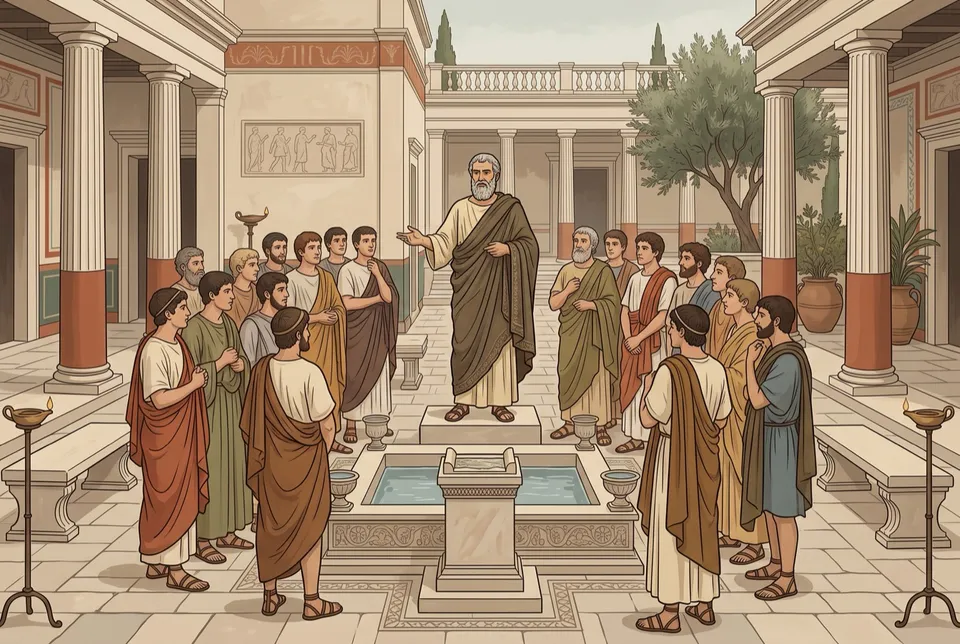
In short. Protagoras of Abdera (c. 490-420 BC) was the first sophist, a paid teacher of virtue and rhetoric, famous for saying man is the measure of all things.
Protagoras of Abdera (c. 490 to c. 420 BC) was the first person to call himself a sophist, a paid teacher of aretē, meaning excellence or virtue, and of the public speaking that let a citizen succeed in the law courts and the assembly of a Greek city-state. He is remembered above all for one line, “man is the measure of all things,” and for being the sophist Plato treats as Socrates’ most serious opponent. In the dialogue named after him, the Protagoras, he comes across not as a charlatan but as a formidable, likeable rival.
Almost nothing Protagoras wrote survives. What we know of him comes from a handful of genuine fragments, quoted by later writers, and from reports, some reliable and some clearly embellished, written long after his death. Plato’s portrait, written decades after Protagoras died, is itself somewhere between history and dramatised argument, and this essay tries to keep the two apart.
What do we actually know about his life?
The outline is thin but widely agreed. Protagoras came from Abdera, a Greek city on the coast of Thrace, and he made a career of travelling between Greek cities, most often Athens, teaching young men for a fee that was, by all accounts, considerable. He was a public figure in the Athens of Pericles, close enough to the city’s leading statesman that later writers link the two men, and the philosopher and historian Heraclides of Pontus reports that Protagoras was asked to draft the law code for Thurii, a new Athenian-sponsored colony in southern Italy founded around 444 BC (a report preserved in Diogenes Laertius, IX.50–55). Diogenes also passes on the tradition that Protagoras was later prosecuted at Athens for impiety over his writing on the gods, that his books were burned in the marketplace, and that he was expelled from the city, dying at sea on his way out. These later details are much less secure than the outline of his career: they appear only in sources written centuries after his death, they read like the kind of morality tale later writers liked to attach to controversial thinkers, and no contemporary source confirms them, so they are worth repeating only with that warning attached.
What is a sophist?
In fifth-century Greece a sophist (sophistēs, from sophos, wise) was simply a professional teacher of wisdom or skill, usually rhetoric and practical judgement, who charged fees. It was not yet an insult. Protagoras seems to have been proud of the title and, according to Plato, the first person to use it of himself openly, where earlier teachers had worked under some other cover (Protagoras 317b). The word only curdled into its modern sense, someone who argues cleverly for whatever position pays, partly because of how Plato and Aristotle wrote about sophists after Protagoras’s generation, and partly because a real skill, teaching people to argue both sides of a case, is easy to caricature as teaching people to deceive.
The “man is the measure” fragment
The one line of Protagoras everyone still quotes is a genuine fragment, catalogued as DK 80 B1: “Of all things the measure is man, of the things that are, that they are, and of the things that are not, that they are not.” Stripped of the archaic phrasing, the claim is that there is no truth about how things are independent of how they appear to some perceiver. If the wind feels cold to me and warm to you, Protagoras is reported to have said, then it simply is cold for me and warm for you: there is no further fact about the wind’s real temperature that could show one of us wrong.
This is a form of relativism: the view that truth, or at least truth about many matters, is relative to the person judging, not fixed and the same for everyone. It is easy to state and hard to hold consistently, and Plato spends much of the Theaetetus working out exactly why.
Plato’s critique in the Theaetetus
The Theaetetus takes up Protagoras’s doctrine seriously, starting from Socrates’ attempt to connect it to the claim that knowledge is perception (152a onward). Socrates develops the position sympathetically for a while, even staging an imagined defence speech on Protagoras’s behalf, before turning to what has become the most famous objection to relativism of this kind: the self-refutation argument.
The argument, given at 171a–c, runs roughly like this. If truth is whatever each person believes, then the belief of people who think Protagoras is wrong, that there is objective truth independent of any individual, must also be true, for them. But then Protagoras’s own doctrine, that “man is the measure,” is false for everyone who believes it is false, which includes most people most of the time. A theory that has to admit its own falsehood, for the majority of people who reject it, looks self-undermining. Whether this argument actually finishes off every version of relativism is still debated by philosophers, but it has shaped the discussion ever since Plato wrote it.
What did Protagoras say about the gods?
A second genuine fragment, DK 80 B4, concerns religion: “Concerning the gods, I cannot know either that they exist or that they do not exist, nor what they are like in form, for there is much that prevents knowledge: the obscurity of the subject and the shortness of human life.” This is agnosticism, a careful statement that the question cannot be settled, not the flat denial of the gods that later, hostile writers sometimes attribute to him. It is this fragment, more than anything else, that is said to lie behind the later story of his prosecution for impiety, though, as noted above, that story itself rests on shaky, late evidence.
Inside the dialogue: the Protagoras
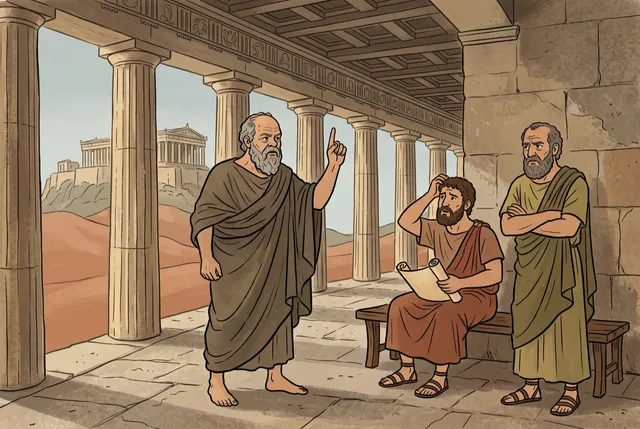
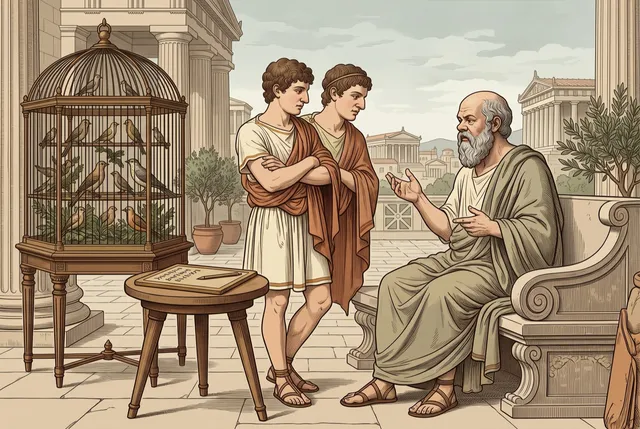
Plato’s Protagoras is set at the house of the wealthy Athenian Callias, where Protagoras is staying along with several other visiting sophists, and the young Athenian Hippocrates has dragged Socrates along before dawn to meet him. The dialogue’s centrepiece is Protagoras’s Great Speech, in which he answers Socrates’ challenge, can virtue be taught, with a long myth about Prometheus and his brother Epimetheus (320c–328d). Epimetheus, tasked with giving out qualities to the animals, uses them all up before reaching humans, leaving people physically defenceless; Prometheus steals technical skill from the gods to compensate, but people still cannot live together in cities until Zeus sends Hermes to distribute a sense of justice and shame to everyone alike, not just to specialists. Protagoras draws the moral that everyone already has some grasp of political virtue, which is why every citizen is allowed a say in the assembly, and that his own teaching only improves on that shared foundation, the way a teacher improves a student who already has some natural aptitude.
The rest of the dialogue is a tense argument, sometimes almost breaking down over Protagoras’s long-windedness and Socrates’ relentless questioning, about whether the virtues, courage, justice, wisdom, temperance, piety, are really one thing under different names or genuinely separate qualities, and it folds in the akrasia argument covered in our essay on the Socratic paradoxes, where Socrates argues that no one knowingly chooses the worse over the better. By the dialogue’s close, the two men have strikingly swapped ground: Protagoras, who began by insisting virtue can be taught, ends up arguing it might not reduce to teachable knowledge at all, while Socrates, who began by doubting virtue is teachable, ends up defending the very position, that virtue is knowledge, that would make it teachable (361a–c). Plato leaves the reversal unresolved, a deliberate irony rather than a straightforward victory for either man.
“Making the weaker argument the stronger”
Aristotle, writing decades later in the Rhetoric, attributes to Protagoras the boast of “making the weaker argument the stronger” (II.24, 1402a), meaning the ability to argue convincingly for the less obviously true side of a case. Aristotle is not impressed: he says the technique trades on probability that is only apparent, not real, and that people were right to object to Protagoras’s promise. The same phrase became, in comedy and in hostile retellings, shorthand for everything people distrusted about sophistry: the idea that a clever enough speaker could make injustice look like justice. Whether Protagoras meant it as a piece of practical rhetorical training or his critics turned an ordinary teaching claim into an accusation is hard to say from this distance.
Protagoras at a glance
| Question | Answer |
|---|---|
| Dates | c. 490 to c. 420 BC |
| Home city | Abdera, in Thrace |
| Known for | First self-declared sophist; “man is the measure of all things” |
| Genuine fragments | DK 80 B1 (man-measure), DK 80 B4 (on the gods) |
| Key Plato dialogues | Protagoras, Theaetetus |
| Plato’s main objection | The self-refutation argument, Theaetetus 171a–c |
| Later, less certain reports | Laws for Thurii; books burned; expelled from Athens (Diogenes Laertius) |
Why Protagoras still matters
Protagoras is worth reading today because the question he raised has never closed. Is truth, at least about matters of value and perception, something fixed and the same for everyone, or does it depend on the standpoint of the person judging? Modern arguments about cultural relativism, about whether moral claims can be objectively true or only true relative to a culture or an individual, are descendants of the same debate Plato staged in the Theaetetus nearly 2,400 years ago. Protagoras lost that debate in Plato’s telling, or at least Plato thought he had shown why the doctrine undoes itself. But the appeal of the underlying idea, that each of us is, in some sense, the measure of how things seem to us, has outlived every refutation aimed at it. The Socratic method that Plato used to test that idea, question by question, is itself partly a response to sophists like Protagoras: a way of checking whether a claim can survive scrutiny, rather than simply accepting that everyone’s view is equally true because they hold it.
Keep reading