Who Were the Sophists? Ancient Greece's First Paid Teachers
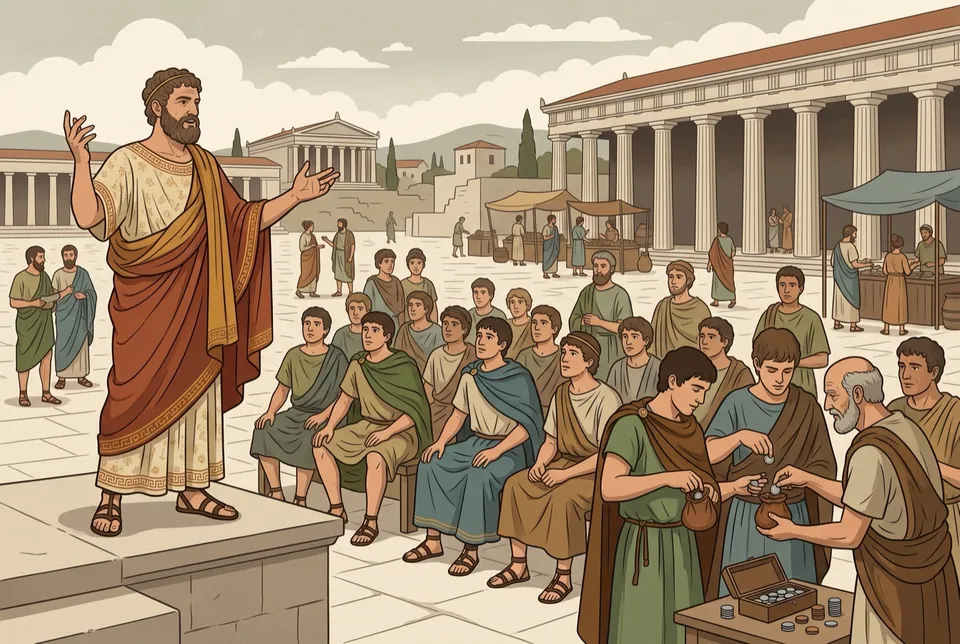
In short. The sophists were travelling professional teachers in 5th-century Greece who charged fees for rhetoric and virtue. Who they were and why Plato opposed them.
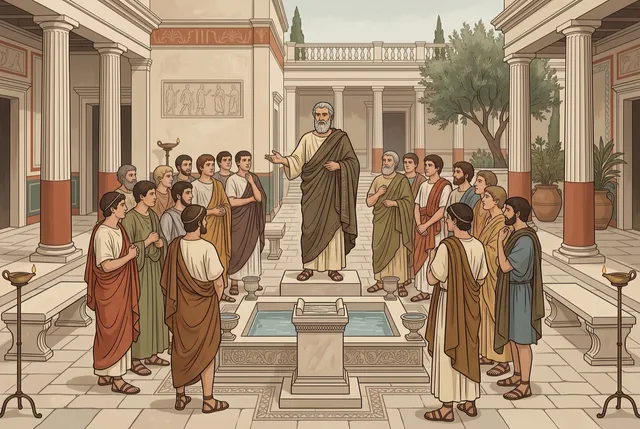
The sophists were itinerant professional teachers in fifth-century BC Greece who charged fees to teach rhetoric, argument, and aretē, the practical excellence or virtue that let a citizen succeed in the law courts and the political assembly. They were not a school or a shared doctrine, just a profession: men who travelled between cities, Athens above all, offering to teach for money what no one before them had openly sold. Plato turned their name into an insult that has stuck for over two thousand years, so that “sophistry” now means clever, dishonest argument rather than simply paid teaching. This essay tries to recover who the sophists actually were before Plato got to them, and then explains why he fought them so hard.
What does “sophist” actually mean?
The Greek word sophistēs comes from sophos, meaning wise or skilled, and originally meant something close to “expert” or “professor of wisdom.” It carried no negative charge at all. Protagoras of Abdera is usually credited as the first person to accept the label openly, where earlier wise men had preferred vaguer titles (Protagoras 317b). A sophist, in his own time, was simply someone skilled enough in a subject, and confident enough in that skill, to teach it for a fee.
Why did the sophists appear in fifth-century Athens?
The sophists were a product of Athenian democracy, not a coincidence alongside it. After the reforms that opened the assembly and the law courts to ordinary male citizens, the single most valuable skill in the city became the ability to speak persuasively in public. A man who could argue his own case well in court, or carry an argument in the assembly, had a real advantage over one who could not, and Athens had no public schools to teach that skill. Into that gap stepped travelling professionals who promised, for a fee, to teach exactly the kind of political and rhetorical competence democracy now rewarded. Protagoras described his own subject plainly as “good counsel in one’s own affairs… and in the affairs of the city” (Protagoras 318e), which is as good a one-line summary of the sophistic curriculum as any ancient source gives.
Who were the major sophists?
No single sophist agreed with all the others on everything, but a handful of names recur across the sources and across Plato’s dialogues.
| Sophist | City | Known for |
|---|---|---|
| Protagoras of Abdera | Abdera, Thrace | “Man is the measure of all things”; relativism; teaching civic virtue |
| Gorgias of Leontini | Leontini, Sicily | Master of rhetorical style; On Not-Being; the Encomium of Helen |
| Prodicus of Ceos | Ceos | Precise distinctions between near-synonyms; the myth of the Choice of Heracles |
| Hippias of Elis | Elis | Polymath, claimed expertise across many subjects, from astronomy to memory technique |
| Thrasymachus of Chalcedon | Chalcedon | “Justice is the advantage of the stronger” (Republic 338c) |
| Antiphon | Athens | Nomos versus physis; law as convention against a harsher natural self-interest |
Protagoras is treated at length in our essay on his life and thought, so this section sketches the others.
Gorgias of Leontini was less a teacher of virtue than a virtuoso of style, famous for short, rhythmic, sound-patterned prose that Athenians had never heard before. He held that persuasion was the supreme art, because whoever can persuade effectively holds power over those who merely know (Gorgias 452e). His surviving showpiece, the Encomium of Helen, is a display speech defending Helen of Troy against the charge of causing the Trojan War, arguing that speech itself has a kind of power close to compulsion over the soul. A separate work, usually called On Not-Being or On Nature, argued in three steps that nothing exists, that if anything did exist it could not be known, and that if it could be known it could not be communicated to another person: less a sincere metaphysical claim than a demonstration of how far rhetorical skill could be pushed. Our essay on Plato’s Gorgias covers the dialogue Plato built around him.
Prodicus of Ceos specialised in the precise meaning of words, insisting that near-synonyms are never really identical and that careful argument depends on drawing those distinctions correctly, an approach ancient sources treat as an early form of what we would now call semantics or lexicography. He is also credited with a moral fable, the Choice of Heracles, in which the young hero meets two women, Virtue and Vice, each arguing for a different way of life, and chooses the harder path of virtue over the easy path of pleasure. Xenophon preserves the fable in his own writing on Socrates, and it became one of the most retold moral allegories of the ancient world.
Hippias of Elis was the polymath of the group, claiming expert knowledge across an unusually wide range of fields, mathematics, astronomy, genealogy, poetry, and memory technique among them, and boasting that he had once arrived at the Olympic games wearing nothing he had not made himself. Plato gives him two dialogues, the Hippias Major and Hippias Minor, both of which portray him as supremely confident and not especially deep.
Thrasymachus of Chalcedon appears as the aggressive antagonist of Book 1 of Plato’s Republic, bursting into the conversation to declare that justice is nothing but the advantage of the stronger party, and that the rules called “just” are simply whatever serves whoever holds power (338c). His full case, and Socrates’ answer to it, is covered in our essay on Thrasymachus.
Antiphon is a harder figure to pin down, since ancient sources disagree about whether the sophist Antiphon and the Athenian orator and oligarch of the same name were one person or two. What survives of his writing argues that the demands of law, or nomos, and the demands of nature, or physis, often conflict, and that a person who could break the law without being caught would, by nature, gain an advantage that obedience to law denies him. That argument is one of the clearest surviving statements of a debate that ran through the whole sophistic movement.
What is the nomos-physis debate?
Much sophistic thought turns on a single distinction: nomos, meaning law, custom, or convention, against physis, meaning nature. Is justice, or any other moral rule, something built into the natural order, the way gravity or growth are, or is it simply a human agreement, a convention that could in principle be otherwise and that different cities in fact do handle differently? Most sophists leaned toward the second answer, and some pushed it further than Plato could accept: in the Gorgias, the character Callias argues that laws restraining the strong are a device invented by the weak to hold the strong back, a conclusion Plato treats as the sophistic movement’s most dangerous idea. The nomos-physis debate is also, in effect, the ancient ancestor of later arguments about moral relativism versus moral realism, whether right and wrong are discovered or agreed upon.
What did the sophists actually teach?
Setting doctrine aside, the sophists had a shared curriculum: rhetoric, the technique of persuasive public speaking; the ability to argue both sides of a question with equal skill, a training exercise meant to sharpen judgement but easily mistaken for teaching dishonesty; and, for Protagoras at least, a broader claim to teach civic virtue itself, the judgement that makes someone a capable citizen. Aristotle later attributes to Protagoras the boast of “making the weaker argument the stronger” (Rhetoric II.24, 1402a), meaning the ability to argue convincingly for the less obviously true side of a dispute. Aristotle is unimpressed, and that phrase became, in the mouths of hostile writers, shorthand for everything people distrusted about the whole profession.
Why did Plato oppose the sophists?
Plato’s objections run on several tracks at once, and they are worth separating.
First, the fee itself. Socrates in the dialogues repeatedly draws attention to the fact that sophists charge money for teaching virtue, and treats this as a sign that something has gone wrong: if virtue is a kind of knowledge, Plato’s Socrates asks, how can it be handed over like a commodity, guaranteed for a price, the way a coat or a horse can be?
Second, persuasion without knowledge. Gorgias openly admits, in the dialogue that bears his name, that rhetoric can make an ignorant speaker sound more convincing on a medical question than an actual doctor, to an audience that cannot judge for itself. Plato treats this as rhetoric’s central danger: a technique for winning belief that has cut itself loose from truth.
Third, relativism. If Protagoras is right that “man is the measure of all things,” so that whatever seems true to a person or a city simply is true for them, then there is no independent standard left by which a philosopher, or anyone else, could show that one view is actually better than another. Plato spends much of the Theaetetus working out why he thinks that position collapses on itself.
Plato pursued the sophists across several dialogues built specifically to answer them: the Protagoras, where Socrates and the great sophist debate whether virtue can be taught; the Gorgias, on rhetoric, power, and moral responsibility; and the Sophist, which tries to pin the sophist down with a formal definition, eventually calling him a “hired hunter of rich young men” and a maker of false appearances, images of knowledge without the reality (231d). That last dialogue is discussed at length in our essay on Plato’s Sophist.
Was Socrates a sophist?
To many ordinary Athenians, yes, and that confusion may have helped kill him. Aristophanes’ comedy Clouds, staged around 423 BC, caricatures Socrates as the head of a “Thinkery” that teaches young men to make the weaker argument the stronger, exactly the sophistic skill Aristotle later attributes to Protagoras, and shows him charging fees and teaching impiety alongside rhetorical trickery. That portrait stuck. Roughly two decades later, defending himself at his actual trial, Socrates spends part of his opening speech in Plato’s Apology specifically distancing himself from the sophists: he says he has never set himself up as a teacher of anyone, has never taken a fee for it, and possesses no wisdom worth charging for beyond knowing that he does not know (19d–20c). Whether or not the jury believed him, the fact that Socrates felt he had to make that denial at all shows how thoroughly the public had folded “philosopher who asks hard questions in public” and “sophist who charges for clever answers” into one suspicious category.
How did “sophistry” become an insult?
The shift from neutral professional title to term of abuse happened largely because of how Plato and, after him, Aristotle wrote about the sophists once the movement’s first generation had passed. Both men were interested in defending a very different kind of inquiry, philosophy aimed at truth rather than victory, and both used the sophists as the foil against which to define it. A real, defensible skill, arguing a position rigorously, including a position you do not hold, in order to test it, is not far in practice from arguing whatever a paying client wants argued, and it was easy for critics to collapse the two together. By the time later Greek and Roman writers used the word, “sophistical” already meant clever but hollow, and that sense is the one that survives in English today.
Were the sophists really the villains Plato made them out to be?
Not everyone since has accepted Plato’s verdict. In the nineteenth century the English historian George Grote wrote an influential defence of the sophists, arguing that Plato and later tradition had flattened a diverse group of serious thinkers into a caricature built mainly to make Socrates look better by contrast. Modern historians of philosophy tend to agree with at least part of that reassessment: the sophists were, among other things, pioneers of linguistics, of the study of persuasion as a subject in its own right, and of the idea, radical for an aristocratic society, that civic virtue could be taught to anyone willing to pay for the lessons rather than inherited by birth. Reading them without Plato as their prosecutor is one of the more interesting exercises in ancient philosophy, even if it is Plato’s version that won the argument over the word.
Keep reading