The Clouds by Aristophanes: The Comedy That Put Socrates on Stage
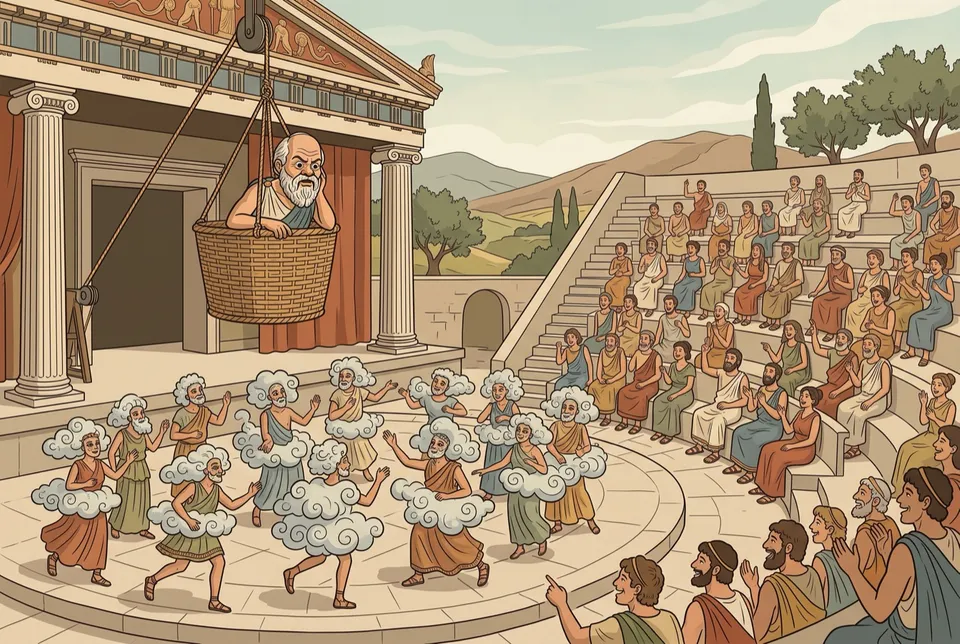
In short. The Clouds is Aristophanes' 423 BC comedy that mocked Socrates as a sophist in a basket. What happens in it, and how Plato's Apology answers it.
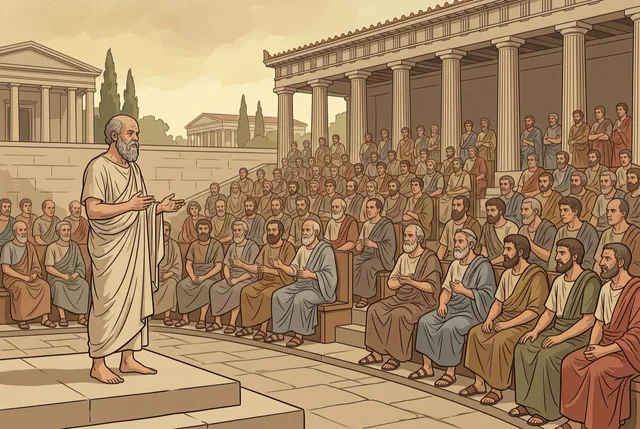
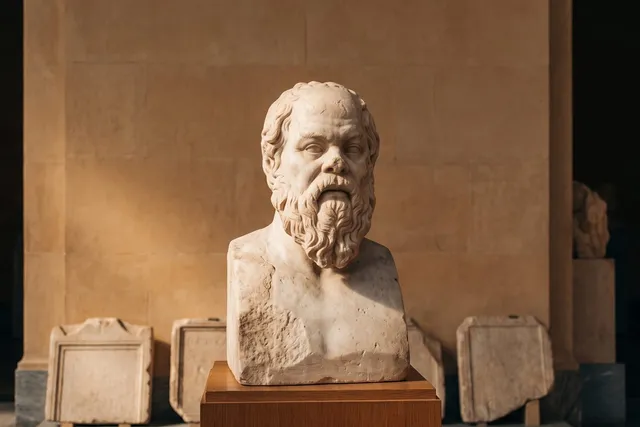
The Clouds (Nephelai) is a comedy by the Athenian playwright Aristophanes, first staged at the City Dionysia festival in 423 BC, that puts Socrates on stage as the head of a fictional school called the Thinkery, teaching students to argue any way out of any debt through clever, morally empty rhetoric. It is the earliest surviving portrait of Socrates written during his own lifetime, decades before Plato or Xenophon wrote a word about him, and it shows a very different Socrates from theirs: a caricature closer to a sophist and a natural philosopher than to the careful ethical questioner of the dialogues. Understanding what The Clouds actually says, and does not say, matters because Plato’s Apology names the play directly as one of the oldest and most damaging sources of prejudice against Socrates, years before the formal charges that led to his execution.
When was The Clouds first performed, and how did it do?
The Clouds was staged at the City Dionysia, Athens’ major dramatic festival, in 423 BC, competing against comedies by Cratinus and Ameipsias for the festival prize. It came third, and last, of the three entries, a result Aristophanes clearly took personally: the version of the play that survives today is not the one performed in 423 BC but a partial revision, begun some years later, that criticizes the audience for failing to appreciate the original and reworks several passages, including the ending. Ancient sources agree that this revised text was never actually restaged, so what readers have is an unfinished rewrite of a play that had already flopped once, not the script the 423 BC audience saw. That matters for how much weight to put on any single passage: the surviving Clouds is already one step removed from the version that first shaped Socrates’ reputation in Athens.
What happens in The Clouds?
The play centers on Strepsiades, an elderly Athenian farmer driven into debt by his horse-obsessed son Pheidippides, whose extravagant tastes (and extravagant name, built from a root meaning “horse”) have run up bills Strepsiades cannot pay. Strepsiades hears that a school nearby, the Thinkery (phrontistērion), teaches a “worse argument” capable of defeating a “better” one in court, exactly the skill he needs to talk his way out of what he owes.
Strepsiades enrolls, then sends his son instead. Too old and slow-witted to learn the material himself, comically failing at basic lessons, Strepsiades persuades Pheidippides to enroll in his place, over the son’s initial objections.
Socrates runs the school from a hanging basket. The comic Socrates is introduced suspended in a basket above the stage, explaining that he must keep his mind aloft to think clearly about things above, mixing its subtle essence with the kindred air, rather than letting the earth drag his thought downward. He and his students study, among other things, precisely how far a flea can jump measured in flea-feet, and which end of a gnat produces its buzz, a trumpet or something else.
The Clouds themselves are the chorus and the play’s new gods. A chorus of female cloud-deities appears in answer to Strepsiades’ prayers, worshipped by this Socrates in place of the traditional Olympian gods; they represent the vague, shifting, ungrounded kind of reasoning the play associates with him.
The Stronger and Weaker Arguments debate on stage. Personified as two characters, the Stronger (or Better) Argument defends old-fashioned discipline, respect for parents, and traditional education; the Weaker (or Worse) Argument defends self-indulgence and argues that shame and restraint are simply conventions a clever speaker can talk past. The Weaker Argument wins the debate, and Pheidippides is handed over to be trained in its methods.
Pheidippides learns the lesson too well. Once trained, he returns home fluent in the new rhetoric, beats his own father in an argument over whether a son may legally beat his parents, and then, more shockingly to the original audience, argues that he could justify beating his mother too by the same logic.
Strepsiades burns down the Thinkery. Realizing what his scheme has actually produced, Strepsiades sets fire to the school in the play’s closing scene, in the surviving revised text, a piece of violent slapstick that punishes Socrates’ school directly for corrupting his son.
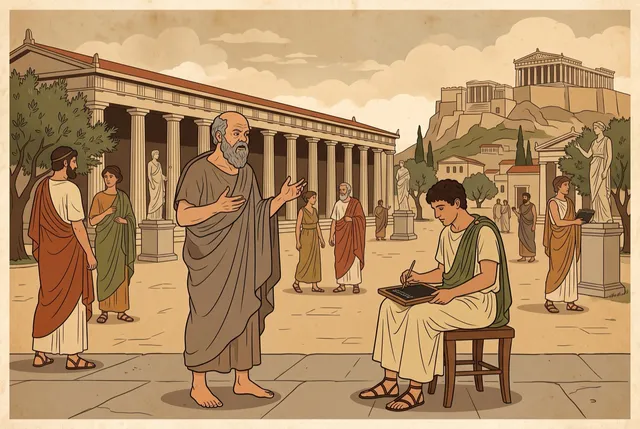
Throughout, the comic Socrates is presented as running a training ground in verbal trickery for hire, indifferent to truth and traditional piety alike, closer to the travelling paid teachers usually called sophists than to the Socrates of Plato’s dialogues, who famously refused to take money for teaching and denied having any doctrine to sell.
Was Aristophanes’ Socrates accurate?
No, not as a portrait of the historical Socrates known from Plato and Xenophon, and this gap is one of the most discussed problems in reconstructing who Socrates actually was. The Clouds fuses Socrates with two groups he is elsewhere recorded as criticizing: the sophists, paid professional teachers of rhetoric and success, and the phusikoi or natural philosophers, who speculated about the physical composition of the sky, the earth, and the heavens rather than about ethics. Plato’s dialogues consistently show Socrates rejecting payment for teaching, professing ignorance rather than claiming expertise, and showing little interest in the kind of physical speculation the play puts in his mouth. Whether Aristophanes genuinely believed the caricature, was simply using a recognizable public figure as a stand-in for an intellectual type the play wanted to mock, or was exaggerating real associations, Socrates did know sophists and natural philosophers personally and discussed their ideas, is debated by scholars and cannot be settled from the text alone.
How does The Clouds connect to Socrates’ trial?
Plato’s Apology, his account of Socrates’ defense speech at his trial in 399 BC, names The Clouds directly, and treats it as a serious problem rather than an old joke. Socrates tells the jury that his real accusers are not only the men who brought the formal charge that year, but a much older, harder to answer prejudice built up over decades, including against a Socrates the jury has “seen in Aristophanes’ comedy,” swinging about claiming to walk on air and talking a great deal of other nonsense about things Socrates says he knows nothing about (Apology 19c). Socrates argues these older slanders are more dangerous than the formal legal charges of impiety and corrupting the young, precisely because they have had a generation to settle into public opinion with nobody available to answer them (Apology 18a-e). The formal indictment against Socrates in 399 BC, impiety and corrupting the young, tracks the shape of the caricature in The Clouds closely enough that Plato clearly saw the play, performed roughly a quarter of a century earlier, as part of the groundwork for the charge that eventually led to Socrates’ execution. That does not mean the play caused the trial on its own; Athens in 399 BC had its own recent political tensions, including Socrates’ association with the discredited oligarch Alcibiades, but Plato plainly regarded the comic image of Socrates as a real and lasting source of damage.
Were Aristophanes and Socrates actually enemies?
The personal relationship seems to have survived the play. Plato’s Symposium, set at a dinner party years after The Clouds was staged, includes Aristophanes among the guests, delivering one of the dialogue’s serious speeches on love, the myth of humans originally formed as fused double-bodied beings later split in two (189d onward), and shows him on easy, joking terms with Socrates rather than as a bitter rival. Late in the dialogue, Alcibiades bursts in drunk to deliver a speech in praise of Socrates himself (Symposium 212c), and by the party’s end Socrates is shown arguing to Aristophanes and the tragedian Agathon, the only two guests still awake, that the same person ought to be capable of writing both comedy and tragedy well, with Aristophanes gradually nodding off partway through (Symposium 223d). Plato, born around 428 BC, was a small child when The Clouds was first staged in 423 BC and still a boy at the time of its surviving revision, so the Symposium’s friendly portrait reflects Plato’s own later reconstruction of Athenian intellectual life rather than an eyewitness account, but it is consistent with what is otherwise known: comic poets regularly lampooned real, named Athenians in this period without it ending real friendships, and there is no other evidence of lasting personal hostility between the two men.
One further, much later anecdote claims that Socrates stood up in the theatre during the 423 BC performance so the audience could compare his real face directly against the mask worn by the actor playing him. The story comes from Aelian, a Roman-era writer working several centuries after the event, and cannot be verified from any contemporary source; it should be read as a vivid legend about Socrates’ famous good humor under mockery, not as a documented fact.
What does The Clouds actually tell us about Socrates?
| Question | The Clouds (423 BC, comedy) | Plato and Xenophon (written after 399 BC) |
|---|---|---|
| Does Socrates teach for money? | Yes, runs a school (Thinkery) with fees | No, repeatedly refuses payment; contrasts himself with paid teachers |
| What does Socrates study? | Physical speculation: flea-jumps, gnat anatomy, meteorology | Ethics and human affairs; explicitly uninterested in natural philosophy in Plato’s account |
| Does Socrates claim expertise? | Yes, presented as an authority with answers to sell | No, professes ignorance; questions others rather than lecturing |
| Religious stance | Worships the Clouds in place of the traditional gods | Plato has him defend his piety at length in the Apology and Euthyphro |
| Effect on students | Trains Pheidippides to justify beating his parents | Plato and Xenophon present his influence as morally serious, if sometimes controversial |
| Genre and purpose | Comic satire aimed at a type (sophists, natural philosophers), using a real name | Philosophical and, in Xenophon’s case, partly defensive biography written after Socrates’ death |
Why does the play still matter for reading Plato?
The Clouds is a reminder that “Socrates” was already a contested public figure in Athens before Plato ever put pen to a dialogue, and that Plato’s own portrait, however much readers now treat it as the default, was itself written partly as an answer to an existing caricature. Reading the Apology’s direct references to the play alongside the play itself shows Socrates, in Plato’s account, treating comic mockery as a genuinely serious rival to formal legal argument, worth confronting by name in a speech for his life. For readers weighing how much of any ancient account of Socrates to trust, Xenophon’s version offers a third independent data point, and the broader question of how much can be recovered about the historical man at all is worth reading alongside was Socrates a real person and a look at what Socrates himself is recorded as saying in the more sober sources.
Keep reading