Was Socrates a Real Person? The Socratic Problem Explained
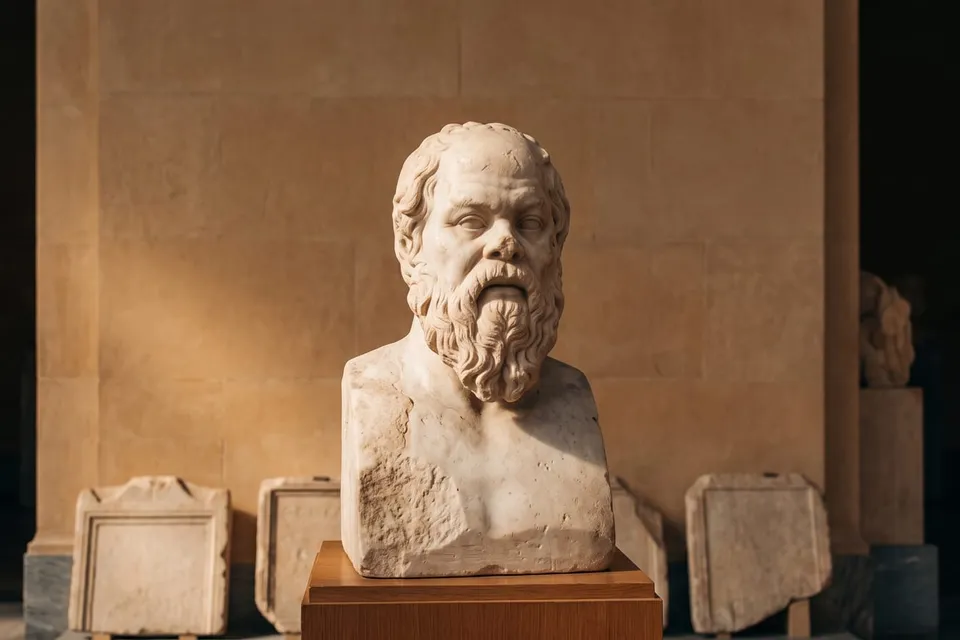
In short. Yes, Socrates was a real historical person, attested by three contemporaries. The harder question is what he actually believed. Here is the Socratic problem.
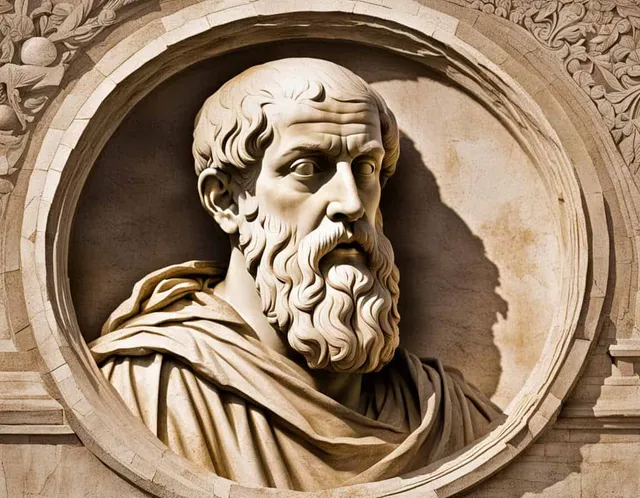
Yes. Socrates was a real historical person who lived in Athens from around 470 to 399 BC. Effectively no serious historian doubts it. The evidence is stronger than for most figures of the period, because we have testimony from three people who knew him personally, one of whom put him on stage while he was alive and sitting in the audience’s city.
The genuinely difficult question is not whether Socrates existed but what he actually thought. That problem has a name: the Socratic problem.
The Contemporary Witnesses
Three writers who knew Socrates left accounts of him, and a fourth wrote about him within a generation:
- Aristophanes staged The Clouds in 423 BC, when Socrates was about 46 and living in Athens. The comedy mocks him as the head of a “Thinkery” teaching students to argue their way out of debts. You cannot build a satire around a fictional person and expect a live Athenian audience to laugh — this is strong evidence that Socrates was a recognisable public figure.
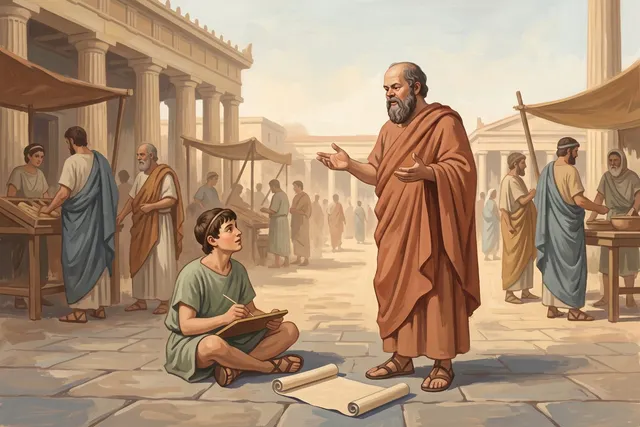
- Plato, his student, made him the central speaker in most of his dialogues.
- Xenophon, a soldier and historian who also knew him, wrote a Memorabilia, an Apology and a Symposium defending his memory.
- Aristotle, born fifteen years after Socrates died, discusses him throughout his work as a straightforwardly historical predecessor.
Add to this that Socrates’ trial was a public legal proceeding before a jury of hundreds of citizens, and the case for his existence is about as secure as ancient history gets.
So What Is the Socratic Problem?
Socrates wrote nothing himself. Everything we have about him was written by other people, and those people do not agree.
The versions are strikingly different:
- Aristophanes’ Socrates is a natural philosopher and a sophist, speculating about the heavens and teaching rhetorical tricks for money.
- Xenophon’s Socrates is a practical, conventionally pious moral advisor who gives sensible guidance about household management and friendship.
- Plato’s Socrates is a relentless metaphysician who argues for the immortality of the soul and the Theory of Forms.
These cannot all be portraits of the same intellectual life. At least some of what each author gives us is the author’s own philosophy wearing Socrates as a mask.
Aristotle’s Useful Clue
Aristotle offers the closest thing we have to an external check. He reports that Socrates concerned himself with ethics rather than the natural world, that he sought universal definitions, and — crucially — that he did not separate the Forms into an independent realm. Plato did that.
If Aristotle is right, then the metaphysics in Plato’s middle dialogues belongs to Plato, and the historical Socrates was a narrower and more relentless figure: someone who asked people what courage or justice actually was, and demonstrated that they could not say.
What We Can Reasonably Claim to Know
Stripping back to what the sources broadly share, a defensible minimum looks like this. Socrates was an Athenian citizen, son of a stonemason and a midwife. He served as a hoplite in the Peloponnesian War. He took no fees for teaching and died poor. He questioned prominent Athenians about their claims to knowledge and made himself unpopular doing it. He claimed to possess no wisdom of his own. He was tried and executed in 399 BC.
Beyond that, every claim about his doctrines has to be argued for rather than simply quoted. The Stanford Encyclopedia of Philosophy entry on Socrates sets out the source problem in detail.
Conclusion
Socrates was unquestionably a real person — attested by a comic playwright who mocked him in his lifetime, two students who knew him, and a public trial. What is uncertain is the content of his philosophy, because he left no writings and his portraitists had incompatible agendas.
The honest position is that we have excellent evidence for the man and contested evidence for the mind. For how the sources describe his final days, see the death of Socrates.
Keep reading