Socrates Facts: 22 Things We Actually Know, With Their Sources
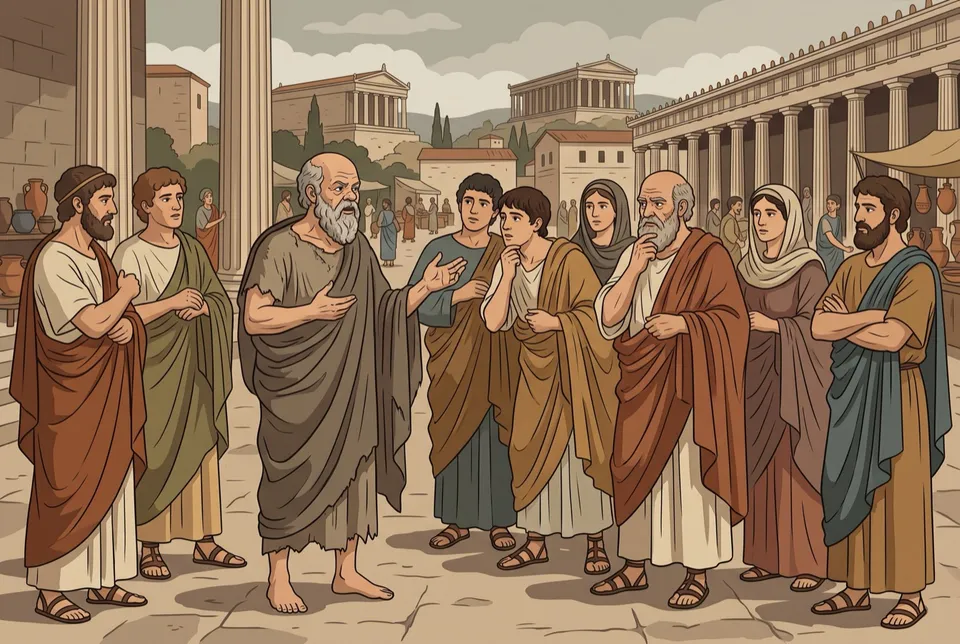
In short. 22 facts about Socrates (c. 470–399 BC), each traced to Plato, Xenophon, Aristotle or Diogenes Laertius, plus the popular myths that are not true.
Socrates (c. 470–399 BC) was an Athenian philosopher who spent his life questioning his fellow citizens about justice, courage and how to live, and who was tried and executed by Athens in 399 BC on charges of impiety and corrupting the young. He wrote nothing himself. Everything we know comes from people who knew him, above all his students Plato and Xenophon and the comic playwright Aristophanes, plus Aristotle (born fifteen years after his death) and much later writers such as Diogenes Laertius (probably third century AD). The facts below are sourced to those writers, and each one says when a detail is a late anecdote rather than an eyewitness report.
Socrates at a glance
| Born | c. 470/469 BC, Athens (Diogenes Laertius II.44) |
| Died | 399 BC, Athens, executed by poison after a trial |
| Home city | Athens, deme of Alopece (Plato, Gorgias 495d) |
| Parents | Sophroniscus (father); Phaenarete, a midwife (mother) |
| Family | Wife Xanthippe; three sons, Lamprocles, Sophroniscus and Menexenus |
| Known for | Questioning people in public; the “Socratic method”; his trial and death |
| Wrote | Nothing |
| Main sources | Plato, Xenophon, Aristophanes’ Clouds, Aristotle, Diogenes Laertius |
1. Socrates never wrote anything down
No book, letter or treatise by Socrates has ever existed, as far as any ancient source knows. Plato and Xenophon wrote conversations starring him, and later writers treated him as the philosopher who taught only by talking. The one near exception is a Plato detail: in prison he turned Aesop’s fables into verse and wrote a hymn to Apollo because a recurring dream told him to “make music” (Phaedo 60d–61b). None of it survives. Why he left nothing is discussed in our piece on whether Socrates wrote anything.
2. His mother was a midwife
In Plato’s Theaetetus (149a) Socrates calls himself the son of “a very fine and burly midwife, Phaenarete”, and builds a whole image of himself on it: he is a midwife of ideas, who cannot give birth to wisdom himself but helps others deliver theirs (150b–d). His father’s name, Sophroniscus, appears in several dialogues, including the Laches (180d).
3. His father was probably a stoneworker, and Socrates may have trained in the trade
That Sophroniscus was a stonemason or sculptor, and that Socrates worked in stone as a young man, is reported by Diogenes Laertius (II.18–19), who adds that some people credited him with a group of the Graces on the Acropolis. This is a late report, not an eyewitness one. Plato only hints at it, when Socrates jokingly calls the mythical craftsman Daedalus his ancestor (Euthyphro 11b–c).
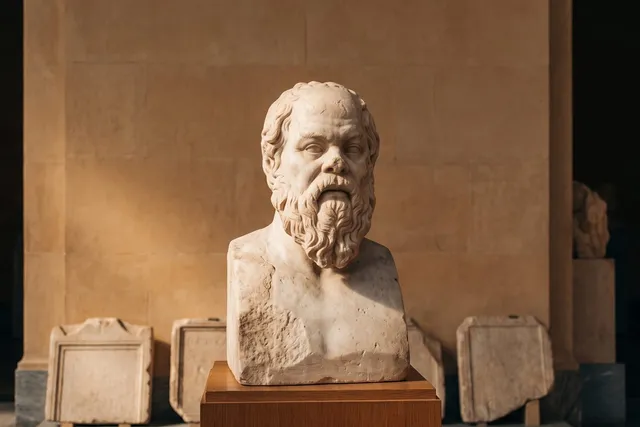
4. He was famously ugly
His friends made no secret of it. In Plato’s Symposium (215a–b) Alcibiades compares him to a Silenus statue and to the satyr Marsyas. In the Theaetetus (143e) the mathematician Theodorus says young Theaetetus is not handsome, because he looks like Socrates, with a snub nose and bulging eyes. Xenophon’s Symposium (5) has Socrates turn this into a joke, arguing that his protruding eyes and wide nostrils are the more useful, and so more beautiful, kind.
5. He fought as a hoplite in three campaigns
Socrates served as a heavily armed infantryman in the Peloponnesian War. In the Apology (28e) he names the three campaigns: Potidaea, Amphipolis and Delium. Alcibiades, in the Symposium (219e–221b), says Socrates saved his life at Potidaea and kept his head during the retreat from Delium, and the general Laches praises his conduct at Delium in the Laches (181b). The story of Alcibiades and Socrates starts on that campaign.
6. He went barefoot and wore the same cloak all year
Alcibiades says that during the brutal winter at Potidaea Socrates walked barefoot on the ice in his ordinary cloak while other soldiers wrapped their feet in felt (Symposium 220a–b). The same dialogue notes that he had put on sandals for Agathon’s party, “which he seldom did” (174a). In Xenophon, the sophist Antiphon mocks him for wearing one cloak summer and winter, with no shoes and no tunic (Memorabilia I.6.2).
7. He once stood still thinking for a whole day and night
At Potidaea, according to Alcibiades, Socrates began thinking about a problem at dawn and stood on the same spot until the next sunrise, while curious soldiers brought out their bedding to watch him; then he prayed to the sun and walked off (Symposium 220c–d). The same dialogue opens with a smaller version: he stops in a neighbour’s porch on the way to dinner and will not come in (175a–b).
8. He married Xanthippe and had three sons
Plato’s Phaedo shows Xanthippe at the prison on his last day, holding their small son (60a), and later says Socrates had three sons, “two small and one grown” (116b). In the Apology (34d) he tells the jury he has three sons, one a youth and two still children. The names Lamprocles, Sophroniscus and Menexenus come from Diogenes Laertius (II.26), and Lamprocles appears in Xenophon (Memorabilia II.2). Her reputation as a shrew is mostly later embroidery, covered in our piece on Xanthippe.
9. The Delphic oracle said no one was wiser than Socrates
In the Apology (21a) Socrates says his friend Chaerephon asked the oracle at Delphi whether anyone was wiser than Socrates, and the priestess answered that no one was. Socrates says he spent years testing the answer by questioning people with a reputation for wisdom, and concluded that he was wiser only in not thinking he knew what he did not know (21d). Xenophon’s Apology (14) tells a version of the same story.
10. He believed a divine sign spoke to him
Socrates described a “divine something” (the daimonion), a voice he had heard since childhood. In Plato it only ever holds him back, never urges him on, and he says it is why he stayed out of politics (Apology 31c–d). Xenophon’s version also gives positive advice (Memorabilia I.1.2–4). Both writers treat it as part of the impiety charge.
11. He refused to take payment for teaching
Unlike the sophists, Socrates charged no fees. In the Apology he offers his poverty as proof: he has neglected his own affairs, and no one can produce a witness that he ever asked for money (31b–c; see also 19d–e). Xenophon says the same (Memorabilia I.2.6).
12. He opposed an illegal trial of Athenian generals
In 406 BC, after the naval victory at Arginusae, the Assembly wanted to try the generals who had failed to rescue survivors together, in a single vote, which was against the law. Socrates says his tribe happened to be presiding and that he alone opposed it (Apology 32b). Xenophon confirms his opposition (Hellenica I.7.15; Memorabilia I.1.18). The generals were condemned anyway.
13. He defied the Thirty Tyrants over Leon of Salamis
In 404 BC the oligarchy of the Thirty ordered Socrates and four others to bring in Leon of Salamis for execution. The other four went; Socrates went home. He says he would probably have been killed for it if the regime had not fallen soon after (Apology 32c–d).
14. He rarely left Athens except on military service
In the Crito (52b) the Laws of Athens point out that he never left the city for a festival, except once to the Isthmian games, and never travelled abroad except on campaign. In the Phaedrus (230c–d) Phaedrus teases him for seeming like a stranger in the countryside just outside the walls; Socrates replies that trees cannot teach him anything, but people in the city can.
15. Aristophanes mocked him on stage in the Clouds
The Clouds, first staged in 423 BC when Socrates was in his forties, presents him as a fraud who runs a “thinkery”, studies the heavens and teaches young men to win bad arguments. At his trial Socrates complains that this caricature poisoned public opinion against him long before his formal accusers did (Apology 18c–d, 19c). More in our guide to the Clouds.
16. He was tried in 399 BC before a jury of about 500 citizens
His accusers were Meletus, Anytus and Lycon (Apology 23e). The charges were not recognising the city’s gods, introducing new divine powers, and corrupting the young (Apology 24b–c; Diogenes Laertius II.40). Socrates says that if only thirty votes had gone the other way he would have been acquitted (Apology 36a). The jury size of about 500, often given as 501, is inferred from normal Athenian practice rather than stated in the dialogue. Why the jury convicted is covered in why Socrates was executed.
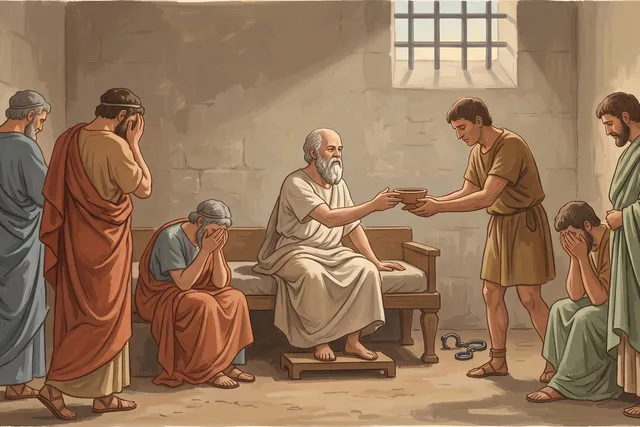
17. He waited about a month in prison before he died
The execution was delayed because Athens performed no executions while its sacred ship was away on the annual mission to Delos (Phaedo 58a–c). Xenophon says the wait was thirty days (Memorabilia IV.8.2). In the Crito his friend Crito uses the time to offer him an escape, which Socrates refuses.
18. Plato never actually names the poison as hemlock
In the Phaedo (117a–118a) the executioner brings “the drug” (pharmakon), Socrates drinks it, walks until his legs are heavy, then lies down as the numbness climbs from his feet. The identification with hemlock comes from the fact that hemlock was the standard Athenian method of execution at the time, and from later writers. Scholars still debate how closely Plato’s calm description matches real hemlock poisoning. The whole scene is covered in our account of the death of Socrates.
19. His last words were about a debt to Asclepius
According to Plato, Socrates uncovered his face and said, “Crito, we owe a cock to Asclepius; pay it and do not neglect it” (Phaedo 118a). Asclepius was the god of healing, and readers have argued for centuries about what the request meant. The exact wording and its sources are on our Socrates quotes page.
20. He was about 70 when he died
In the Apology (17d) he tells the jury that this is his first time in court, at over seventy years of age, and the Crito (52e) speaks of his seventy years in Athens. Diogenes Laertius (II.44), following the chronicler Apollodorus, places his birth in 469/468 BC.
21. Plato was not at his death
The Phaedo names the friends in the cell that day, including Crito, Apollodorus, Antisthenes and Aeschines, then adds: “Plato, I believe, was ill” (59b). Aristippus was away on Aegina (59c), and Xenophon was on campaign in Asia. The most famous death scene in philosophy was therefore written by someone who says he was not there.
22. His students included Plato, Xenophon, Antisthenes and Aristippus, and also Alcibiades and Critias
Four of his followers founded schools or wrote major works of their own: Plato, Xenophon, Antisthenes and Aristippus. But he was also linked with Alcibiades, who defected to Sparta, and Critias, leader of the Thirty. Xenophon admits both spent time with him and argues they learned nothing bad from him (Memorabilia I.2.12–16). About fifty years later the orator Aeschines told a jury that Athens had executed “Socrates the sophist” because he had educated Critias (Against Timarchus 173). For Xenophon’s own career, see who Xenophon was.
A note on the “Socratic problem”
Because Plato, Xenophon and Aristophanes give three quite different Socrates, historians cannot be sure which ideas belonged to the real man. Aristotle’s short remarks, for instance that Socrates asked about definitions but did not separate the Forms from things (Metaphysics XIII.4, 1078b), are often used as a tie-breaker. The facts above are the ones that survive that scrutiny best. The problem itself is explained in was Socrates a real person?, and his most famous student has his own list in Plato facts.
Myths about Socrates
He said “I know that I know nothing.” Not in those words. The closest line is Apology 21d, where he says that, unlike a man he questioned, he does not think he knows what he does not know. The famous slogan is a later compression. See what he actually meant.
He was a paid teacher, or a sophist. Both Plato and Xenophon insist he took no fees, and the Apology separates him from the sophists Gorgias, Prodicus and Hippias (19e). The “sophist” label comes from his enemies: Aristophanes’ play and, later, Aeschines.
His wife emptied a chamber pot over his head. The earliest version is in Diogenes Laertius (II.36), writing some 600 years later, and there she scolds him and then drenches him with water. The chamber pot is a later upgrade, and neither Plato nor Xenophon mentions any such scene.
Most “Socrates quotes” online are his. Many are not: “The secret of change is to focus all of your energy…” comes from a 1980 novel by Dan Millman, and “Education is the kindling of a flame” is a loose paraphrase of Plutarch. Our Socrates quotes page separates the real lines from the fakes.
Keep reading