Plato Facts: 24 Things We Know About His Life, and Where They Come From
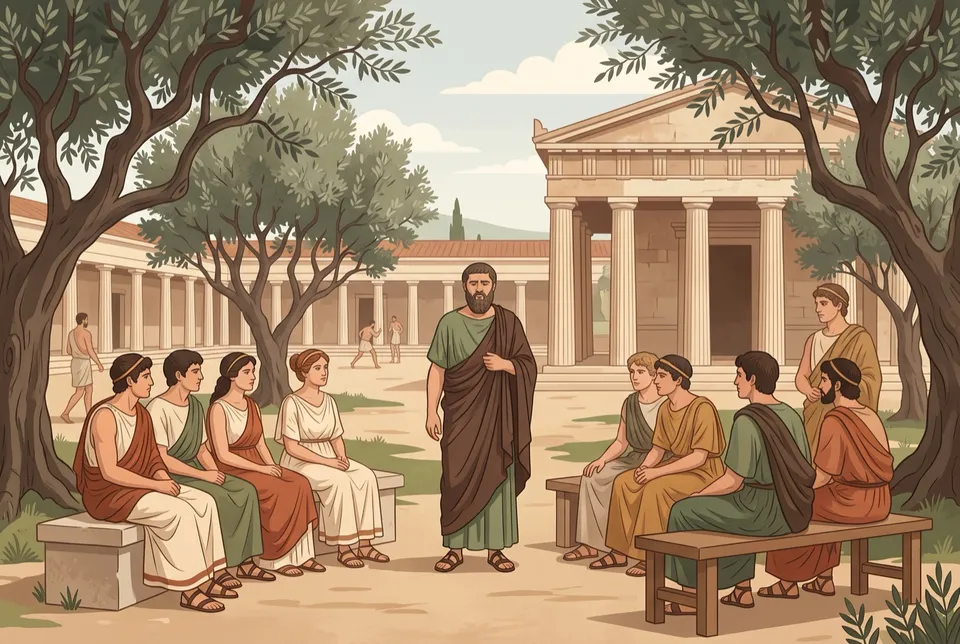
In short. 24 facts about Plato (c. 428–348 BC), from his family and name to the Academy and Atlantis, each sourced, plus the myths people repeat about him.
Plato (c. 428–348 BC) was an Athenian philosopher, the most famous student of Socrates, the teacher of Aristotle and the founder of the Academy, whose dialogues on justice, love, knowledge and the soul are the oldest complete body of Western philosophy to survive. His own writings say almost nothing about his life, so most biographical details come from two places: the Seventh Letter, which claims to be by Plato but whose authenticity is debated, and Diogenes Laertius, who wrote his Lives of the Eminent Philosophers some 550 years after Plato’s death. The facts below say which source each detail comes from and flag the ones that are later anecdotes.
Plato at a glance
| Born | c. 428/427 BC, Athens (some ancient sources say Aegina) |
| Died | c. 348/347 BC, Athens, aged about 80 |
| Home city | Athens |
| Parents | Ariston (father); Perictione (mother) |
| Family | Brothers Glaucon and Adeimantus; sister Potone; half-brother Antiphon. No known wife or children |
| Known for | The theory of Forms; the Republic; founding the Academy; teaching Aristotle |
| Wrote | About 35 dialogues and 13 letters under his name, all surviving |
| Main sources | His dialogues; the Seventh Letter; Diogenes Laertius, Lives Book III |
1. He was born around 428/427 BC
Diogenes Laertius (III.2), following the chronicler Apollodorus, dates his birth to 428/427 BC, a few years into the Peloponnesian War and just after the death of Pericles. Diogenes also reports that some said he was born on the island of Aegina rather than in Athens (III.3). Athens is the usual answer, and he was certainly an Athenian citizen.
2. “Plato” was probably a nickname, and his birth name was reportedly Aristocles
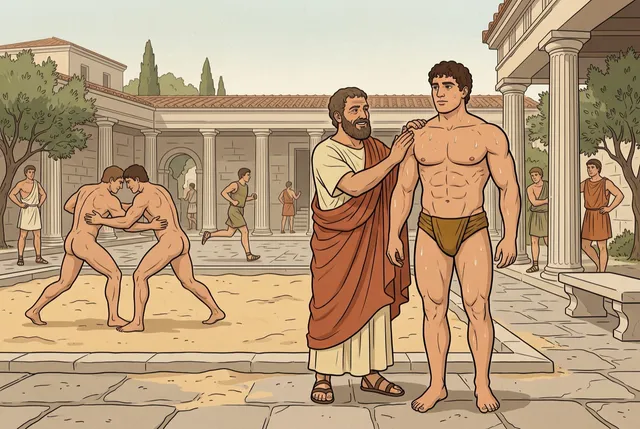
According to Diogenes Laertius (III.4), he was named Aristocles after his grandfather, and “Plato” came later. Greek platys means “broad”, and Diogenes gives three explanations: his broad build, the breadth of his style, or a broad forehead. The popular version, that his wrestling coach Ariston of Argos gave him the name, is one of those late stories. Some modern scholars point out that Plato was an ordinary Athenian name, so it may simply have been his real name. Full details in why Plato was given his name.
3. He came from one of the most aristocratic families in Athens
His father was Ariston and his mother Perictione (Diogenes Laertius III.1). Perictione’s family traced itself back to relatives of Solon, the great lawgiver of Athens. Her brother was Charmides, who gives his name to Plato’s Charmides, where Socrates praises the family’s ancestry (157e–158a).
4. His brothers are characters in the Republic
Glaucon and Adeimantus, the two young men who push Socrates hardest in the Republic, were Plato’s brothers, probably both older. Socrates calls them “sons of Ariston” (Republic 368a), and in the Apology (34a) Socrates points out “Adeimantus, whose brother Plato is here”. Plato also had a sister, Potone, whose son Speusippus later ran the Academy (Diogenes Laertius III.4, IV.1), and a half-brother, Antiphon, from his mother’s second marriage (Parmenides 126b–c). More on Glaucon.
5. Two of his relatives were among the Thirty Tyrants
Critias, his mother’s cousin, led the pro-Spartan oligarchy that seized Athens in 404 BC, and Charmides, his uncle, served under it. The Seventh Letter says some of these relatives invited young Plato to join them, and that he was quickly disgusted by their violence, including their attempt to involve Socrates in an arrest (324c–e).
6. He wanted a political career, not a philosophical one
The Seventh Letter (324b–326b) describes a young man who expected to enter public life, was repelled first by the Thirty and then by the restored democracy’s execution of Socrates, and concluded that cities would not be well run until philosophers ruled or rulers became philosophers. Scholars disagree about whether Plato wrote the letter, but many accept that its account of his early life is at least close to the truth.
7. He was reportedly a wrestler, and may have competed at the Isthmian Games
Diogenes Laertius (III.4) reports, citing the philosopher Dicaearchus, that Plato wrestled at the Isthmian Games. This is a later report, not something Plato mentions, but it fits the “broad-shouldered” explanation of his name.
8. He is said to have burned his tragedies after meeting Socrates
Diogenes Laertius (III.5) says Plato wrote poetry and tragedies as a young man and was about to enter a tragedy in a competition when he heard Socrates speak, and burned his work. It is a good story and may be invented, since it neatly matches Plato’s later attacks on poetry in the Republic.
9. He followed Socrates for about eight years
Diogenes Laertius (III.6) says Plato became a pupil of Socrates at twenty and, after Socrates died, went to Megara at twenty-eight. That gives roughly eight years, which is later tradition rather than Plato’s own statement.
10. He was at Socrates’ trial
In the Apology Socrates names Plato as present in court (34a), and later says that Plato, Crito, Critobulus and Apollodorus are offering to guarantee a fine of thirty minae (38b). These are two of only three places where Plato names himself in all his dialogues.
11. He says he was not at Socrates’ death
The third self-mention is in the Phaedo, where the narrator lists the friends present in the prison and adds, “Plato, I believe, was ill” (59b). The scene that made Socrates’ death famous was, on Plato’s own account, written by someone who was not in the room. See the companion list of Socrates facts.
12. He travelled widely after 399 BC
After Socrates’ execution Plato went first to Megara, to the Socratic philosopher Euclides (Diogenes Laertius III.6). Later tradition adds Cyrene, Italy and Egypt. The Italian journeys are the best attested: the Seventh Letter shows him on friendly terms with Archytas of Tarentum, a Pythagorean mathematician and statesman (338c, 350a), and Pythagorean ideas about number and the soul run through his later work. The Egypt trip is less certain.
13. He went to Syracuse three times, and it went badly each time
The Seventh Letter says he first went to Sicily at about forty (324a), to the court of Dionysius I of Syracuse, and he returned twice under Dionysius II, hoping with his friend Dion to turn the young tyrant towards philosophy. It failed, and he left the last time with difficulty.
14. He was reportedly sold into slavery
Diogenes Laertius (III.19–20) tells how Dionysius I, angered by Plato, handed him to a Spartan ambassador who sold him at the slave market on Aegina, where Anniceris of Cyrene recognised and ransomed him. This is a later anecdote with no support in Plato’s own writings or the Seventh Letter. The story and its problems are covered in why Plato was enslaved.
15. He founded the Academy around 387 BC
Plato set up his school in a public park and gymnasium outside Athens named after the hero Academus, which is where the word “academy” comes from (Diogenes Laertius III.7). Some form of the school lasted for centuries, although whether there was an unbroken institution until the Emperor Justinian’s ban on pagan teaching in AD 529 is disputed. See Plato’s Academy.
16. Aristotle studied there for about twenty years
Diogenes Laertius (V.9) says Aristotle joined Plato at seventeen and stayed twenty years, until Plato’s death. He went on to disagree with his teacher on major points, most famously the theory of Forms.
17. Women studied at the Academy
Diogenes Laertius names two women among Plato’s students, Lastheneia of Mantinea and Axiothea of Phlius, and says Axiothea wore men’s clothes (III.46). It is a late report, but it fits the Republic’s argument that women could be guardians and rulers.
18. All of his works survive, which is rare for an ancient author
Almost every ancient writer is known only in fragments. Plato’s works appear to have come down complete: about 35 dialogues and 13 letters under his name, arranged in antiquity by Thrasyllus into nine groups of four (Diogenes Laertius III.56–61). Several of these, including many of the letters, are probably not by Plato, but nothing he is reported to have written has been lost. Our complete list of Plato’s works goes through them one by one.
19. He almost never appears in his own dialogues
Plato names himself only three times in all his dialogues: twice in the Apology (34a, 38b) and once in the Phaedo (59b). He never speaks. In the Seventh Letter (341c–d) he even says there is no written work of his on the subjects he cares most about, because they cannot be put into words like other studies.
20. The story of Atlantis comes from him
Atlantis first appears in Plato’s Timaeus (20d–25d) and Critias, told as an account the lawgiver Solon supposedly heard from Egyptian priests at Sais. The Critias breaks off unfinished. There is no earlier source for Atlantis, which is why most scholars read it as Plato’s invention. More in Plato’s Atlantis myth.
21. Whitehead called European philosophy “footnotes to Plato”
In Process and Reality (1929), Alfred North Whitehead wrote that the European philosophical tradition consists of “a series of footnotes to Plato”. Whitehead meant it as a claim about the range of Plato’s questions, not as a claim that later philosophers simply agreed with him. More in who is Plato?
22. Socrates slowly disappears from his later dialogues
In most of Plato’s dialogues Socrates leads the conversation. In several later works he steps back: a visitor from Elea leads the Sophist and Statesman, Timaeus delivers almost all of the Timaeus, and in the Laws Socrates does not appear at all, replaced by an unnamed Athenian visitor. Many scholars take this as a sign that Plato was moving further from his teacher’s views, which is one reason separating the historical Socrates from Plato’s character is so hard.
23. His last and longest work, the Laws, was reportedly left unfinished
The Laws, in twelve books, is longer than the Republic. Diogenes Laertius (III.37) reports that Plato left it written on wax tablets and that his student Philip of Opus copied it out after his death. That detail is a later report, but the loose, unrevised feel of parts of the Laws is often taken as support for it.
24. He died at about 80, reportedly at a wedding feast or while writing
Diogenes Laertius (III.2) dates his death to 348/347 BC and, citing Hermippus, says he died at a wedding feast in his eighty-first year. Cicero (On Old Age 13) says he died at his desk, writing, in his eighty-first year. Both are later anecdotes, but they agree on his age. He was buried at the Academy (Diogenes Laertius III.41).
Myths about Plato
Plato invented “platonic love” as non-sexual friendship. The phrase is Renaissance, not ancient: the Florentine scholar Marsilio Ficino wrote of amor platonicus in the fifteenth century. Plato’s own account of love in the Symposium and Phaedrus begins with erotic desire and aims to redirect it, not to deny it. See what platonic love really is.
“Plato” was definitely a wrestling nickname. Diogenes Laertius offers three different explanations and names no early witness for any of them, and Plato was a normal Athenian name. The wrestling coach story is possible but unproven.
Plato founded the first university. The Academy had no degrees, no examinations and no charter. It was closer to a community of people doing mathematics and philosophy together around a teacher. “University” is a useful comparison, not a description.
“Let no one ignorant of geometry enter” was carved over the Academy door. No source from Plato’s time or the centuries just after mentions this inscription. It first turns up in late antique writers, many centuries after Plato died.
Plato said “Only the dead have seen the end of war.” That line is from George Santayana (Soliloquies in England, 1922). For what Plato actually wrote, see Plato quotes: what he actually said.
Keep reading