Plato's Books: A Complete List of His Works and What Each Is About
In short. Plato wrote about 35 dialogues and 13 letters. A complete list, grouped early, middle and late, with what each one is about and why it matters.
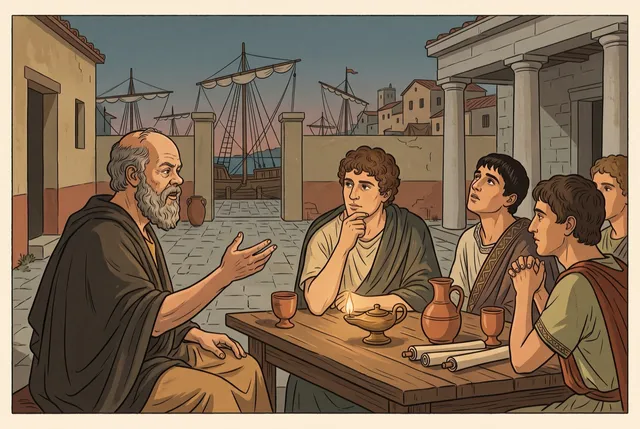
Plato wrote about 35 dialogues and 13 letters that survive under his name, plus a handful of works ancient scholars already doubted. He never wrote a treatise and he never speaks in his own voice: every work is a conversation, almost always led by Socrates, and Plato’s own view has to be read out of the argument rather than stated on the page. This page lists everything in the corpus, tells you what each work is about, and points you to the essays on this site that cover the major ones in depth.
How many books did Plato write?
The standard count is 35 dialogues and 13 letters, though the real number of works Plato actually wrote is disputed and has been since antiquity. In the first century AD the scholar Thrasyllus arranged the accepted works into nine tetralogies, groups of four: 36 works in all, made up of 35 dialogues plus the Letters counted as a single work. Outside the tetralogies sat an appendix of works already flagged as spurious, including a short collection of Definitions. That Thrasyllan arrangement is still the reference structure modern editions use, even though almost nobody thinks Plato himself planned his output in fours.
A caution up front: several works on Thrasyllus’s list, including some listed below as “doubtful or spurious”, are not accepted as authentic by most modern scholars. A few others, genuine dialogues by consensus, are argued over at the edges (the authenticity of the Seventh Letter, for instance, is debated, though it is taken seriously by enough scholars that it is regularly cited as evidence for Plato’s biography and philosophy, including the line at 341c on why he never wrote down his deepest teachings). None of this is settled science. It is closer to a field with a strong consensus core and a genuinely contested edge.
How are Plato’s works usually grouped?
Scholars conventionally sort the dialogues into three rough periods: early (or Socratic), middle, and late. The grouping is useful and almost universally used, but it is a convention, not a fact Plato confirmed anywhere.
The main evidence is stylometric: computer-assisted counts of sentence rhythm, particle use, and prose style show that a cluster of dialogues (headed by the Laws, which ancient sources agree was Plato’s last and unfinished work) share close stylistic company, and that cluster is taken as “late”. Dialogues that share Socrates as the sole examiner, short question-and-answer exchanges, and no positive doctrine of Forms are grouped as “early”. Everything stylistically and thematically in between, including the works most people mean when they say “Plato”, is “middle”.
Two honest caveats. First, stylometry tells you about writing style, not necessarily about when Plato held which view; it is possible he wrote a “late-style” idea early, in principle, even if in practice the clusters line up well with other evidence (references to contemporary events, cross-references between dialogues). Second, the early/middle/late labels say nothing about literary quality. The Republic, a middle dialogue, and the Laws, a late one, are both major works; “early” does not mean minor.
The complete list of Plato’s dialogues
Early (Socratic) dialogues
These are short, mostly inconclusive, and built around Socrates cross-examining someone confident they already know an answer. Most end in aporia, a state of puzzlement, rather than a settled definition.
| Title | What it’s about | Main question | Notable for |
|---|---|---|---|
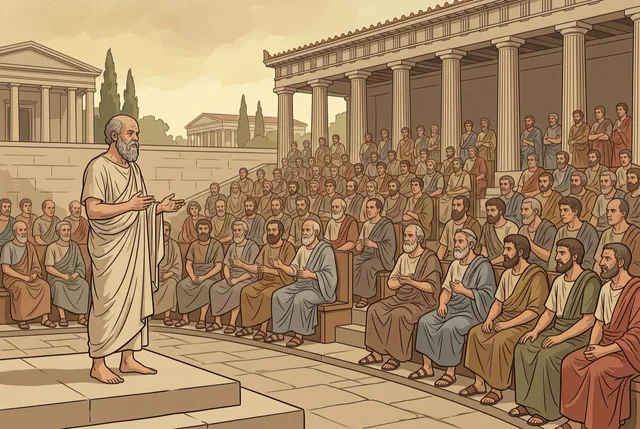
| Apology | Socrates’ defence speech at his trial for impiety and corrupting the young | Is a life spent questioning everything worth dying for? | The single best entry point into Plato; “the unexamined life is not worth living” |
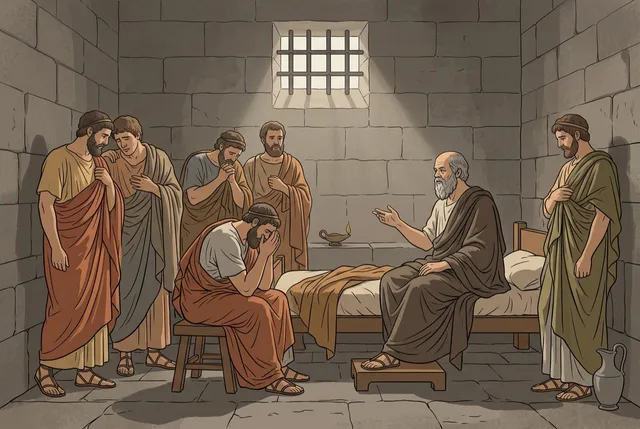
| Crito | Socrates in his prison cell, refusing a friend’s offer to help him escape | Do citizens owe obedience to laws that have wronged them? | Still cited directly in debates about civil disobedience |
| Euthyphro | Socrates questions a confident young man about piety, on the courthouse steps | Is something pious because the gods love it, or do the gods love it because it is pious? | The Euthyphro dilemma, a problem philosophy of religion has never fully escaped |
| Laches | Two generals are asked to define courage for two Athenian fathers | What is courage? | A short, clean example of a definition collapsing under questioning |
| Charmides | Socrates examines a beautiful, modest young man about self-control | What is temperance, and can you know that you have it? | An early look at self-knowledge and the limits of introspection |
| Lysis | Socrates talks with two boys about what makes people friends | What is friendship, and why do we love what we love? | One of Plato’s most tentative, least resolved dialogues |
| Ion | Socrates questions a rhapsode (a professional reciter of Homer) about his skill | Does poetic performance rest on knowledge, or on inspiration alone? | A short, sharp challenge to the idea that poets know what they are talking about |
| Hippias Minor | Socrates and a boastful sophist argue about lying | Is it better to do wrong voluntarily or involuntarily? | A deliberately uncomfortable, paradox-driven early argument |
| Protagoras | Socrates and the famous sophist Protagoras debate whether virtue can be taught | Is virtue a kind of knowledge, and can it be taught? | A lively, almost comic set piece; introduces the “unity of virtue” |
| Gorgias | Socrates takes on rhetoric, and then Callicles’ case that might makes right | Is it worse to suffer injustice or to commit it? | The dress rehearsal for the Republic; Callicles is one of Plato’s great villains |
| Euthydemus | Two sophist brothers try to trap Socrates and a young man in verbal tricks | What separates real argument from sophistry? | Plato at his funniest; a satire of bad reasoning |
| Meno | Socrates leads an enslaved boy to a geometric proof using questions alone | Can virtue be taught, and where does knowledge come from? | The theory that learning is recollection; the geometry demonstration |
| Menexenus | A funeral oration for Athenian war dead, delivered by Socrates, said to be composed by Aspasia | What makes political speech persuasive, and is that a good thing? | Usually read as a parody of Athenian funeral oratory |
Middle dialogues
The middle dialogues are longer, more constructive, and this is where the theory of Forms, the account of the soul’s immortality, and Plato’s major political philosophy are worked out.
| Title | What it’s about | Main question | Notable for |
|---|---|---|---|
| Cratylus (middle, or transitional from early) | A dialogue on whether words are natural or conventional | Do names capture the nature of the things they name? | Plato’s only extended treatment of language |
| Phaedo | Socrates’ final conversation and death, on the day of his execution | Does the soul survive the death of the body? | The most famous death scene outside scripture; arguments for immortality |
| Symposium | A drinking party where guests each give a speech in praise of love (Eros) | What is love, and where does it lead? | The ladder of love, from bodies to Beauty itself; the most entertaining dialogue Plato wrote |
| Republic | Justice examined in an imaginary city and in the individual soul | Is a just life better than an unjust one, even for someone who could get away with injustice? | The Cave, the Sun, the Line, the philosopher-king, the Myth of Er |
| Phaedrus | A dialogue on love and rhetoric, held outside the city walls | What makes a speech, and a soul, genuinely persuasive rather than merely clever? | Plato’s own argument against writing, made in writing |
| Parmenides (transitional to late) | A young Socrates is cross-examined by the elderly philosopher Parmenides | Does the theory of Forms survive its own best objections? | Plato’s toughest self-critique of his own central theory |
| Theaetetus (transitional to late) | Socrates and a young mathematician try to define knowledge | What is knowledge? | Tests “justified true belief” roughly two thousand years before the phrase existed |
Late dialogues
The late dialogues are stylistically distinct (the stylometric cluster mentioned above), often more technical, and in places abandon the question-and-answer format for long, near-continuous speeches.
| Title | What it’s about | Main question | Notable for |
|---|---|---|---|
| Sophist | A sequel to the Theaetetus, hunting for a definition of the sophist | What is falsehood, and how can “what is not” be spoken of at all? | Revises the theory of Forms; a technical, demanding dialogue |
| Statesman | A companion piece to the Sophist, on the true statesman | What distinguishes genuine political expertise from its imitations? | The image of the ruler as a weaver holding the city together |
| Philebus | A debate on pleasure versus wisdom | What is the good life made of? | A careful, unglamorous late treatment of happiness |
| Timaeus | An account of the origin and structure of the universe, told as a “likely story” | How was the physical world made, and why? | Enormously influential cosmology; the source of the Atlantis legend |
| Critias | An unfinished sequel to the Timaeus, describing ancient Athens and Atlantis | What would a genuinely just, ancient society have looked like? | Breaks off mid-sentence; Plato apparently abandoned it |
| Laws | Plato’s longest work, a second, more practical political philosophy | How should a realistic, workable city be governed? | Written in old age; no Socrates; left unfinished at Plato’s death |
Doubtful or spurious works, and the letters
Ancient scholars already argued about which works under Plato’s name were genuine. Modern scholarship agrees the following group is either doubtful or, in most cases, not by Plato at all, though a few (marked “disputed”) still have serious defenders.
| Title | Status | Notes |
|---|---|---|
| Alcibiades I | Disputed | Ancient sources treat it as introductory Plato; many modern scholars doubt it, others still defend it |
| Alcibiades II | Widely rejected | Almost certainly not Plato’s |
| Hippias Major | Disputed | On the nature of beauty; strong stylistic case both for and against |
| Clitophon | Disputed | A short, unfinished-feeling critique of Socrates, sometimes read as genuinely Plato’s |
| Epinomis | Usually rejected | Usually attributed to Philip of Opus, a student who may have edited the Laws |
| Minos | Widely rejected | On the nature of law |
| Hipparchus | Widely rejected | On love of gain |
| Theages | Widely rejected | On the nature of wisdom |
| Lovers (Rival Lovers) | Widely rejected | On the nature of philosophy |
Thirteen letters also survive under Plato’s name. Most are considered later forgeries or are simply unverifiable, but the Seventh Letter is different: it is long, biographically detailed, describes Plato’s disastrous political adventures in Syracuse, and contains his clearest statement about why he distrusted writing as a vehicle for philosophy’s deepest truths (341c). Its authenticity is debated, but enough scholars take it seriously that it is routinely used as evidence for Plato’s life and thought, with appropriate caution.
What are Plato’s most important works?
If you only ever read six, the usual list is the Republic, Symposium, Phaedo, Apology, Timaeus, and Laws, and they earn the place for different reasons.
The Republic is Plato’s most complete statement of his philosophy in one place: ethics, politics, metaphysics, and psychology all argued through together. The Symposium is the most purely enjoyable thing Plato wrote and contains his most influential account of love and beauty. The Phaedo pairs Socrates’ death with Plato’s fullest case for the soul’s immortality. The Apology is the best short introduction to Socrates and to why Plato thought philosophy was worth a life. The Timaeus shaped a thousand years of later cosmology and theology, Christian and pagan alike, more than almost anything else Plato wrote. The Laws, finally, matters because it is Plato revising his own politics in old age, trading the ideal city of the Republic for something meant to actually work.
Where should I start?
Not with the Republic, despite its reputation; most first-time readers who start there stall out somewhere around the argument over censoring poets in Book 2. A better route runs through the trial dialogues (Euthyphro, Apology, Crito), then the Meno and Symposium, before the Republic itself. For the full sequence, with what to expect from each stop, see how to read Plato: a beginner’s reading order.
What did Plato not write?
Plato never wrote a philosophical treatise in his own voice. Every one of his works is a dialogue, a dramatised conversation, usually led by Socrates, and Plato himself never appears as a speaker anywhere in the corpus (he is mentioned twice, both times as absent). That choice was deliberate: Plato had specific reasons for writing in dialogue form rather than laying out his conclusions directly.
Socrates himself, meanwhile, wrote nothing at all. Everything we know of his historical views comes filtered through other people’s accounts, chiefly Plato’s dialogues and Xenophon’s, which do not always agree, which is part of why the historical Socrates is so hard to pin down behind Plato’s literary one.
There is also a long-standing tradition, going back to remarks in Aristotle and later Academic sources, that Plato held “unwritten doctrines” he taught only orally inside the Academy, involving mathematical first principles (the One and the Indefinite Dyad) that go beyond anything spelled out in the dialogues. This is a real and old scholarly debate, associated especially with the so-called Tübingen school, but it remains contested and unproven; treat it as a hedge on what the written corpus might be leaving out, not as settled fact.
A note on translations
For a first read of any of these works, any reputable modern English translation will serve you well; you do not need Greek. Readers who want everything in one place often reach for the Hackett Complete Works, edited by John M. Cooper (1997), a single-volume edition that gathers modern translations of the whole accepted corpus, including the letters, with brief introductions to each work. It is not the only good option, but it is the one you will see cited most often as a general-purpose shelf edition.
Related reading
For the story of why Plato wrote this way at all, see why Plato wrote dialogues instead of treatises. For individual works not summarised in depth here, the essays linked in the tables above cover the Republic, Phaedo, Symposium, Apology, Crito, Euthyphro, Gorgias, Meno, Parmenides, Theaetetus, Sophist, Timaeus, Laws, Cratylus, Phaedrus, Laches, and Charmides in full, along with profiles of key figures like Protagoras and Alcibiades who appear across several of them.
Keep reading