Plato Quotes: What He Actually Said, and What He Didn't
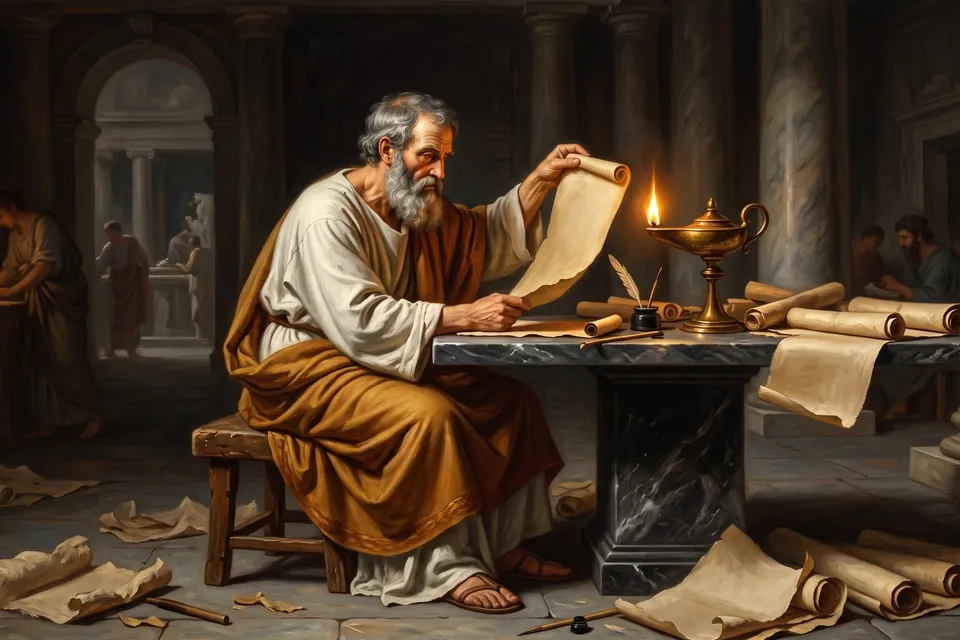
In short. "I know that I know nothing", "all learning is remembering", "only the dead have seen the end of war" — which Plato quotes are real, where they come from, and what they mean.
Plato may be the most quoted — and most misquoted — philosopher who ever lived. The famous lines circulate stripped of their dialogues, reworded by translators, and mixed freely with things he never wrote. This page sorts them: the genuine quotes with their sources and meaning first, then the impostors.
One complication up front: Plato wrote dialogues, so almost every “Plato quote” is actually a line he gave to a character — usually Socrates, who wrote nothing himself. When you quote Plato, you are nearly always quoting Plato’s Socrates.
“I know that I know nothing”
Status: genuine in substance, compressed in wording. The slogan — sometimes given as “all I know is that I know nothing” — does not appear verbatim anywhere in Plato. It compresses the Apology (21d), where Socrates, puzzling over the oracle that called him the wisest of men, concludes:
I am wiser than this man; it is likely that neither of us knows anything worthwhile, but he thinks he knows something when he does not, whereas when I do not know, neither do I think I know.
The point is not modesty theatre, and it is not the self-refuting claim “I know one thing: nothing.” It is a comparison: Socratic wisdom consists in not mistaking ignorance for knowledge. The compressed slogan is a fair summary — just don’t put quotation marks around it and cite a page number.
“The unexamined life is not worth living”
Status: genuine. Apology 38a, spoken by Socrates at his trial, explaining why he will not stop philosophising even to save his life. The Greek — ho anexetastos bios ou biōtos anthrōpōi — is as blunt as the English. In context it is not a self-help maxim but a defiant answer to a death sentence: an offer to live quietly without questioning would, for Socrates, not be an offer of life at all.
“All learning is remembering”
Status: genuine as a doctrine, paraphrased as a sentence. This is Plato’s theory of anamnesis — recollection — argued in the Meno (81d):
Seeking and learning are, as a whole, recollection.
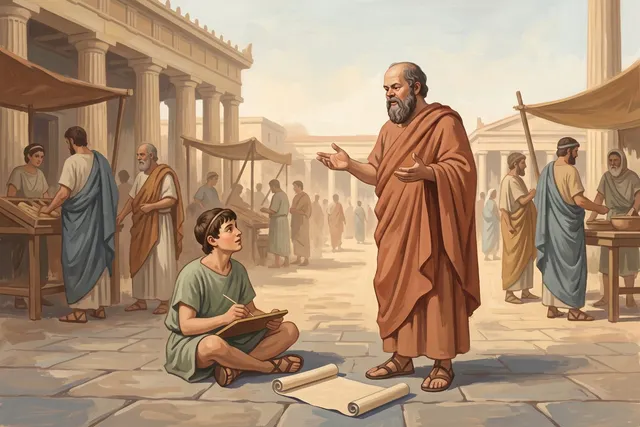
In the dialogue Socrates demonstrates it by leading an uneducated slave boy, question by question, to a geometrical truth the boy was never taught. Plato’s explanation is that the soul knew before birth and is being reminded. You do not have to accept the immortal soul to feel the observation underneath: genuine understanding arrives as recognition — the sense that the truth was somehow already yours — which is quite unlike being handed a fact. The Phaedo (72e) argues the same doctrine.
“We can easily forgive a child who is afraid of the dark; the real tragedy of life is when men are afraid of the light”
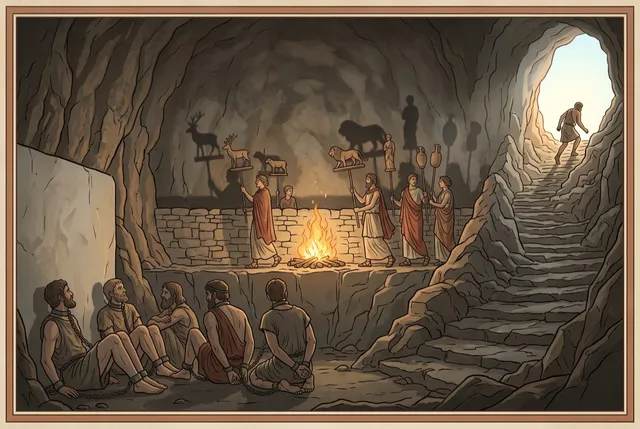
Status: not Plato. This appears nowhere in his works and is unattested before the twentieth century. It survives because it sounds like a one-line summary of the allegory of the cave — where the released prisoner, pained by the fire and sunlight, genuinely does prefer the dark (515c). If you want the authentic version of the thought, quote the cave itself: the men who cannot bear the light are Plato’s image of all of us before philosophy.
“Only the dead have seen the end of war”
Status: not Plato. Widely engraved, widely attributed, and found nowhere in the dialogues. The line comes from the philosopher George Santayana (1922); the misattribution to Plato spread in the twentieth century, helped along by a famous war film. Plato had ample opportunity to say it — he lived through the Peloponnesian War — but he did not.
“What is happening to our young people?”
Status: not Plato. The long lament about disrespectful youth “crowding into taverns” is a modern fabrication, though it is pinned to him constantly. We have a full essay on this quote — where it actually comes from, and what Plato really said about the young.
“Be kind, for everyone you meet is fighting a hard battle”
Status: not Plato. Nineteenth-century in origin (usually traced to the Scottish writer Ian Maclaren), attached to Plato by internet osmosis. Nothing like it appears in the dialogues.
“Beauty lies in the eyes of the beholder”
Status: not Plato — nearly the opposite of Plato. In the Symposium (210e–211b), beauty is the least beholder-dependent thing there is: the lover ascends from beautiful bodies to beautiful souls to Beauty itself, “always being and neither coming to be nor perishing”. A philosopher who thought beauty was in the eye of the beholder would not have needed the ladder.
“Until philosophers are kings… cities will have no rest from evils”
Status: genuine. Republic 473d, the most notorious political sentence Plato wrote, proposing what we now call the philosopher king. He knew how it would land — Socrates braces for the proposal to be “drowned in laughter and contempt” before he makes it. The argument behind the punchline is the business of much of the Republic.
How to check a Plato quote yourself
Three quick tests catch most fakes:
- Ask for the dialogue. Real Plato quotes have an address — a dialogue and a Stephanus number (like Apology 38a) that works in any edition. A quote that circulates with no source usually has none.
- Mind the translation. Plato wrote Greek; every English “quote” is one translator’s choice. If the wording is suspiciously snappy and modern, it is at best a paraphrase.
- Check the voice. Aphorisms about being yourself, following your dreams, or winning at life are foreign to Plato’s concerns. His real one-liners are about knowledge, justice, the soul, and how hard it is to see the truth — and they are usually questions.
Keep reading