Did Socrates Write Anything? Why He Left No Books
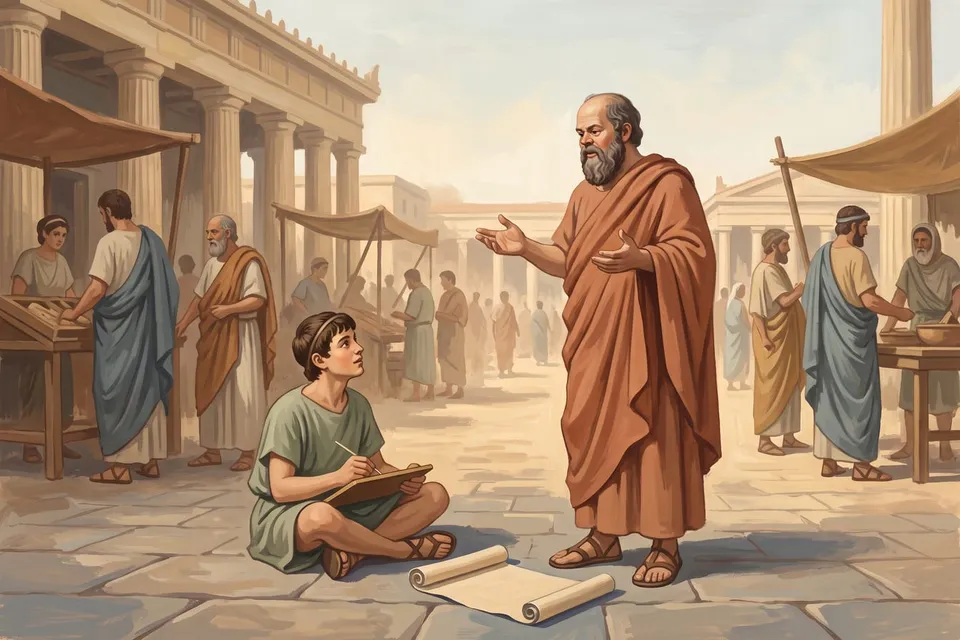
In short. Socrates wrote no philosophy at all. He composed verse only once, in prison. Here is why he refused to write, and what that cost us.
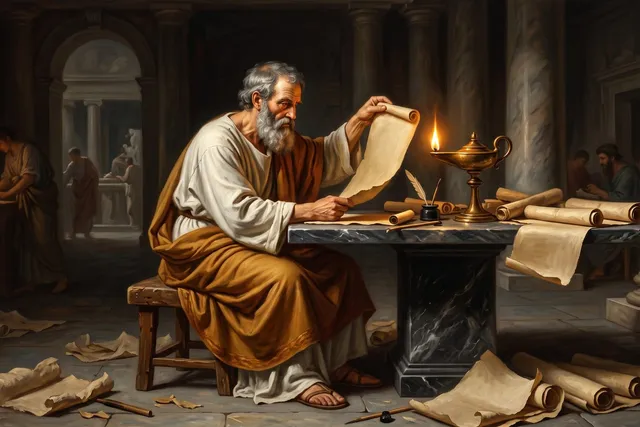
Socrates wrote nothing. Not a treatise, not a dialogue, not a set of notes. Every book sold today with his name on the cover is really a collection of Plato or Xenophon writing about him.
This was a deliberate choice by a man who had strong views about what writing does to thinking — and it is the single fact most responsible for how much about him remains uncertain.
The One Exception
There is exactly one reported composition, and it comes at the very end. In Plato’s Phaedo (60c–61b), Socrates tells his friends in prison that he has been visited repeatedly by a dream urging him to “make music.” Having always assumed philosophy was the music meant, he decides in his last days to cover the literal reading as well: he sets some of Aesop’s fables into verse and composes a hymn to Apollo.
Neither survives, and neither is philosophy. A man who spent fifty years refusing to write produced poetry only when he had a month left and nothing to lose.
Why He Refused to Write
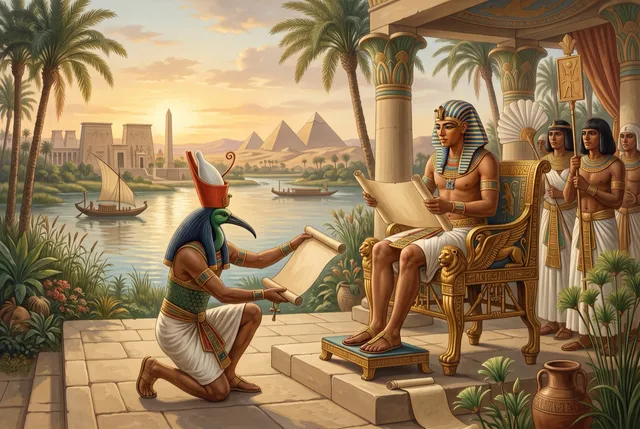
Plato gives the reasoning in the Phaedrus (274b–278b), where Socrates tells the myth of the Egyptian god Theuth presenting writing to King Thamus as a cure for forgetfulness. Thamus rejects it: writing will produce forgetfulness, because people will trust external marks instead of remembering for themselves.
Socrates then adds the objections that matter philosophically. A written text:
- cannot answer a question — ask it something and it just repeats itself;
- cannot defend itself when misunderstood or attacked;
- says the same thing to everyone, regardless of whether the reader is ready for it.
For someone whose entire method was adjusting each question to the particular person in front of him, writing was not a neutral medium. It was the wrong tool. Philosophy, on this view, is something that happens between two people who can interrupt each other. The paradox of writing in the Phaedrus explores this paradox in more depth.
The Irony
The argument reaches us in writing, composed by Socrates’ most gifted student. Plato wrote dialogues rather than treatises — the closest a text can get to a conversation — which reads as an attempt to honour the objection while ignoring the conclusion.
Whether Plato is reporting his teacher’s view or using him to voice a worry of his own is, fittingly, impossible to settle, because the only person who could tell us declined to leave a record.
What It Cost Us
The consequence is that Socrates survives entirely through other people. Aristophanes lampooned him, Xenophon defended him, Plato philosophised through him, and Aristotle assessed him from a distance. These portraits do not agree, and there is no autograph text to arbitrate between them.
That is why scholars talk about the Socratic problem rather than simply reading Socrates. His silence created the very problem his students have been arguing about ever since.
Conclusion
Socrates wrote no philosophy, on principle, because he thought written words could not answer back. The single exception was some Aesop in verse, written in a prison cell in his final weeks and now lost.
For the ancient testimony and its interpretation, see the Stanford Encyclopedia of Philosophy entry on Socrates.
Keep reading