What Did Socrates Mean by “I Know That I Know Nothing”?
In short. Socrates never actually said “I know that I know nothing.” Here is what he really claimed in the Apology, and why the difference matters.
The first thing to say about the most famous sentence attributed to Socrates is that he never said it. “I know that I know nothing” is a later compression — catchier than the original, and philosophically weaker.
What Socrates actually claims, in Plato’s Apology, is more careful and more interesting: not that he possesses knowledge of his own ignorance, but that he does not imagine he knows things he does not.
What He Really Said
At Apology 21d, Socrates explains why he might be wiser than a man with a reputation for wisdom: “It is likely that neither of us knows anything worthwhile; but he thinks he knows something when he does not, whereas when I do not know, neither do I think I know.”
The claim is comparative and modest. Socrates is not asserting a doctrine about the limits of human knowledge. He is describing a difference in self-assessment. Both men are ignorant; only one of them has noticed.
The pithy Latin version, scio me nihil scire, took hold much later. It converts a remark about intellectual honesty into a paradox, because knowing that you know nothing is self-refuting — if you know that, you know at least one thing. Socrates’ actual formulation neatly avoids the trap.
Where the Idea Came From: The Oracle at Delphi
The context is a story Socrates tells at his trial. His friend Chaerephon went to the oracle at Delphi and asked whether anyone was wiser than Socrates. The priestess answered that no one was.
Socrates says he found this baffling, because he was aware of possessing no wisdom at all. So he set out to refute the god by finding someone wiser, and worked through three groups:
- Politicians, who were thought wise and thought themselves wise, and were not.
- Poets, who produced beautiful work but could not explain it, and wrongly concluded from their gift that they understood everything else.
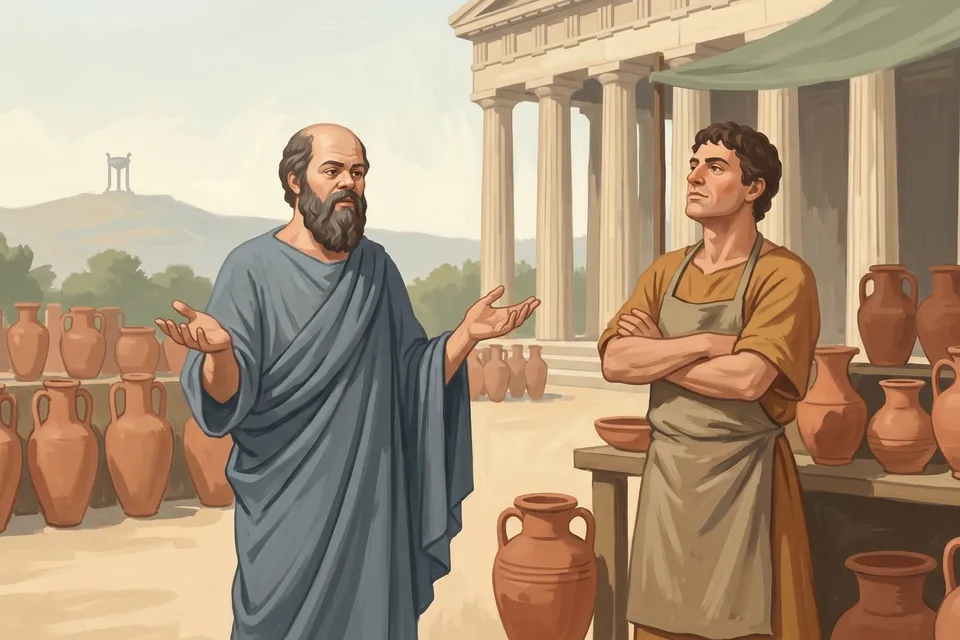
- Craftsmen, who genuinely did know their trades — but whose real expertise led them to assume authority on matters they knew nothing about.
The craftsmen are the sharpest observation in the passage. Socrates is not saying expertise is worthless. He is identifying the specific way competence becomes dangerous: it persuades people that their judgement travels beyond its domain.
Why This Is Not Scepticism
Socratic ignorance is often mistaken for the claim that knowledge is impossible. It is not. Socrates spent his life pursuing definitions of courage, justice and piety, which would be pointless if he thought no answer existed.
The position is better described as a working method. Genuine enquiry can only begin once you have stopped pretending to have arrived. The function of the disclaimer is to clear the ground — which is why his conversations so often end without a conclusion. An interlocutor who leaves confused but aware of it has, by this standard, gained something.
Why It Made Him Enemies
The method also explains the hostility. Socrates was not demonstrating his own cleverness; he was publicly showing prominent Athenians that they could not define the things they claimed to be experts in. Done once, that is embarrassing. Done for decades, in public, in front of impressionable young men, it accumulates into a serious political liability — and it forms part of the background to why he was eventually executed.
Conclusion
“I know that I know nothing” is a paraphrase that has outlived the thing it paraphrases. Socrates’ real claim was narrower and more usable: he did not believe he knew what he did not know. His supposed wisdom consisted entirely in declining to overstate his position.
For the ancient sources and the interpretive debates, see the Stanford Encyclopedia of Philosophy entry on Socrates. For why so much about his views remains contested, see the Socratic problem.
Keep reading