What Is Socratic Irony? Meaning, Examples and Why Socrates Used It
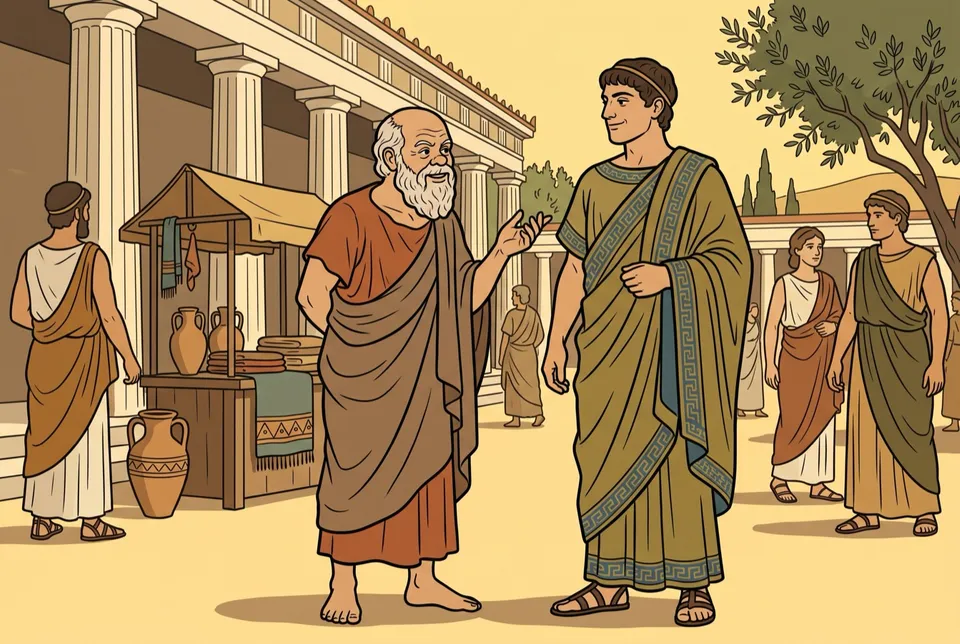
In short. Socratic irony is Socrates' habit of claiming ignorance and praising the people he questions while exposing what they don't know. What it means, with examples from Plato.
Socratic irony is Socrates’ habit of pretending to know less than the people he talks to: he claims ignorance, flatters his companions as experts, and asks to be taught, then lets his questions show that they do not know what they thought they knew. The term comes from Plato’s dialogues, where Socrates’ opponents complain about it, and it has been argued over ever since, because it is never quite clear how much of Socrates’ modesty is a pose.
In short, Socratic irony is feigned or partial ignorance used as a teaching method.
A simple example of Socratic irony
In the Euthyphro, Socrates meets a young man on his way to prosecute his own father for murder. Euthyphro is sure he knows exactly what piety requires. Socrates is on his way to court too, charged with impiety, and he responds with elaborate admiration:
“Then the best thing for me, my wonderful Euthyphro, is to become your pupil” (5a).
Socrates does not believe for a moment that Euthyphro is wise. Within a few pages, Euthyphro has offered several definitions of piety, each of which collapses under questioning, and he leaves in a hurry, still claiming to know. The praise at the start is the bait; the questions are the trap. That pattern, admiring the expert, asking to learn, then quietly dismantling the expertise, is Socratic irony at work. The Euthyphro dilemma that comes out of this conversation is still debated today.
Where does the word “irony” come from?
The Greek word is eirōneia, and in Socrates’ time it was not a compliment. An eirōn was a dissembler, someone who says less than he means in order to mislead. The word appears in the dialogues as an accusation made by Socrates’ irritated opponents:
- In the Republic, Thrasymachus loses patience: “There it is, Socrates’ usual irony! I knew it. I told everyone you would refuse to answer and would play ignorant” (337a).
- In the Symposium, Alcibiades says Socrates “spends his whole life being ironic and playing games with people” (216e).
Aristotle, a generation later, gave the word a milder sense. In the Nicomachean Ethics (1127b) the eirōn is someone who understates his own merits, the opposite of the boaster, and he names Socrates as the example. From there the word slowly became the literary term we use today: saying one thing while meaning something else.
Was Socrates really pretending?
This is the real puzzle, and there are three main answers.
1. It was a pose. On this reading, Socrates knew perfectly well what he thought and played dumb to draw people out. Thrasymachus believes this, and so do many readers who find Socrates manipulative.
2. It was sincere. Socrates says in the Apology that when the oracle at Delphi called him the wisest of men, he was baffled, because he knew he was not wise (21b). He concluded that his wisdom lay only in knowing that he did not know (21d). On this reading, his ignorance was real, and the “irony” is in the way others heard it. What Socrates meant by “I know that I know nothing” is the heart of this view.
3. It was both at once. The classicist Gregory Vlastos argued for what he called complex irony: Socrates’ claims are true in one sense and false in another. When he says he knows nothing, he means he has no certain, expert knowledge of the kind a craftsman has about his craft. That is true. But he also holds firm moral beliefs, for example that it is worse to do wrong than to suffer it, and he acts on them to the point of death. That is why his disclaimers sound false to his opponents, even though they are true in the sense he intends. Most scholars today hold some version of this view.
What was Socratic irony for?
Whatever its sincerity, the irony did several jobs in the conversations Plato recorded:
- It lowered people’s guard. Someone praised as an expert is happy to explain. People who would never admit ignorance to a critic will reveal it to an admirer.
- It put the burden on the other person. By refusing to state his own view, Socrates made his companions define their terms, and the definitions were what he tested.
- It forced people to think for themselves. In the Theaetetus (150b), Socrates compares himself to a midwife who delivers other people’s ideas rather than producing his own. Irony keeps the teacher from simply handing over answers.
- It exposed false confidence. The people Socrates questioned were usually the ones most sure of themselves: politicians, poets, sophists, experts on piety. His examination of them was, he said, a service to Athens: “the unexamined life is not worth living” (Apology 38a).
It also made him enemies. Being exposed in public by a man claiming to know nothing is humiliating, and Plato is clear that resentment of Socrates’ questioning played a part in his trial and death.
Socratic irony vs dramatic irony
Socratic irony is often confused with dramatic irony, and Plato uses both.
| Socratic irony | Dramatic irony | |
|---|---|---|
| Who knows more | The speaker (Socrates) | The audience |
| How it works | A character pretends not to know | Characters don’t know what readers know |
| Example | Socrates asking to be Euthyphro’s pupil | Readers knowing Socrates is about to be executed while he discusses piety |
Plato’s readers knew how Socrates’ story ended, so many dialogues carry dramatic irony on top of the Socratic kind. The opening of the Republic, set in the house of Cephalus, is a famous case: every reader knew the family would soon be ruined by the Thirty Tyrants.
Socratic irony in teaching and everyday life
The technique survives wherever someone asks a question they already know the answer to in order to make you work it out. Teachers use it in the Socratic method: “I’m not sure I follow, can you explain why that’s true?” Lawyers use it in cross-examination. The television detective Columbo made a career of it, apologising for being slow while leading suspects into contradictions.
The Danish philosopher Søren Kierkegaard wrote his doctoral thesis on the subject, The Concept of Irony, with Continual Reference to Socrates (1841), arguing that Socrates’ irony was not a trick at all but a whole stance towards life: a refusal to accept any answer as settled. That may be the best short definition. Socratic irony is the questioning attitude of a man who suspected that nobody, himself included, knew as much as they claimed.
Keep reading