Who Was Diotima? The Woman Who Taught Socrates About Love
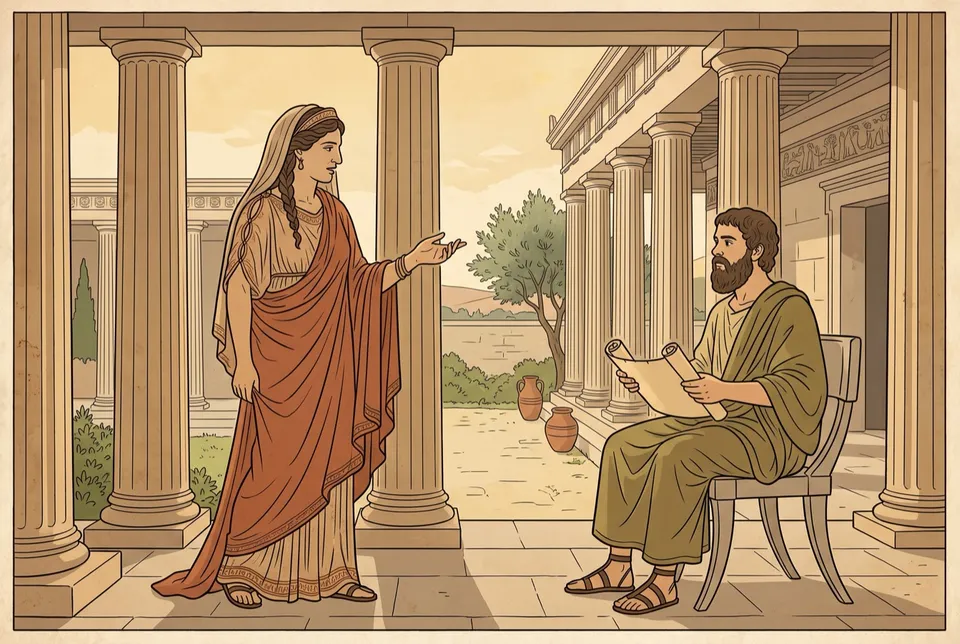
In short. Diotima of Mantinea is the priestess who, in Plato's Symposium, teaches Socrates what love is. Who she was, whether she was real, and why Plato gave her the last word.
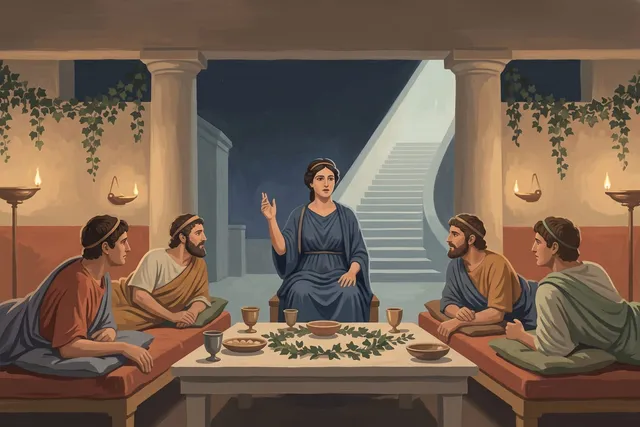
Diotima of Mantinea is the priestess who, in Plato’s Symposium, teaches Socrates what love is. She never appears on stage. Socrates reports her lessons from memory at a drinking party in Athens (201d–212a), and the speech he gives in her name is the philosophical core of the dialogue and the origin of what we now call platonic love.
She is one of only two characters in Plato who teach Socrates philosophy at length (the other is the old Parmenides, in the dialogue named after him), and the only woman. Whether she ever existed is another question.
What does Plato tell us about Diotima?
Very little, and all of it in one sentence. Socrates introduces her as “a woman of Mantinea, Diotima, who was wise in this and in many other things”, and adds that she once persuaded the Athenians to make sacrifices that held off the plague for ten years (201d). That is the whole biography. Everything else we know is what she says.
Three details are worth noticing:
- Her name. Diotima means roughly “honoured by Zeus”. It was a real Greek name, but it also fits her role a little too neatly.
- Her city. Mantinea was a real town in Arcadia, in the Peloponnese. Its name sounds like mantis, the Greek word for a seer or prophet, and Plato’s readers would have heard the pun: “the prophetess from Prophet-town”.
- Her profession. She is a religious expert, not a philosopher. Plato gives the most philosophical speech in the dialogue to someone whose authority comes from the gods.
Was Diotima a real person?
We cannot know, and most scholars think she was probably Plato’s invention. The case against her historical existence is simple: no ancient source independent of Plato mentions her. Every later reference to Diotima goes back to the Symposium.
The plague detail cuts both ways. Athens really was struck by a devastating plague in 430 BC. Plato’s first readers could have checked whether a Mantinean priestess had been credited with delaying it, which may argue for a real person behind the story. On the other hand, Socrates invents or embroiders teachers elsewhere: in the Menexenus (235e) he claims to have learned rhetoric from Aspasia, Pericles’s partner, and delivers a funeral speech that is plainly a pastiche.
A late-fifth-century relief found at Mantinea, showing a woman holding what looks like a liver (the tool of a seer who reads omens in sacrificed animals), is popularly called the “Diotima relief”. Nothing on it names her, and the identification is guesswork.
The honest position is the one most scholars take: Diotima may be based on a real religious figure, but the Diotima of the Symposium speaks Plato’s philosophy.
What did Diotima teach Socrates?
Her lesson has three parts. The first two are hers alone; the third, the famous ladder, is explained in full in our essay on platonic love.
Love is not a god. The earlier speakers at the party all praised Eros as a god, and Agathon called him the most beautiful of them. Diotima corrects Socrates, who had believed the same thing. Love desires beauty, she argues, and nobody desires what they already have, so Love cannot be beautiful. Nor can it be a god, since gods lack nothing. Love is a daimōn, a spirit halfway between mortals and gods, carrying messages between them (202d–203a). She tells a myth to make the point: Eros is the child of Poros (Resource) and Penia (Poverty), always needy and always scheming to get what he lacks (203b–e).
Love wants the good forever. What lovers really want, she argues, is for the good to be their own always (206a). Because mortals cannot live forever, love works through “giving birth in beauty” (206b). Some people are pregnant in body and have children; others are pregnant in soul and produce poems, laws, discoveries and virtues. Love is how a mortal creature reaches for immortality.
Love can climb. Rightly guided, love rises from one beautiful body to all beautiful bodies, then to beautiful souls, laws, and knowledge, until the lover suddenly sees Beauty itself, eternal and unchanging (210a–211b). This is the ladder of love, and it is where the idea of “Platonic love” comes from.
Why does Socrates learn from a woman?
The framing is deliberate, and it reverses the usual pattern of the dialogues.
In almost every other work, Socrates asks the questions and his companions discover that they do not know what they thought they knew. In the Symposium he tells us that Diotima did exactly this to him. When he was young, he says, he told her “nearly the same things Agathon has just told me”, and she refuted him the same way (201e). Socrates, the great questioner, presents himself as the one who was questioned. It fits his earlier claim in the same dialogue that the only thing he knows about is love (177d), and it shows his habit of disowning his own wisdom.
Giving the speech to a woman also sets it apart from everything that came before. The other speakers at the party are Athenian men praising a love conducted between men, largely as a social and sexual relationship. Diotima is an outsider in every sense: a foreigner, a woman, and a religious authority. Her speech carries the discussion above the party’s own assumptions, towards a love of wisdom and of Beauty itself.
Readers have argued for centuries about what this says about Plato’s views on women. He is, at the least, a philosopher who put his best account of love into the mouth of a woman, and who in the Republic let women rule as philosopher-guardians.
What happened after Diotima’s speech?
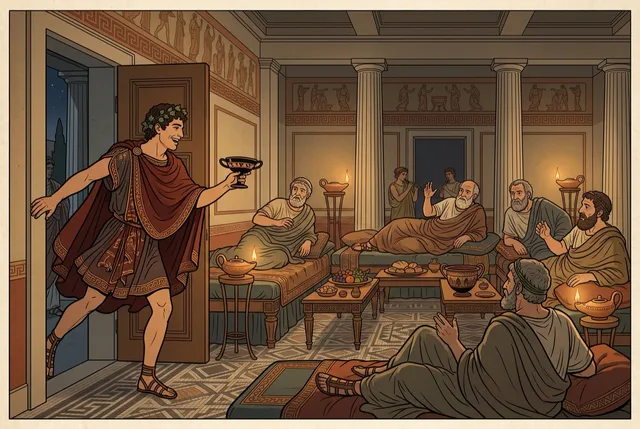
Plato does not let the speech end the evening. Just as the guests begin to respond, Alcibiades bursts in drunk (212c–d) and delivers a speech praising not love but Socrates, the man he could never seduce. After the calm heights of Diotima’s ladder, the dialogue drops back into the messy world of one real, unhappy love affair, and the contrast is the point. Diotima describes where love can lead; Alcibiades shows what it looks like when it doesn’t get there.
That is Diotima’s lasting role: the voice that tells Socrates, and every reader after him, that desire is not a distraction from philosophy but where philosophy begins.
Keep reading