Who Was Plotinus? The Philosopher Who Founded Neoplatonism
In short. Plotinus (c. 204/5-270 AD) was the philosopher who read Plato as a system centred on the One. His life, the Enneads, and his core ideas explained.
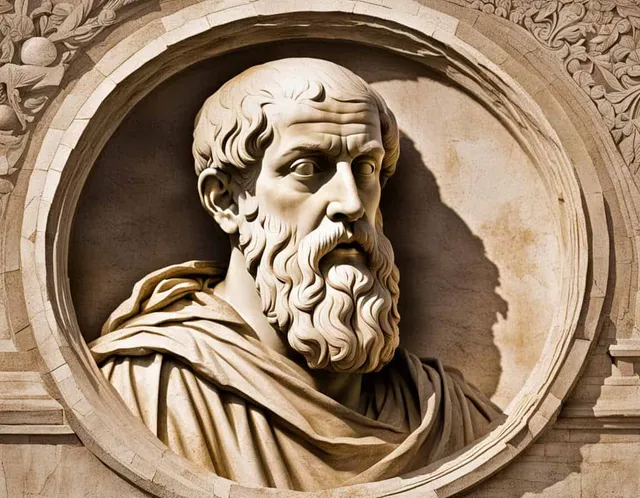
Plotinus (c. 204/5–270 AD) was a Greek-speaking philosopher, probably born in Egypt, who read Plato’s dialogues as the basis of a single connected system and became, in effect, the founder of what modern historians call Neoplatonism. He taught in Rome for over two decades, and his students collected and edited his essays into a work known as the Enneads, the most influential body of Platonist writing produced after Plato himself. Nearly everything known about his life comes from one source, a memoir by his student Porphyry, so this essay treats the biography and the philosophy separately and flags where the evidence is thin. For the technical vocabulary Plotinus gave to the levels of reality below the One, see what is hypostasis for Plato and Aristotle; for the wider movement he started, see what is Neoplatonism.
Who was Plotinus?
Plotinus was born around 204 or 205 AD, most likely in Lycopolis in Egypt, though that birthplace comes from later biographical tradition rather than from Porphyry’s near- contemporary account, so it should be held loosely. Porphyry’s Life of Plotinus opens with a famous, almost startling line: Plotinus “seemed ashamed of being in the body,” and would not discuss his parents, his homeland, or his birthday, and refused to sit for a portrait or have a statue made of him (Life 1). That single sentence sets the tone for everything that follows. Plotinus treated the body and its history as incidental to who he really was, and his philosophy gives a reasoned account of why.
At around twenty-eight, by his own later telling, Plotinus felt drawn to philosophy and went looking for a teacher in Alexandria, then the great centre of Greek learning. He tried several well-known lecturers and came away dissatisfied, until a friend took him to hear Ammonius Saccas. Porphyry reports that Plotinus said, on leaving that first lecture, “this is the man I was looking for” (Life 3), and he stayed with Ammonius for eleven years. Almost nothing certain survives of Ammonius’s own teaching, since he wrote nothing himself, which makes it hard to say exactly what Plotinus took from him beyond a general method and a devotion to Plato.
Why did Plotinus join a Persian military expedition?
In 243, curiosity about Eastern philosophy pushed Plotinus into an unusual detour. He joined the army of the emperor Gordian III as it marched east against Persia, hoping to make contact with Persian and Indian thought at first hand (Life 3). The campaign went badly: Gordian was killed, reportedly by his own mutinous troops, in Mesopotamia in 244, and Plotinus escaped the collapse with difficulty, eventually making his way to Antioch and then to Rome. Whatever he hoped to learn in Persia, nothing in the Enneads shows clear, specific debts to Persian or Indian sources, so the episode is usually read as evidence of Plotinus’s intellectual appetite rather than a real channel of influence on his mature thought.
What did Plotinus teach in Rome?
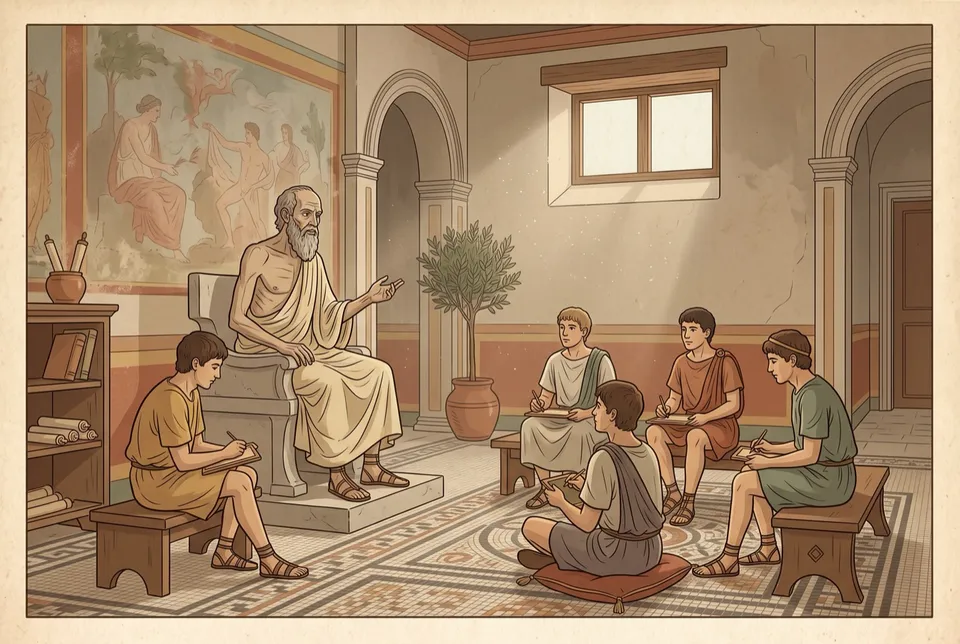
Plotinus settled in Rome in 244 and taught there for the rest of his life, running what was effectively a philosophical school out of the house of a well-connected Roman widow, Gemina. His circle included senators, doctors, and at least one emperor’s confidence: he enjoyed the favour of Gallienus and his wife Salonina. Porphyry reports that Plotinus used this standing to pitch an unusual project, refounding a ruined city in Campania as Platonopolis, a community to be governed by Plato’s laws from the Republic, with Plotinus and his students living there under a constitution drawn from Plato’s own text (Life 12). Court opposition killed the plan before it started, and no other source independently confirms the episode, so it is generally treated as a real but unrealised ambition rather than settled fact.
For the first ten years in Rome, Plotinus lectured but wrote nothing down, teaching by argument and question in the manner of a live Socratic circle rather than by dictating finished texts. He did not begin writing until about 253, when he was nearly fifty, and by Porphyry’s account he wrote quickly, in a kind of continuous inner dictation, and never reread or corrected a text once it was down, partly because of failing eyesight (Life 8). Porphyry, who joined the circle in 263, became his literary executor and edited the resulting essays after Plotinus’s death.
What is Porphyry’s Life of Plotinus, and how reliable is it?
Porphyry’s Life of Plotinus is the biography Porphyry placed at the head of his edition of the Enneads, and it is by far the fullest source for Plotinus’s life, personality, and teaching circle. It is not a neutral document. Porphyry wrote it decades after the fact, as an introduction meant to present his teacher, and by extension his own edition of the text, in the most favourable and often the most exalted light, so specific anecdotes deserve more caution than the broad outline of dates, places, and students, which scholars generally accept.
The Life’s most striking claim concerns Plotinus’s inner life rather than his outward biography. Porphyry writes that in the time he knew him, Plotinus reached a state of mystical union with “the god who is above all” four separate times (Life 23), a claim Porphyry offers as an eyewitness report of something Plotinus himself described rather than something Porphyry could verify independently. Whatever one makes of the claim, it fits the philosophy: the Enneads describe the soul’s highest goal as a direct, non-discursive contact with the One, beyond ordinary thought and language, and Porphyry is telling readers that his teacher did not just theorise about that ascent but, in his account, reached it.
What is Plotinus’s Enneads?
The Enneads is the collected philosophical writing of Plotinus, 54 essays that Porphyry arranged, after Plotinus’s death, into six groups of nine treatises each: ennea is Greek for “nine,” which gives the work its name. Porphyry’s ordering is thematic rather than chronological, moving roughly from ethics and the individual soul in the early Enneads through natural philosophy and psychology to metaphysics and the One in the last, so a treatise’s number in the Enneads does not tell you when Plotinus actually wrote it; Porphyry also records a separate chronological list in the Life for that purpose. Individual treatises are cited by Ennead and number, for example Ennead V.1, the treatise “On the Three Primary Hypostases.”
What are Plotinus’s core ideas?
Plotinus reads Plato’s dialogues, especially the Republic, Symposium, Timaeus, and Parmenides, as pointing toward a single ordered structure of reality, which he sets out most directly in Ennead V.1.
- The One. The absolute first principle, beyond being, beyond thought, and beyond description, since any positive description would make it a determinate something rather than the source of everything determinate. Plotinus identifies it with the Good “beyond being” of Republic 509b.
- Intellect (nous). The first thing to emanate from the One, and the level at which the Platonic Forms exist as objects of a perfect, unified thought.
- Soul (psuchē). The emanation of Intellect, which animates the physical cosmos and extends downward into individual souls, including human ones. The full account of how these three levels work as technical “hypostases” is covered in what is hypostasis for Plato and Aristotle, so this essay only sketches them here.
Everything below Soul comes from emanation, a procession in which each level overflows into the next without the source being diminished, the way light radiates from a lamp without the lamp losing anything. At the very bottom of the scale sits matter, which Plotinus treats not as a positive substance but as sheer privation, the near-total absence of form, order, and being. Because he identifies the good with being and order, Plotinus treats evil, correspondingly, not as a real force opposed to good but as an absence or deficiency of it, a position that lets him deny any independent, equal principle of evil in the universe.
The soul’s task, on this picture, is a return: the same movement as emanation run in reverse, back up through Soul and Intellect toward reunion with the One, achieved through virtue and philosophical contemplation. The most quoted description of that goal comes at the end of Ennead VI.9, commonly translated as the “flight of the alone to the alone,” the soul’s solitary approach to the solitary One, stripped of every intermediate thing.
What does Plotinus say about beauty?
Ennead I.6, Plotinus’s treatise “On Beauty,” is one of the most read sections of the Enneads on its own. It argues that beauty is not just pleasing proportion in matter but a sign of form and intelligible order shining through matter, so that the soul, recognising beauty, is really recognising something akin to its own true nature and is drawn upward by it. The treatise draws directly on the ascent through beautiful things to the Form of Beauty itself that Plato has Diotima describe in the Symposium; see who was Diotima and what is Platonic love for that source text.
What was Plotinus’s argument against the Gnostics?
Ennead II.9, conventionally titled “Against the Gnostics,” is Plotinus’s sustained attack on a religious movement present in his own Roman circle that taught the physical world was the flawed or malicious creation of a lesser, ignorant power, and that matter itself was evil. Plotinus rejects this on both philosophical and, notably, aesthetic grounds: he argues that the visible cosmos, with its order and beauty, is a good and rational production of Soul, and that contempt for the physical world reflects a failure to see the intelligible order shining through it, not insight into some deeper truth. The treatise is also useful evidence that debates we might expect to belong only to early Christianity, over whether matter and creation are good or evil, were live within pagan Platonist circles of the third century too.
How did Plotinus die?
Porphyry reports that Plotinus fell ill and withdrew to an estate in Campania, where he died around 270 AD, attended by a doctor named Eustochius. Porphyry records his last words as something like “I am trying to bring the god in us back to the god in the all,” though the exact wording is transmitted with some textual uncertainty across manuscripts and translations (Life 2), so it should be treated as a strong tradition rather than a verbatim transcript. It is, in any case, a fitting summary of the whole philosophy: the return of the divine element in the soul to its divine source.
What influence did Plotinus have?
Plotinus’s influence runs through the rest of ancient and medieval thought and well beyond it.
- Porphyry edited and published the Enneads and wrote the Life, without which almost none of this would be known in any detail.
- Augustine read “the books of the Platonists,” almost certainly Plotinus in Latin translation, and says in the Confessions (Book VII) that they helped free him from a crude, materialist idea of God before his conversion to Christianity; see what were Plato’s views on Christianity and how Plato’s philosophy shaped Christian theology for the wider line from Plato through Plotinus into Christian thought.
- Pseudo-Dionysius the Areopagite, writing around 500 AD, built a Christian theology of ascent and negative description of God that draws heavily on Plotinian and later Neoplatonic language, and carried that vocabulary into medieval Christian mysticism.
- Marsilio Ficino, in Renaissance Florence, translated the complete Enneads into Latin, published in 1492, putting Plotinus’s full text in front of Western readers for the first time in a millennium and shaping Florentine Platonism.
Plotinus: key dates
| Date | Event |
|---|---|
| c. 204/5 AD | Born, probably in Lycopolis, Egypt (tradition, not contemporary record) |
| c. 232 | Begins studying under Ammonius Saccas in Alexandria |
| 243 | Joins Gordian III’s expedition against Persia, hoping to learn Eastern philosophy |
| 244 | Gordian killed; Plotinus escapes to Antioch, then settles in Rome |
| 244–253 | Teaches in Rome without writing |
| c. 253 | Begins writing the treatises later collected as the Enneads |
| 263 | Porphyry joins Plotinus’s circle in Rome |
| c. 267–268 | Proposes Platonopolis to Emperor Gallienus; the plan is blocked |
| c. 270 | Dies in Campania |
| after 270 | Porphyry edits the Enneads into six groups of nine treatises |
| 1492 | Ficino’s Latin translation of the complete Enneads is published in Florence |
Why does Plotinus still matter?
Plotinus took Plato’s dialogues, written as open-ended conversations rather than a fixed system, and built from them a coherent metaphysics of the One, Intellect, and Soul that later readers, pagan and Christian alike, treated as the definitive account of what Platonism actually taught. That system, and the movement historians now call Neoplatonism that grew out of it, shaped how the late ancient and medieval world talked about God, creation, evil, and the soul’s return to its source, channels covered in full in what is Neoplatonism. Reading Plotinus is, in large part, reading the lens through which most of Western philosophy and theology first received Plato at all.
Keep reading