Who Taught Socrates? The Teachers Behind the Philosopher
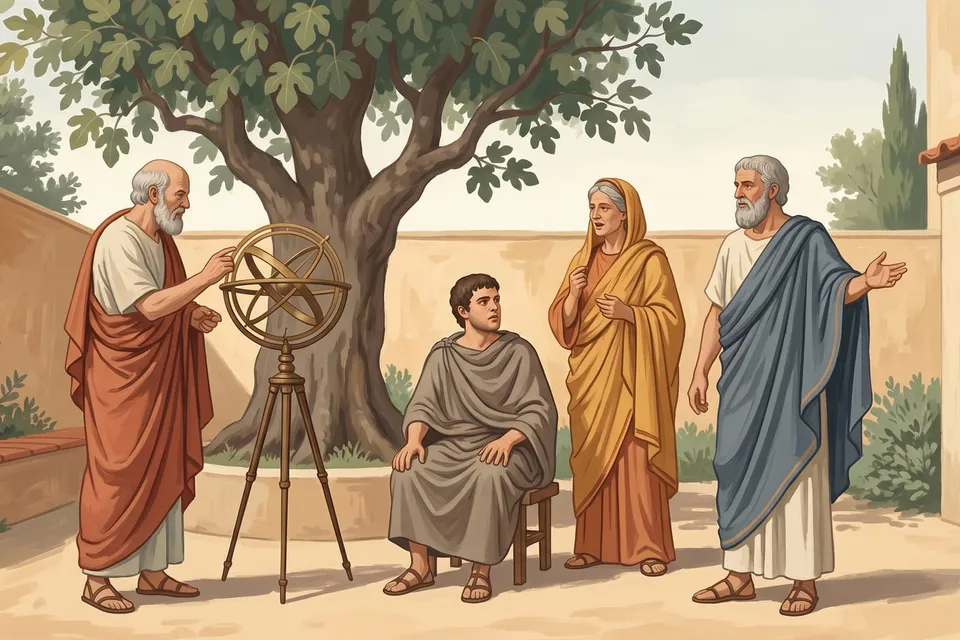
In short. Socrates named Archelaus, Aspasia, Diotima and Prodicus among his teachers. Here is what the sources actually say about who educated Socrates.
Socrates is so firmly fixed in the imagination as the original teacher that the question of who taught him rarely gets asked. The ancient sources do answer it, though they answer it inconsistently, and Socrates himself had an awkward habit of naming teachers half in jest.
The most commonly given answer is Archelaus, an Athenian natural philosopher. But the fuller picture involves a physicist he only read, two women he credited with teaching him, and a sophist he repeatedly claimed as his master while smiling.
Archelaus, the Natural Philosopher
The standard biographical tradition, preserved in Diogenes Laertius, names Archelaus of Athens as Socrates’ teacher. Archelaus was himself a pupil of Anaxagoras and worked on cosmology and the origins of life — the kind of natural science that the young Socrates is said to have pursued before turning to ethics.
This fits an otherwise puzzling piece of evidence. Aristophanes’ Clouds portrays Socrates as a physical speculator suspended in a basket studying the heavens. If Socrates had a documented youthful phase as a natural philosopher under Archelaus, that caricature had a target.
Anaxagoras: The Book That Disappointed Him
One teacher reached Socrates only through writing. In Plato’s Phaedo (97b–98c), Socrates describes hearing someone read from a book by Anaxagoras claiming that Mind orders all things. He was thrilled: it promised that everything could be explained by showing why it was best for things to be as they are.
Then he read on and found Anaxagoras explaining everything mechanically, by air and ether and water. The disappointment is one of the most important moments Plato attributes to him — it is the point at which Socrates gives up on physics and turns to a different kind of question altogether.
Aspasia of Miletus
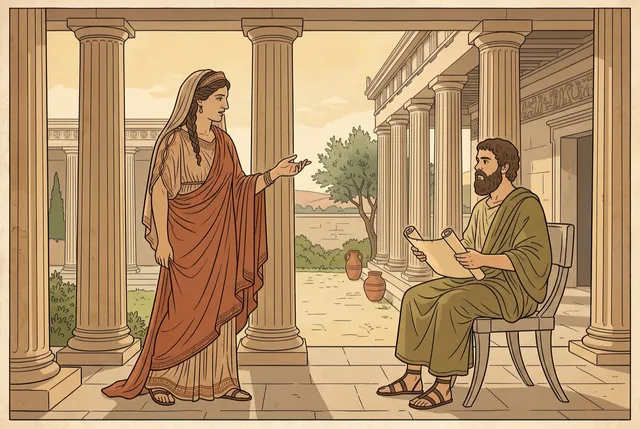
In Plato’s Menexenus (235e), Socrates claims that his teacher of rhetoric was Aspasia — the Milesian woman who was Pericles’ partner and one of the most intellectually formidable figures in Athens. He then delivers a funeral oration he says she composed.
The tone is playful and the attribution is probably not meant literally. But the joke only works if Aspasia was genuinely known as someone who could teach rhetoric to Athenian men, and other sources independently place her at the centre of Periclean intellectual life.
Diotima of Mantinea
The most famous teacher Socrates claims is Diotima, the priestess who, in Plato’s Symposium (201d onwards), taught him everything he knows about love. Socrates presents his entire theory of eros as a report of her instruction, positioning himself as the student rather than the authority.
Most scholars regard Diotima as Plato’s literary invention — a device that lets the philosophy arrive from outside Socrates and, notably, from a woman. Whether or not she lived, the framing tells us something real about how Socrates preferred to present knowledge: as something received and questioned, never simply possessed.
Prodicus, Damon and the Sophists
Socrates repeatedly names Prodicus of Ceos as his teacher, particularly on the precise use of words — in the Protagoras and the Meno among others. The claim is usually delivered with visible irony, since Socrates spent his life attacking the sophists’ practice of charging fees. The irony does not mean the influence was nil: distinguishing between words that look synonymous is exactly the technique Socrates uses to dismantle his interlocutors.
Some traditions add Damon, the music theorist associated with Pericles, on the theory that Athenian education in music and rhythm shaped his thinking about harmony in the soul.
Why Socrates Denied Having Teachers
There is a tension running through all of this. At his trial, Socrates insisted he had never been anyone’s teacher and had no wisdom to transmit. He described his own role using his mother’s trade: he was a midwife to other people’s ideas, delivering thoughts he had not himself conceived.
That self-description makes naming his teachers genuinely awkward, and it is likely why the ancient record is so mixed. A man whose entire method was to disclaim knowledge was never going to leave a tidy account of his own education. For the source material and its problems, see the Stanford Encyclopedia of Philosophy entry on Socrates.
Conclusion
If you want one name, it is Archelaus, the natural philosopher named by the biographical tradition. If you want the truer answer, Socrates was shaped by Anaxagoras through a book that let him down, by Prodicus’ precision about language, and by two women — Aspasia and Diotima — whom he credited with teaching him rhetoric and love respectively.
What he did not have was a school or a doctrine handed down to him, which is part of why reconstructing his actual views is so difficult.
Keep reading