What Is Socratic Questioning? Definition, Types and Examples
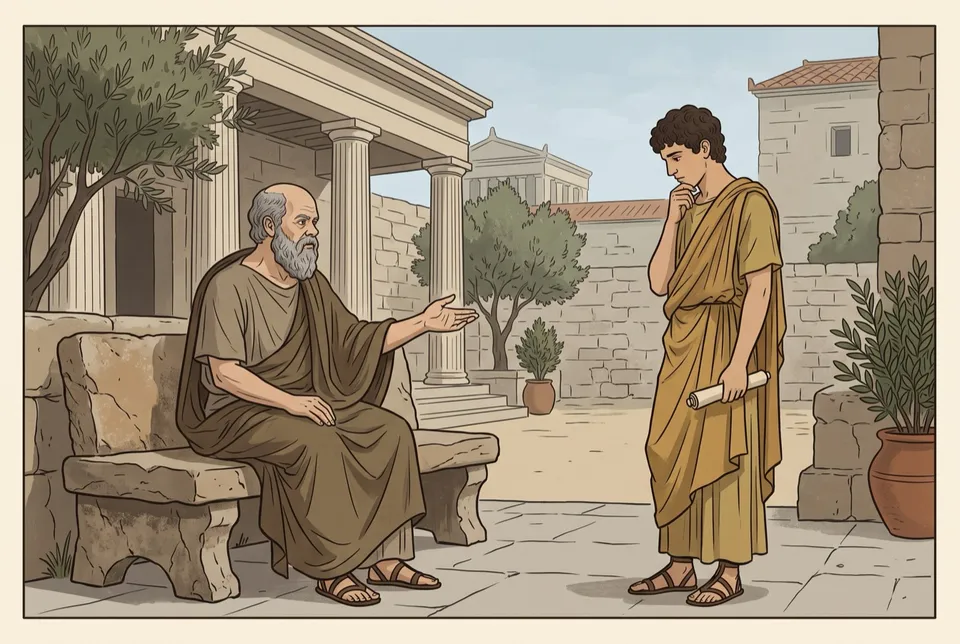
In short. Socratic questioning is a method of probing questions that test beliefs, uncover assumptions and expose contradictions. Its origins, six types and uses.
Socratic questioning is a method of disciplined, focused questioning used to test the truth, clarity and consistency of a belief, rather than simply asking for information. It takes its name from Socrates, the Athenian philosopher whose conversations Plato recorded, and its basic move is always the same: ask someone to define a term, test that definition against a hard case, and follow the resulting contradiction wherever it leads.
Today the phrase covers two related but distinct things. There is what Socrates actually did in Plato’s dialogues, which was often sharp, relentless and aimed at refutation. And there is the modern classroom and therapy technique that borrows his name but is usually gentler, more structured and aimed at guiding someone to a better answer rather than tearing down a bad one. Both are worth understanding on their own terms.
Where does Socratic questioning come from?
The method comes from the elenchus (Greek for “refutation” or “cross-examination”), the technique Socrates uses throughout Plato’s early dialogues. It has a recognisable shape. Socrates asks an interlocutor, someone he is questioning, for a definition of some important term: piety, courage, justice, friendship. The interlocutor gives an answer, usually with confidence. Socrates then tests that answer against a case where it seems to give the wrong result, or he shows that it contradicts something else the interlocutor already believes. The definition collapses, the interlocutor offers a revised one, and the cycle repeats.
Two early dialogues show the pattern clearly. In the Euthyphro, Socrates meets a young man on his way to prosecute his own father, supremely confident that he knows what piety is. Socrates, playing the eager student, asks to be taught (5a), then walks Euthyphro through one definition after another until each one fails. Our essay on Socratic irony covers that opening move, the false modesty that gets the questioning started, in detail. In the Laches, Socrates asks two respected generals to define courage. Laches offers “standing firm in battle” as a first answer (190e), and Socrates quickly finds cases, a strategic retreat, courage shown outside combat, that the definition cannot handle. Neither dialogue ends with a settled answer. That open-ended outcome is common enough in Plato’s early work to have its own name, aporia, which our companion essay explains in full.
Socrates offered an image for what he thought he was doing. In the Theaetetus, he compares himself to his mother, who was a midwife, and says he practises a kind of mental midwifery: he does not hand people finished ideas but helps them deliver ideas they already carry, then tests whether those ideas are healthy or false (150b-c). Whether that image is entirely honest is a separate question. What is Socratic irony? looks at how much of Socrates’ claimed ignorance was real and how much was strategy.
A worked example: what does it mean to be a “good friend”?
The following is not a quotation from any dialogue. It is a short illustration, written in plain modern language, of how a Socratic exchange tends to unfold.
Socrates: You said Maria is a good friend to you. What makes her a good friend?
Companion: She always agrees with me and supports whatever I decide.
Socrates: Suppose you decided to do something that would hurt you badly, and Maria knew it. Would agreeing with you then still be a sign of a good friend?
Companion: No, I suppose not. A good friend would say something.
Socrates: So a good friend does not simply agree with you.
Companion: Not always, no.
Socrates: Then what would you say instead: that a good friend supports your real interests, even when that means disagreeing with you?
Companion: That sounds closer to it.
Socrates: And how does Maria know what your real interests are, if not by knowing you well and caring what happens to you? Perhaps that, knowing you and caring for your good, is closer to the heart of friendship than agreement ever was.
Notice the shape: a confident first answer, a test case that the answer cannot survive, a revised answer, and a question that pushes further. That movement from case to contradiction to revision is the engine of Socratic questioning, whether it appears in Plato or in a classroom two and a half thousand years later.
The six types of Socratic questions used today
Modern teaching of Socratic questioning owes a great deal to the American critical thinking theorist Richard Paul, whose work with the Foundation for Critical Thinking set out a widely used taxonomy of Socratic question types. This classification is a modern teaching tool, not something found in Plato; Socrates himself did not organise his questions into these categories, though his actual practice touches on most of them.
| Type of question | Purpose | Example |
|---|---|---|
| Clarification | Get the person to explain what they mean | “What exactly do you mean by ‘fair’?” |
| Probing assumptions | Surface beliefs taken for granted | “What are you assuming when you say that?” |
| Probing reasons and evidence | Ask what the claim rests on | “What evidence supports that view?” |
| Viewpoints and perspectives | Introduce an alternative angle | “How might someone who disagrees see this?” |
| Implications and consequences | Follow the claim to what it entails | “If that is true, what follows from it?” |
| Questions about the question | Step back from the topic to the inquiry itself | “Why do you think I asked that question?” |
These six categories are usually taught as a toolkit rather than a strict sequence. A teacher or facilitator might move between them freely within a single conversation, picking whichever type will do the most to test or deepen the answer just given.
Socratic questioning in education
In schools and universities, the method is often run as a Socratic seminar: a group of students sits in a circle and works through a text or a problem using only questions, usually with a teacher moderating rather than lecturing. The goal is not to reach a single correct answer as fast as possible but to make students articulate their reasoning, respond to challenges, and notice when their own position does not hold up. Law schools use a close cousin of this, cold-calling students to defend a legal position under questioning. Our longer piece on the Socratic method in Plato covers its broader use in education and other fields.
The classroom version differs from Socrates’ own practice in an important way: it is usually cooperative. The goal is for the group, and the individual being questioned, to end up somewhere better than they started, not simply to be shown wrong.
Socratic questioning in cognitive behavioural therapy
Socratic questioning also has a well-established place in cognitive behavioural therapy (CBT), where it is used to help a client examine automatic thoughts, the quick, often distorted judgements a person makes about a situation without noticing they are doing it. A therapist might ask what evidence supports a thought like “everyone at the meeting thinks I did badly,” what evidence weighs against it, whether there is another way to interpret the same event, and what the client would say to a friend who had the same thought. This use of guided questioning to test the accuracy of a belief, rather than simply telling the client they are wrong, is closely associated with the American psychiatrist Aaron Beck, one of the founders of cognitive therapy. The aim in a therapeutic setting is collaborative: the client, not the therapist, is meant to reach the revised, more balanced thought.
How modern Socratic questioning differs from what Socrates did
It is worth being honest about the gap between the ancient method and its modern descendants.
- Aim. Socrates’ elenchus was often aimed squarely at refutation, showing that a confident claim to knowledge did not survive scrutiny, and it frequently ended in aporia rather than a better answer. Modern Socratic questioning, in classrooms and in therapy, is usually aimed at construction: helping someone build a more accurate or defensible view.
- Tone. Socrates could be relentless, and his interlocutors sometimes left irritated or embarrassed; Euthyphro simply hurries away. Modern practitioners are trained to keep the process collaborative and to avoid questioning that feels like an attack.
- Who leads. In Plato, Socrates usually already senses where the argument is going, even while denying he knows the answer. In a well-run classroom seminar or therapy session, the questioner is meant to be genuinely open to where the client’s or student’s own reasoning leads, guiding rather than steering to a predetermined conclusion.
- Outcome. Ancient Socratic dialogues frequently end without resolution. Modern applications generally aim for, and usually reach, some kind of resolution: a clearer definition, a more balanced thought, a defensible position.
Common pitfalls of Socratic questioning
Used badly, the method can curdle into something unhelpful. A few things to watch for:
- Turning into interrogation. A rapid sequence of “why” questions can feel like an attack rather than an inquiry, especially if the questioner already has a fixed answer in mind and is just walking the other person toward it.
- Rhetorical questions in disguise. A question asked only to make a point, with no real interest in the answer, is not Socratic questioning; it is a lecture wearing a question mark.
- Skipping clarification. Jumping straight to probing assumptions or implications before establishing what the person actually means invites talking past each other.
- Mistaking discomfort for progress. Socrates was willing to leave people in aporia, genuinely stuck, because he thought that discomfort was valuable. In a classroom or therapy session, prolonged confusion without any scaffolding to move forward is usually a sign the questioning has gone too far, too fast.
Why the method has lasted
Socratic questioning survives, in the classroom, the therapist’s office, the courtroom and the debate stage, because the basic insight behind it is hard to improve on: people rarely examine their own beliefs unless someone asks them to, one careful question at a time. Socrates’ version was sharper and less forgiving than the modern classroom or clinical version, and it often ended in confusion rather than clarity. But the underlying discipline, asking what a claim actually means, what it assumes, and what follows if it is true, is the same discipline in both cases, twenty-four centuries apart.
Keep reading