What Is Aporia? Meaning in Plato, Philosophy and Rhetoric
In short. Aporia is a Greek word for being at a loss, a state of genuine puzzlement. Its meaning in Plato's dialogues, in Aristotle, in rhetoric and in modern thought.
Aporia is a Greek word meaning “without a passage” or “no way through,” used to describe a state of genuine puzzlement, being stuck, with no clear route to an answer. In Plato’s dialogues it names the point a conversation often reaches after Socratic questioning has stripped away a confident but mistaken belief and left nothing obviously better in its place. The word later travelled into rhetoric, where it means a speaker’s staged display of doubt, and into modern philosophy, where it has come to stand for impasses that cannot be neatly resolved at all.
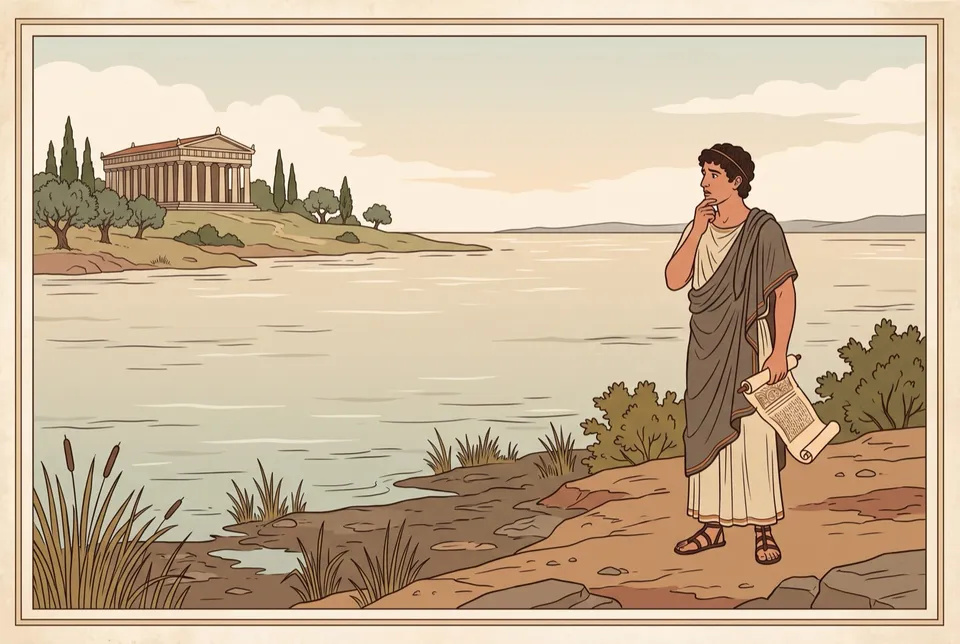
The root is a- (without) plus poros (a passage, a ford, a way across). A poros was literally a crossing point, over a river or a strait; someone in aporia has come to the edge of the water and cannot find where to cross. That image, of being stopped rather than simply ignorant, is the key to understanding why Plato treats the state as valuable rather than merely frustrating.
Aporia in Plato’s early dialogues
Many of Plato’s earlier dialogues, often grouped together as the “aporetic” or “Socratic” dialogues, end without settling the question they raise. The Euthyphro asks what piety is and ends with Euthyphro hurrying away, his definitions all refuted, still not knowing. The Laches asks what courage is and ends the same way; our essay on why Plato wrote the Laches looks at that dialogue’s inconclusive close in more detail. The Charmides asks what temperance, or self-control, is, and reaches a similarly open ending, a pattern covered in our piece on the Charmides. The Lysis asks what friendship is and closes with Socrates admitting that he and his young companions still do not know, despite having talked the whole time as if they did.
This is not Plato failing to finish his argument. It is the expected result of the method Socrates uses throughout these conversations: ask for a definition, test it against hard cases, show that it fails, and repeat. Our essay on Socratic questioning sets out that method, the elenchus, in full. Aporia is simply what that method produces when no better definition survives testing by the end of the conversation.
The torpedo fish and Meno’s paradox
The clearest and most famous discussion of aporia in Plato comes in the Meno. After Socrates has spent some time refuting Meno’s attempted definitions of virtue, Meno complains, comparing Socrates to a narkē, the Greek word for the electric torpedo fish or stingray that can numb anything it touches. Meno says that Socrates has numbed his mind and mouth alike, so that he no longer knows what to say, and that if a stranger tried this trick in another city Socrates would likely be arrested as a wizard (80a-b).
Meno then turns the numbness into an objection to the whole method, in an argument known as Meno’s paradox or the paradox of inquiry. If you already know what you are looking for, he says, you do not need to inquire, because you already have it; and if you do not know what you are looking for, you cannot recognise it even if you stumble on it, so you would not know what to look for or know it if you found it (80d-e). Either way, Meno concludes, real inquiry into the unknown looks impossible. It is one of the sharpest statements in Plato of why aporia might seem like a dead end rather than a useful stopping point.
Socrates’ answer is the theory of recollection: the soul, having existed before birth, has already learned everything, so what looks like learning something new is really the soul recovering knowledge it already possesses. Our essay on the theory of recollection in the Meno sets out that argument and its implications for education in full. Whatever one makes of the theory, its purpose in the dialogue is precise: it is Plato’s way of showing that aporia is not the end of the road, because there is, after all, a way to search for something you do not yet consciously know.
The slave boy’s productive perplexity
Socrates then demonstrates the point with a young slave who has had no training in mathematics. Through a careful sequence of questions about a square and its area, Socrates leads the boy to give a wrong answer, shows him it is wrong, and brings him to the point of being genuinely stuck, unable to say what the answer is (84a-c). Socrates draws attention to this moment directly: before the questioning, the boy thought he knew the answer and was wrong; now he knows that he does not know, and Socrates says this new awareness has done him no harm and has in fact left him better off, more eager to find out the truth (84b-c).
This is the clearest statement anywhere in Plato of why aporia matters. Confident ignorance, thinking you know when you do not, is worse than aporia, because it closes off inquiry before it can start. Aporia, uncomfortable as it is, opens inquiry up. The boy’s perplexity is not a failure of the lesson. It is the necessary first step of it.
Why Plato thought aporia was valuable
Aporia clears the ground. Someone convinced they already understand piety, courage or virtue has no reason to keep thinking about it. Only once that false confidence is removed, which is exactly what happens in the Euthyphro, the Laches and the Meno before its turn to recollection, is there room for real inquiry to begin.
Plato connects this directly to wonder. In the Theaetetus, Socrates tells the young mathematician Theaetetus that wonder, thauma in Greek, is the mark of a philosopher, and that philosophy has no other origin than this feeling of astonished puzzlement (155d). Aporia and wonder are close cousins: both mark the moment when the familiar stops making sense and genuine thinking becomes necessary. A conversation that ends in aporia has not failed; it has done the one thing that has to happen before philosophy can start.
Aristotle’s aporiai: puzzles to work through
Aristotle took the word in a more structured direction. In Book III of the Metaphysics, also known as Book Beta, he opens his inquiry by laying out a series of aporiai, puzzles or standing difficulties in the subject he is about to investigate, such as whether the study of being belongs to one science or several, and whether universals or particulars are more truly real. Aristotle’s method is to work carefully through each puzzle, considering the arguments on both sides, before proposing his own answers in later books. His guiding idea, stated in that same discussion, is that a thinker who has not first grasped the knot cannot hope to untie it: you have to see the full difficulty of a problem before you can solve it. Where Socratic aporia in Plato is often the end point of a conversation, Aristotelian aporiai are typically the starting point of a systematic inquiry, catalogued in advance so that the investigation knows what it has to answer.
Aporia as a figure of speech
Aporia also has a life in rhetoric, quite separate from its philosophical use, where it names a figure of speech: a speaker voices real or feigned doubt about what to say or where to begin, usually to draw the audience in or to signal the difficulty of the subject. “Where shall I begin?” or “I hardly know how to put this” are simple examples. Hamlet’s soliloquy “To be, or not to be, that is the question” is commonly cited by rhetoricians as a famous instance of deliberative aporia in this sense, a character staging his own indecision aloud. This rhetorical aporia is a performance of uncertainty, which may or may not reflect real puzzlement in the speaker, unlike the philosophical aporia of Plato’s dialogues, which is meant to be genuine.
Aporia in modern philosophy
The word survives in modern philosophy too, most notably in the work of the French philosopher Jacques Derrida, who used aporia to describe certain impasses, such as the relationship between a rule and its application in a particular case, that he argued could not be resolved by finding a cleverer answer, because the difficulty was built into the structure of the concepts themselves. For Derrida, unlike for Plato’s Socrates, some aporias are not waiting to be dissolved by better inquiry; they are a permanent feature of certain kinds of thought.
Aporia at a glance
| Context | What aporia means | Example |
|---|---|---|
| Plato’s early dialogues | A conversation ends with no agreed answer, false confidence stripped away | Euthyphro, Laches, Charmides, Lysis end without a settled definition |
| The Meno | The paradox of inquiry, and the productive confusion that precedes learning | Meno’s torpedo-fish complaint (80a-b); the slave boy’s perplexity (84a-c) |
| Aristotle | A catalogued philosophical puzzle to be worked through methodically | The aporiai opening Metaphysics Book III (Beta) |
| Rhetoric | A speaker’s staged doubt about what to say, used for effect | Hamlet’s “To be, or not to be” |
| Modern philosophy | An impasse built into a concept, not fully resolvable by argument | Derrida’s use of the term for undecidable cases |
The value of being stuck
What ties these different uses together is the idea that being stuck is not always a failure. Plato’s Socrates deliberately brings his companions to aporia because he thinks confident false belief is the real obstacle to knowledge, and that clearing it away, even without immediately replacing it with something better, is progress. Our essay on Socratic questioning explains the method that produces this state, and our piece on Socratic irony looks at the false modesty Socrates uses to get the conversation there. Read together with the Meno, they show why Plato treated the feeling of not knowing where to turn not as an embarrassment, but as the beginning of the only kind of thinking worth doing.
Keep reading