What Is a Socratic Seminar? Definition, Format and How to Run One
In short. A Socratic seminar is a student-led discussion of a text, driven by open questions, aimed at shared understanding rather than winning. How it works.
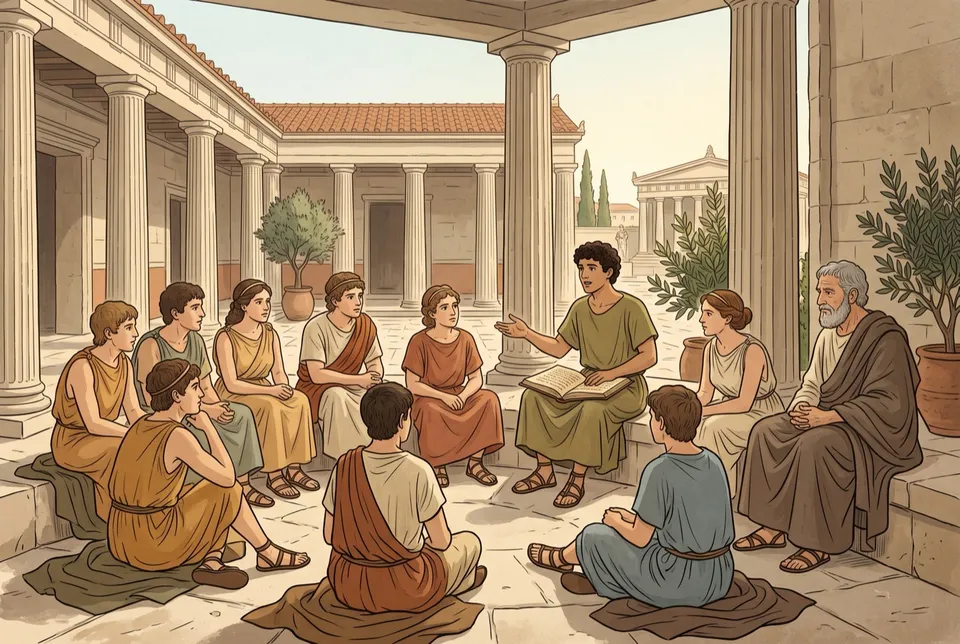
A Socratic seminar is a structured, student-led discussion of a text, driven by open-ended questions rather than a search for one right answer. The class sits where they can see each other, usually a circle, and talks through a shared text using questions the teacher or the students themselves have prepared. The goal is shared understanding, not winning an argument, and the teacher facilitates from the side rather than lecturing from the front.
If your teacher has assigned one, or you are the teacher planning one, this essay covers how it actually works: the norms, the question types, how to prepare, how it tends to be graded, and the common ways it goes wrong. It also traces the format back to its namesake, Socrates, and is honest about where the classroom version and the historical Socrates part ways.
Where does the idea come from?
The name comes from Socrates, the Athenian philosopher who spent his life in the streets and gymnasia of Athens asking people questions about what they claimed to know. Plato wrote these conversations down, and the method behind them, cross-examining a claim until it either holds up or falls apart, is usually called Socratic questioning. Our essay on Socratic questioning covers that method in full, including the six question types teachers still draw on today, and our essay on the Socratic method looks at how it spread into classrooms and law schools.
It is worth being precise here: Socrates did not run seminars. He questioned one or two people at a time, in public, often to refute a confident but mistaken claim, and he had no fixed classroom, no roster of students, and no lesson plan. The modern Socratic seminar, a whole class working through a text together in a structured, cooperative format, is a 20th-century American invention. Mortimer Adler’s Paideia Proposal (1982) is commonly credited with popularising the seminar as one of three basic kinds of teaching, alongside didactic instruction (lecturing) and coaching (guided practice). The seminar format has been adapted and refined by many educators since, but the underlying idea, borrowing Socrates’ name for a discussion method he himself never practised in this shape, is the same across most versions.
How does a Socratic seminar work?
A typical seminar has five moving parts.
The text. Everyone reads the same short text beforehand, an excerpt, a poem, a primary source, a case study. The text has to be dense enough to reward re-reading and open to more than one reasonable interpretation. A text with one obvious “correct” meaning does not give a seminar much to work with.
The opening question. The facilitator starts with a broad, genuinely open question tied to the text, one that does not have a single right answer and that everyone in the room can respond to from what they read. A good opening question gets several different people talking in the first few minutes rather than settling into a back-and-forth between two students.
The norms. Before the talking starts, the class usually agrees on a short set of ground rules:
- Refer back to the text. Claims need to be anchored in a specific line or passage, not just a general impression.
- Build on what others say. A comment that starts with “I want to add to what Sam said” is doing the job better than one that ignores the last five minutes of conversation.
- Disagree with the idea, not the person. It is fine, expected even, to push back on a classmate’s reading of the text; it is not fine to make it personal.
- Invite quieter voices in. Students are usually asked to watch who has spoken and to open space for people who have not, rather than leaving that entirely to the teacher.
The facilitator’s role. The teacher (or a trained student facilitator) asks the opening question, then mostly steps back. Their job during the discussion is to keep it moving, ask a follow-up question if it stalls, redirect a conversation that has drifted off the text, and make sure it stays a discussion rather than a debate or a lecture. A facilitator who talks more than a couple of students combined has usually taken over the seminar rather than run it.
Closing reflection. Most seminars end with a short written or verbal reflection: what changed in your thinking, what question are you still stuck on, what did someone else say that you had not considered. This is often where the most honest thinking shows up, after the group conversation has done its work.
What are the different Socratic seminar formats?
The whole-circle format is the simplest: the entire class sits in one circle and everyone can speak. It works well with smaller classes or a group that already discusses well.
The inner circle / outer circle format, often called a fishbowl, splits the class in two. A smaller inner circle actually discusses the text while a larger outer circle observes, usually with a specific job: tracking how often each inner-circle student speaks, noting when someone refers to the text, or logging a particular move like building on another student’s point. Circles sometimes swap partway through so everyone gets a turn discussing. The fishbowl format is common in larger classes, where a single circle of thirty students makes real discussion hard to sustain.
These two are the most widely used variations, but they are common practices rather than a single official method. Different schools and teachers adapt the basic shape, adding a “hot seat” chair for a student to temporarily join the inner circle, a silent round where students can only write comments on paper before speaking, or a second-round rule that caps how many times any one student can speak before others have had a turn.
What are good Socratic seminar questions?
Seminar questions are usually grouped into three rough stages.
Opening questions get the discussion started and should be answerable from more than one angle. Examples: “What does the author seem to believe is more important, and how do you know?” or “What is the central tension in this passage?”
Core or analytical questions dig into specific claims, word choices, or contradictions in the text, and usually come from the facilitator’s prepared list or from students’ own annotations. Examples: “Why does the character make this choice here rather than earlier?” or “Is there a place where the text seems to contradict itself?”
Closing or connecting questions ask students to step back and relate the text to something bigger, another text, their own experience, a present-day issue. Examples: “Has anyone changed their mind during this discussion, and why?” or “Where else have you seen this same idea play out?”
Students are usually given, or asked to bring, a small set of sentence starters to keep the conversation anchored and civil:
- “I agree with ___ because…”
- “Can you point to where the text says that?”
- “I see it differently. I think…”
- “That connects to what ___ said earlier, because…”
- “I’m not sure I follow. Can you say more about…?”
How are students graded in a Socratic seminar?
Most teachers use some form of participation rubric, scored either by the facilitator or, in a fishbowl, by outer-circle observers. The exact scale varies by school, but the criteria tend to cluster around the same few things:
- Use of the text. Are comments backed by a specific line, quote, or example, rather than a general opinion about the topic?
- Listening. Does the student respond to what was just said, or do they just wait for a gap to make an unrelated point?
- Building on others. Does the student reference classmates by name and extend, qualify, or respectfully challenge what they said?
- Balance. Did the student speak enough to contribute, without dominating the conversation?
Rubrics differ from teacher to teacher and school to school, so it is worth checking exactly what yours rewards before the seminar starts.
How should a student prepare for a Socratic seminar?
Preparation happens almost entirely before the seminar, not during it.
- Annotate the text. Read it once for the overall sense, then again with a pen. Mark anything confusing, surprising, or that seems to contradict something else in the text.
- Write three or four open questions. These should be questions you genuinely do not know the answer to, not ones with an obvious response. “What does the writer mean by this line?” is more useful than “Do you agree this is bad?”
- Mark evidence you can cite. Flag two or three passages you could point to if the discussion turns to a claim you want to make. Going in with page numbers or line references ready makes it much easier to speak up.
- Plan one thing to say early. The hardest part of a seminar for many students is the first thirty seconds. Having a comment or question ready for the opening question removes that barrier.
Tips for teachers running a Socratic seminar
- Choose a text with real ambiguity. If everyone will agree in the first two minutes, the discussion has nowhere to go.
- Resist the urge to answer your own opening question, or to correct a wrong reading too quickly. Let the group work it out; that is the point of the format.
- Use wait time. A silence after a question feels long to a teacher and short to a student who is still thinking.
- Keep a visible tally of who has spoken, even informally, so the same two or three students do not carry the whole seminar.
- Debrief afterward. A short conversation about how the discussion itself went, not just its content, helps a class improve at the format over time.
Common pitfalls in a Socratic seminar
- A few dominant voices. Without some structure, the most confident students can end up doing most of the talking, while others opt out entirely.
- Turning into a debate. A seminar is not about winning. If students start scoring points instead of building shared understanding, the facilitator needs to redirect back to the text.
- Off-text opinion. It is easy for a discussion to drift into general opinions about the topic with no reference to what the text actually says. The “point to the text” norm exists specifically to prevent this.
- The facilitator taking over. A teacher who jumps in to correct every misreading or answer every question has turned the seminar back into a lecture.
Socratic seminar vs. debate
| Socratic seminar | Debate | |
|---|---|---|
| Goal | Shared understanding of a text | Winning an argument |
| Structure | Open discussion, often circular | Structured turns, opposing sides |
| Preparation | Annotate text, write open questions | Build a case for an assigned position |
| Roles | Facilitator plus participants, all exploring together | Two sides, often with assigned positions they may not hold |
| Success looks like | A deeper or changed understanding, not necessarily agreement | A judged winner, or a clearly stronger case |
| Evidence used | Direct citation from the shared text | Any supporting evidence for the assigned side |
How this differs from what Socrates actually did
The classroom seminar and the historical Socrates share a name and a commitment to real questions over lectures, but the resemblance has limits. Socrates compared his own method to midwifery, helping someone else deliver an idea they already carried rather than handing them a finished answer (Theaetetus 150b-c), and he insisted, famously, that the unexamined life is not worth living for a human being (Apology 38a), one of the genuine Socrates quotes with a clear source. But his conversations were usually one-on-one or one-against-a-few, not a whole class working together, and they were often adversarial: he was testing a specific person’s claim to know something, and he frequently left that person in aporia, genuinely stuck, with no replacement answer at all. Our essay on aporia covers that outcome and why Plato treated it as valuable rather than as a failure.
A Socratic seminar is built to avoid that ending. It is cooperative by design: the whole group is meant to leave with a fuller understanding than they arrived with, even if they still disagree. Socrates would likely recognise the commitment to real questions and to following the text wherever it leads. He would probably find the tidiness of a forty-minute period, and the expectation that everyone leaves satisfied, quite foreign to how he actually worked.
Keep reading