Who Was Cephalus? The Old Man Who Opens Plato's Republic
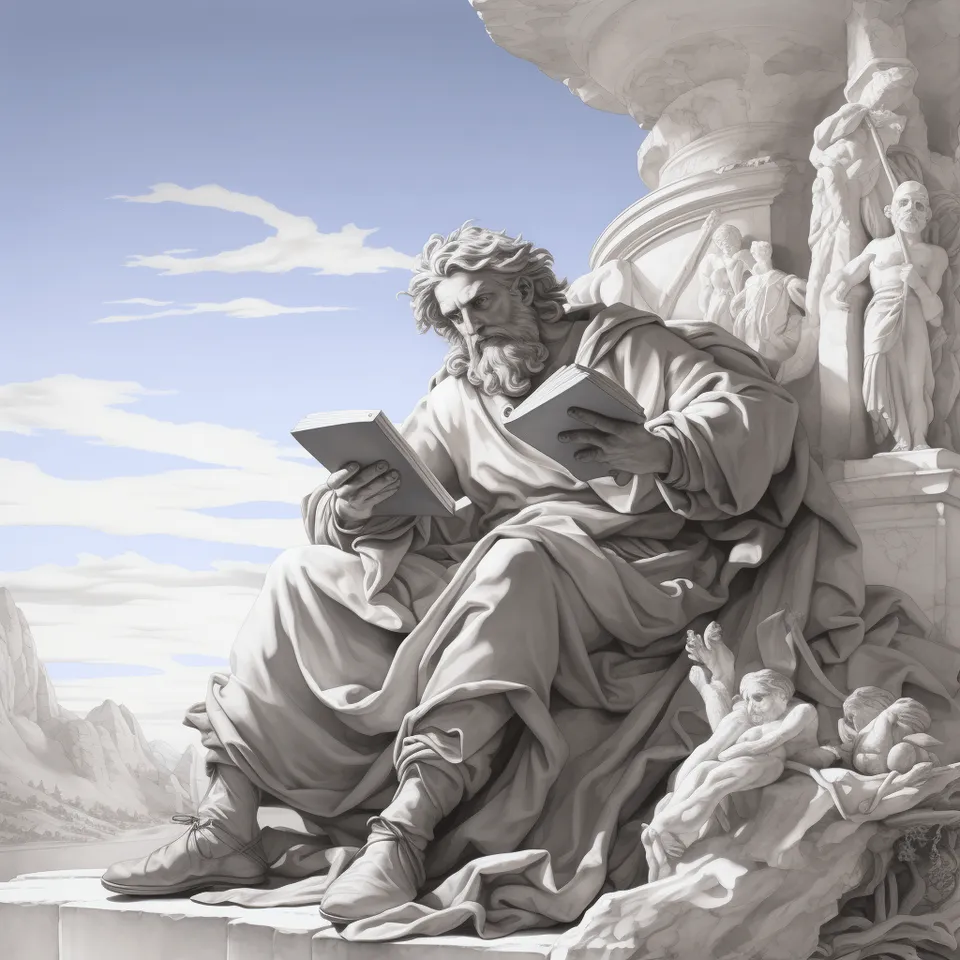
In short. Cephalus is the wealthy old arms-maker whose definition of justice — telling the truth and paying your debts — opens Plato's Republic, and whose fate is its darkest irony.
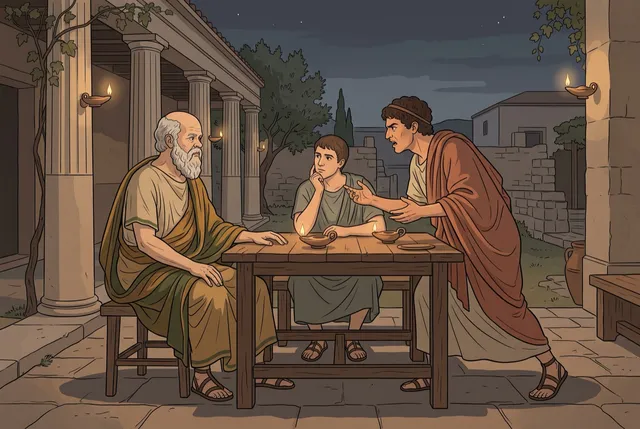
Cephalus is the first interlocutor of Plato’s Republic: a wealthy, pious old man at whose house the whole dialogue takes place, and whose definition of justice — telling the truth and paying what you owe — is the first one Socrates examines and the first one that fails. He is on stage for only a few pages (328b–331d), and Plato uses every one of them.
He was also a real person, and knowing who he was changes how the scene reads.
The historical Cephalus
Cephalus was a metic — a resident foreigner — from Syracuse, invited to Athens in the time of Pericles. He made his fortune manufacturing shields, ran one of the largest workshops in Attica, and settled in the port district of Piraeus, where the Republic is set. Two of his sons appear in the dialogue: Polemarchus, who inherits the argument, and Lysias, who became one of the greatest Greek orators.
So the opening of the Republic is set in the house of an arms dealer: a man whose comfortable old age was purchased, quite literally, by war. Plato chose that setting for a dialogue about justice on purpose.
What Cephalus actually says
Socrates, seeing a man near the end of life, asks him what old age is like. Cephalus’s answer (329d) is one of the most humane moments in Plato: most of his contemporaries complain, he says, but they blame the wrong thing — the troubles of age come from a person’s character, not their years. For the orderly and even-tempered, old age is a release: he quotes the poet Sophocles, who, asked whether he could still make love, replied that he was delighted to have escaped that “raging and savage master”.
Socrates presses: isn’t it easier to be serene when you’re rich? Cephalus concedes wealth matters, but not for luxury — its real value is that a rich man need not cheat or lie (331b). He owes no one money, no sacrifices to the gods; he can leave life without debts. And there, without quite intending to, he has defined justice: speaking the truth and repaying what one has taken.
Socrates’ counterexample: the madman’s weapon
Socrates answers with a single case (331c): suppose a friend, sane, lends you a weapon — and then, mad, demands it back. Returning it would be “paying what you owe”. It would also be wrong, and telling such a man the plain truth would be wrong too. So justice cannot simply be truth-telling and debt-paying: sometimes the just act breaks both rules.
The move is the whole Socratic method in miniature: take the received definition, find the case where it fails, and force the search for something deeper. Every definition of justice in Book 1 — Cephalus’s rules, Polemarchus’s “help friends and harm enemies”, Thrasymachus’s “the advantage of the stronger” — falls to the same treatment, clearing the ground for the city-building of the rest of the Republic.
The exit that says everything
Cephalus does not stay to argue. Smiling, he hands the discussion to Polemarchus — “the heir of the argument”, as he puts it — and leaves to tend the sacrifices (331d). Readers have laughed at the line for two thousand years: the argument is inherited along with the money, and the old man would rather perform piety than examine it.
But Plato’s point is not mockery. Cephalus is decent — genuinely so — and that is precisely the problem. His justice is habit resting on comfort: it has never been tested, because wealth spared him the occasions for injustice, a point he half-admits himself (330d, citing the poet Simonides). Conventional morality works until the hard case arrives. The Republic exists because the hard cases always arrive.
The irony Plato’s first readers knew
Plato wrote the dialogue decades after its dramatic date, and his audience knew what happened to that household. When the Thirty Tyrants seized Athens in 404 BC, they went after the metics’ money: Polemarchus was arrested and forced to drink hemlock — without trial — and the family’s shield factory and fortune were confiscated. Lysias barely escaped, and his speech Against Eratosthenes, prosecuting his brother’s killer, is how we know the details.
So the old man’s confidence — that wealth lets a man stay honest, that a well-run life ends in peace — is spoken, in Plato’s arrangement, in the last golden hour before the roof falls in. Justice that depends on comfortable circumstances dies with the circumstances. And the man who leads the discussion, Socrates, would drink the same hemlock five years after the Thirty fell — sentenced by the restored democracy. Book 1’s genial opening conversation is conducted entirely by dead men, and Plato’s first readers felt it.
Why Cephalus matters
Cephalus stands for everything the Republic is written against and cannot do without: tradition, decency, religion, and the good life as inherited practice rather than examined conviction. Plato treats him gently — he is the only interlocutor in the dialogue Socrates does not humiliate — because his answer is not so much wrong as unexamined. The whole ten books that follow are the examination he declined to stay for.
Keep reading