Who Was Diogenes? The Cynic Philosopher Who Lived in a Jar
In short. Diogenes of Sinope (c. 412-323 BC) was the Greek Cynic who lived in a storage jar and mocked convention. His life, sayings, and his rivalry with Plato.
Diogenes most often means Diogenes of Sinope (c. 412/404 to 323 BC), the Greek philosopher who founded no school, wrote little that survives, and instead taught by living: sleeping in a large storage jar, walking through Athens in daylight with a lit lamp “looking for a human being,” and telling Alexander the Great to get out of his sunlight. He is the founder, or at least the most famous early practitioner, of Cynicism, a philosophy of radical self-sufficiency and contempt for social convention. Almost everything known about him comes from anecdotes written centuries after his death, so this essay treats the stories as reports of a reputation, not a verified biography, and flags the uncertain ones as it goes.
Which Diogenes is this?
The name Diogenes was common in ancient Greece, and three of them matter for readers of Plato and the history of philosophy. Keeping them apart avoids real confusion.
| Name | Dates | Known for |
|---|---|---|
| Diogenes of Sinope | c. 412/404-323 BC | The Cynic philosopher this essay is about; lived in a jar, mocked Plato and Alexander |
| Diogenes Laertius | fl. 3rd century AD | Biographer, not a philosopher himself; his Lives of Eminent Philosophers is the main surviving source for Diogenes of Sinope and dozens of other Greek thinkers, written roughly 500-600 years after his subjects lived |
| Diogenes of Apollonia | 5th century BC | An earlier natural philosopher who argued air was the basic substance of everything; unrelated to Cynicism, occasionally confused with Diogenes of Sinope because of the shared name |
Diogenes Laertius deserves a word of caution on his own account. He was a compiler, gathering earlier sources, letters, and popular anecdotes that were already old and often embellished by the time he wrote them down. Some of what he reports about Diogenes of Sinope is plausible and consistent across sources; some is clearly a good story attached to a famous name. Where this essay cites Diogenes Laertius by book and section (the standard form, for example VI.40), it is citing the anecdote, not asserting that it definitely happened as told.
When and where was Diogenes born?
Diogenes was born in Sinope, a Greek trading city on the southern coast of the Black Sea, sometime around 412 or 404 BC; ancient sources disagree and modern scholars cannot fix the date more precisely. He died in 323 BC, reportedly in Corinth, which puts his life roughly alongside the end of Socrates’ generation and the whole of Plato’s career.
Why was Diogenes exiled from Sinope?
The ancient tradition holds that Diogenes left Sinope after a scandal involving currency. Diogenes Laertius reports that Diogenes’ father, Hicesias, worked at the city mint and that either he, or Diogenes himself, was caught adulterating or defacing the coinage, and that Diogenes was exiled or fled as a result (Diogenes Laertius VI.20-21). The details differ between sources: some blame the father alone, some make Diogenes an accomplice, some say Diogenes consulted the oracle at Delphi first and was told to “deface the currency,” which he initially misunderstood as literal advice about coins and only later came to read as a call to deface nomos, the customary and conventional, since the Greek word for currency and the word for custom or law share the same root. That reinterpretation is almost certainly a later, tidier story built to explain his philosophy after the fact, and it should be read as a legend built around a kernel of an actual coinage scandal, not as history. What is reasonably solid is that Diogenes left Sinope in disgrace over money and arrived in Athens with nothing, and that he later treated “defacing the currency” as a kind of personal motto for his whole approach to life: reject the stamped, official value society puts on things and test what they are actually worth.
What did Diogenes actually teach?
Diogenes left behind no philosophical treatise that survives intact, and it is not clear he ever wrote a systematic one. Cynicism as he practiced it was less a set of doctrines than a way of living, meant to be demonstrated rather than argued. Its core commitments:
- Living according to nature (kata physin). Diogenes treated most of what people call necessities, houses, fine food, social status, modesty about bodily functions, as arbitrary conventions layered on top of what nature actually requires, which is very little.
- Self-sufficiency (autarkeia). The fewer wants a person has, the freer and less vulnerable they are. Diogenes Laertius reports that Diogenes owned almost nothing: a cloak, a staff, a beggar’s pouch, and for a time a wooden cup, which he then threw away after watching a child drink from cupped hands and realizing the cup was an unnecessary possession (Diogenes Laertius VI.37).
- Shamelessness (anaideia). Diogenes reportedly did in public what convention says should be private, eating, and by some accounts other bodily functions, treating the discomfort this caused onlookers as proof that their standards, not his behavior, were the problem.
- Cosmopolitanism. Asked where he was from, Diogenes is said to have answered that he was kosmopolitēs, a citizen of the world, rather than naming a city (Diogenes Laertius VI.63). This is among the earliest recorded uses of the idea, and it became one of Cynicism’s most durable exports into later philosophy.
- Poverty as training, not misfortune. Diogenes treated hardship deliberately sought out as a kind of exercise (askēsis) for the soul, the root of the modern word “ascetic.”
The word “Cynic” itself comes from the Greek kynikos, meaning “dog-like.” Ancient sources give competing explanations: that Diogenes taught at a gymnasium called the Cynosarges (“white dog”), or, more likely the reason it stuck as an insult and then a badge of honor, that his shameless, indifferent, scavenging way of living in public struck contemporaries as the behavior of a stray dog. Diogenes appears to have accepted the comparison rather than fighting it, at one point reportedly calling himself simply “the Dog.”
Did Diogenes really live in a jar?
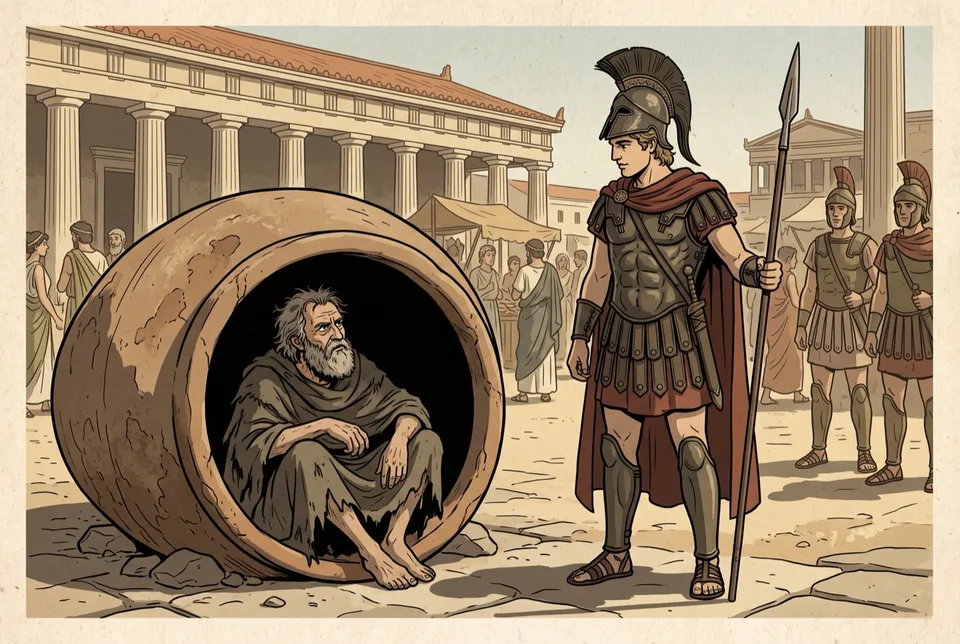
The image of Diogenes living in a barrel is one of the most repeated details from antiquity, but the vessel described in the Greek sources is a pithos, a large ceramic storage jar big enough for a person to shelter in, of a kind used across the ancient Mediterranean to store grain, oil, or wine, not a wooden barrel, which is a later, Western-European image that crept into translations and illustrations over the centuries. Diogenes Laertius records that Diogenes made his home in a pithos in the Metroon, the temple of the Mother of the Gods in the Athenian agora (Diogenes Laertius VI.23). Whether the detail is literal fact or a vivid shorthand later writers used to sum up his contempt for ordinary shelter, it became the single most recognizable image attached to his name.
What are the most famous Diogenes stories?
The anecdotes about Diogenes are the main reason he is still remembered, and they were already circulating as a fixed set of favorites by the time Diogenes Laertius wrote them down. Each belongs to the category of anecdote: a good story that illustrates a reputation, not a court record.
| Anecdote | Source | Reliability |
|---|---|---|
| Walks through Athens by day with a lit lamp, saying he is looking for a human being (often shortened to “an honest man”) | Diogenes Laertius VI.41 | Widely repeated in antiquity; almost certainly a real habit or a well-worn joke attached to him early, exact phrasing uncertain |
| Tells Alexander the Great, who asked what he could do for him, to “stand out of my sunlight” | Diogenes Laertius VI.38 | A famous meeting; scholars doubt the two ever actually spoke, but the line was attached to Diogenes very early |
| Throws away his only cup after seeing a boy drink from his cupped hands | Diogenes Laertius VI.37 | Plausible and consistent with his teaching on self-sufficiency |
| Captured by pirates and sold into slavery, tells the buyer he can govern men and should be sold to someone who needs a master | Diogenes Laertius VI.74 | Reported as fact by Diogenes Laertius; impossible to verify independently |
| Masturbates in public and says he wishes hunger could be satisfied as easily by rubbing the stomach | Reported in the ancient tradition around Diogenes | A shock-anecdote consistent with his doctrine of shamelessness; treat as illustrative rather than confirmed |
| Dies holding his breath, from eating raw octopus, or from a dog bite, sources disagree | Diogenes Laertius VI.76-77 | Diogenes Laertius himself records multiple competing versions and clearly does not expect the reader to take any one as certain |
What was Diogenes’ rivalry with Plato?
The two lived in Athens at overlapping times, and later biography turned them into a matched pair of opposites: Plato the systematic theorist of Forms, Diogenes the man who tested every abstraction against bodily fact. Diogenes Laertius preserves two exchanges that, whether or not they happened exactly as told, capture something real about how the two approaches to philosophy differed.
Plato is said to have defined a human being as a “featherless biped,” a definition meant to work the way definitions in his dialogues often do, by genus and distinguishing feature. Diogenes’ reported response was to walk into Plato’s school with a plucked chicken and announce, “Here is Plato’s man.” Plato, or his students, then amended the definition to add “with broad, flat nails,” to exclude the bird (Diogenes Laertius VI.40). It is a neat philosophical joke, precisely the kind of anecdote likely to be sharpened or invented later to illustrate a known contrast between the two men, and it should be read that way rather than as a transcript.
The second exchange runs the other direction. Watching Diogenes wash his vegetables in a public fountain, Plato is said to have remarked that if Diogenes had paid court to the tyrant Dionysius of Syracuse, as Plato himself had done, he would not now need to wash vegetables; Diogenes replied that if Plato had learned to wash vegetables, he would not have needed to pay court to Dionysius. Diogenes Laertius separately reports Plato calling Diogenes “Socrates gone mad” (Diogenes Laertius VI.54), a line that captures how later antiquity liked to place Diogenes: as heir to Socrates’ plain speech and indifference to wealth, but with all the moderation stripped out. Plato founded the Academy as a school with a curriculum and a physical home; Diogenes rejected the very idea of a settled institution, which is part of why the two make such an effective pair in the later tradition, and part of why Plato’s approach to argument and persuasion looked, to a Cynic, like another kind of performance rather than a shortcut to truth.
How does Diogenes connect to Socrates?
Diogenes is often placed in an informal lineage running from Socrates through Antisthenes, a former student of Socrates, to Diogenes and then on to Crates and the Stoics. The sources are thin on exactly how much time, if any, Diogenes spent studying under Antisthenes directly, but the philosophical debt is clear: Socrates’ famous indifference to wealth and reputation, and his insistence on testing received opinion rather than accepting it, are recognizably the seeds of what Diogenes turned into a full way of life. Where Socrates argued in the agora and accepted an Athenian jury’s verdict against him, Diogenes skipped the arguing and simply lived the conclusion in public. Readers who want the fuller case for treating Socrates as a historical figure at all, given how much of what is known about him also comes through later, sometimes contradictory sources, can see was Socrates a real person for how historians weigh that kind of evidence.
Who continued Diogenes’ philosophy?
Diogenes reportedly took on a wealthy young Theban named Crates of Thebes as a student; Crates gave away his fortune to live as a Cynic in turn, and Crates himself later taught Zeno of Citium, the founder of Stoicism. Stoicism kept Cynicism’s emphasis on virtue as the only true good and its rejection of external status, while dropping the shameless, provocative public performance that made Diogenes famous, and building instead a more systematic ethics and physics, partly in conversation with Plato’s own ideas about virtue, reason, and the ordered cosmos. In that sense Diogenes sits at the root of a line running from a single eccentric figure sleeping in a jar in Corinth to one of the most influential ethical traditions in Western philosophy.
How did Diogenes die?
Diogenes Laertius records several competing accounts of his death in Corinth around 323 BC: holding his breath deliberately, dying from eating raw octopus, or dying from an infected dog bite (Diogenes Laertius VI.76-77). None can be confirmed, and Diogenes Laertius offers them as rival traditions rather than settled fact. A separate, later tradition holds that Diogenes died on the very same day as Alexander the Great, who died in Babylon in June 323 BC. The coincidence, if it is one, was too good for ancient biographers to resist, and most modern historians treat the shared date as a literary flourish rather than a documented fact.
What is Cynicism’s legacy?
The modern English word “cynic,” meaning someone who assumes the worst of other people’s motives, is a descendant of Diogenes’ philosophy but a considerable narrowing of it. Ancient Cynicism was not cynical in the modern, sour sense; it was an optimistic claim that a genuinely good life needs almost nothing external and is available to anyone willing to strip away convention. The gap between the ancient and modern meanings is worth keeping in mind whenever the word comes up in a discussion of Plato or Socrates.
One more piece of modern vocabulary borrows his name without borrowing his philosophy. “Diogenes syndrome” is a term clinicians sometimes use for a pattern of severe self-neglect and extreme hoarding seen mostly in older adults, usually living alone. It is not a diagnosis Diogenes of Sinope had, and it is not a term ancient sources use; it was coined in the twentieth century, borrowing his name for the image of a person living in squalid, minimal conditions by choice, without any claim that the two situations are medically or philosophically alike.
The short version
Diogenes of Sinope turned a childhood coin scandal and an exile into a whole philosophy of owning nothing and answering to nobody. Almost everything colorful about him, the jar, the lamp, the line to Alexander, comes down through Diogenes Laertius and earlier writers whose stories had already been told and retold for centuries by the time they were written down. Treat the anecdotes as a portrait of how later antiquity remembered him rather than a verified record, and the philosophy underneath, self-sufficiency, living according to nature, and a citizenship that reaches beyond any one city, still holds up as one of the sharpest challenges Greek thought ever made to the value of convention.
Keep reading