What Is the Plato Crater? The Moon's Dark-Floored Crater and the Philosopher Behind the Name
In short. The Plato crater is a 101 km dark-floored lunar crater on the Moon's northern near side, named after the philosopher by Riccioli in 1651. Facts, disputed 'transient' flashes, and the Plato link.
The Plato crater is a large, dark-floored crater on the near side of the Moon, in the northern hemisphere, at about 51.6 degrees north and 9.3 degrees west. It is roughly 101 km across, sits on the northern edge of Mare Imbrium beside the Montes Alpes, and is named after the philosopher Plato. The name was suggested by the Jesuit astronomer Giovanni Battista Riccioli in 1651. Plato himself, who died around 347 BC, never saw a crater through a telescope and knew nothing of this feature; the link between the man and the Moon is one of honour, not discovery.
What is the Plato crater, and where is it on the Moon?
Plato is what lunar astronomers call a walled plain: a very large crater with a broad, flat floor and no central peak. It lies on the northeastern shore of Mare Imbrium, at the western end of the Montes Alpes mountain range, with Mare Frigoris, the “Sea of Cold”, just to the north. Its diameter is usually given as 101 km (about 63 miles); individual measurements vary slightly, and some catalogues give figures a little over or under 100 km.
The rim is jagged. Its highest peaks stand roughly 2 to 3 km above the floor, depending on which measurement you use, and when the Sun is low they throw long, sharp shadows across the interior. Seen from Earth the crater looks oval, but that is only foreshortening, because it sits well up toward the Moon’s northern limb. It is easy to find with binoculars.
Why is the Plato crater so dark?
The floor of Plato is unusually dark and smooth compared with the terrain around it. Observers in the nineteenth century described it as a “steel-gray” patch. The standard explanation is that the original crater floor was later flooded with dark volcanic lava, the same kind of basalt that fills the lunar maria, which resurfaced it and buried any central peak and most smaller craters. The crater is classed as Upper Imbrian in age, a little younger than the Imbrium impact basin on whose rim it sits, which puts it at roughly 3.8 billion years old, though that dating is approximate. Only a handful of tiny craterlets are visible on the floor, which is part of why it has been watched so closely.
Who named the Plato crater?
Lunar features had no agreed names before the seventeenth century. Early mapmakers used their own labels. Johannes Hevelius, in his Selenographia of 1647, called the dark patch Lacus Niger Major, “Greater Black Lake”, and Michael van Langren had called it Lacus Panciroli. Neither name survived.
The modern scheme comes from Riccioli’s Almagestum Novum (1651), in which the large dark areas were named as seas and the crater-marked terrain was named for philosophers and astronomers. Riccioli’s name for this crater was Plato, and when the International Astronomical Union standardised lunar naming in the twentieth century, it kept most of his names. The naming is a mid-seventeenth-century compliment to the philosopher, nothing more.
Is it true that strange lights appear in the Plato crater?
Sometimes reported, but the evidence is disputed. Plato has long been one of the Moon’s most-reported sites for transient lunar phenomena: brief flashes, coloured glows, haze and apparent changes in the dark floor. One catalogue tally credits Plato with some 40 reports, second only to the crater Aristarchus. The astronomer Arlin Crotts has argued that many such reports are real and may reflect gas escaping from the Moon.
Others point out that most were visual observations made under varying sunlight angles and poor atmospheric “seeing”, and that a dark floor with low-contrast detail is exactly the kind of target on which the eye and the atmosphere can mislead. Whether the reports reflect real events or observing effects is unresolved, so they should be treated as unconfirmed. The crater is real; the flashes remain an open question.
Why would astronomers name a crater after Plato?
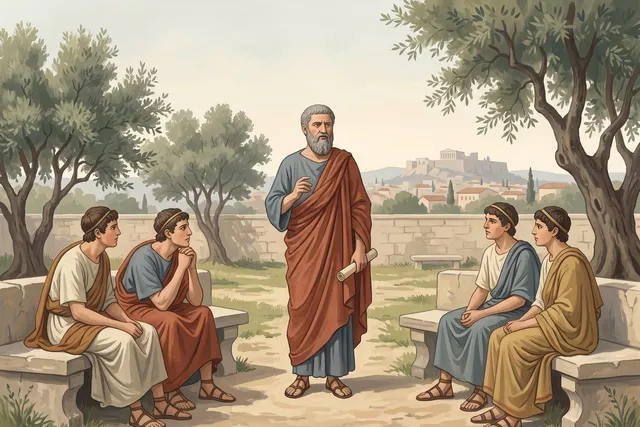
Plato was not himself a working astronomer, but astronomy sits close to the centre of his philosophy, and that is the most plausible reason a seventeenth-century astronomer put him among the founding names of the Moon. (Riccioli’s own motives are an inference here, not something we can quote.) Three things stand out in Plato’s own writings.
The heavens as a model of order. In the Timaeus, Plato’s character Timaeus says the maker of the universe fashioned time as a “moving image” of eternity, and that the sun, moon and planets came into being as instruments for marking and keeping that time (Timaeus 37d, 38c-39e). Sight itself, he says, was given to us so that we could watch the revolutions of the heavens and bring our own thinking into line with them (Timaeus 47b). For more on the craftsman behind this picture, see our essay on the Demiurge and the longer account of Plato’s Timaeus and cosmology.
Astronomy as a study of the unseen. In Republic VII (527d-530c), astronomy is one of the subjects the future guardians must learn. Socrates says the patterns in the visible sky are the finest of visible things but are still only illustrations of truer, unseen motions, and that students should treat them like geometrical diagrams and pursue problems rather than simply gaze at the stars (Republic 529a-530c). It is a surprising view: Plato wants astronomy done by thought, not just by looking.
The problem of “saving the phenomena”. A late tradition holds that Plato set astronomers a challenge: to find which uniform, ordered motions would account for the apparently wandering paths of the planets. The story comes from Simplicius, a sixth-century AD commentator on Aristotle, who says he is drawing on Sosigenes, who in turn drew on Eudemus (Simplicius, On the Heavens 488.18-24). It is therefore a report written many centuries after Plato, and some modern scholars doubt it. What is not in doubt is that Eudoxus of Cnidus, a younger contemporary of Plato and a mathematician and astronomer, built a model of nested rotating spheres to explain planetary motion, as Aristotle later describes (Metaphysics XII.8). Whether or not Plato posed the question, his insistence that the heavens could be understood mathematically shaped the research programme that ran from Eudoxus to Ptolemy and beyond.
What does the crater tell us about Plato?
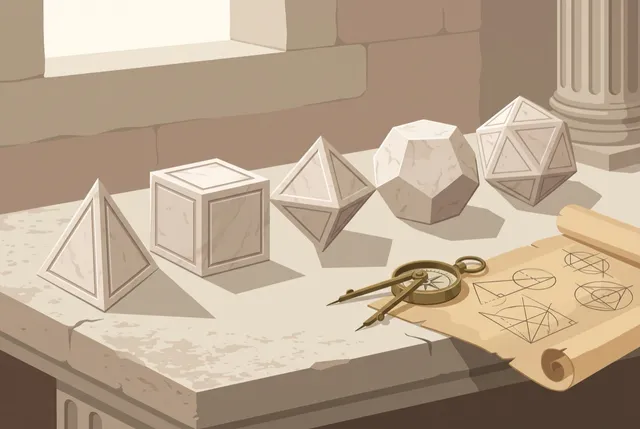
Very little directly, and that is the honest answer. The crater is named in his honour; it does not record anything he said or did. But the name fits. Riccioli was working in a tradition that read the heavens as an ordered, intelligible system, and Plato, more than most Greek thinkers, made that idea a founding principle of Western philosophy. The same instinct led him to use the five Platonic solids as the building blocks of the elements, with the fifth kept for the cosmos as a whole, and he founded the Academy, the school where, by later accounts, mathematics and astronomy were studied alongside philosophy.
How can you see the Plato crater?
Plato is easy to spot in binoculars or a small telescope. Look for a dark, rounded patch on the northern side of Mare Imbrium, between the Montes Alpes and Mare Frigoris. Sunrise reaches the crater about eight days after new Moon, a day or so after first quarter, and for a day or two afterwards the shadows of the rim peaks stretch across the floor, a classic observing target. At other phases the dark floor stands out against the brighter ground around it.
That is also the best way to connect the crater back to the philosopher. Plato would have seen the same Moon, with the naked eye and without a telescope, and he would have read it as part of a moving image of eternity. For the man himself, start with who Plato was.
Keep reading