The Platonic Solids: What They Are, Why There Are Only Five, and What Plato Made of Them
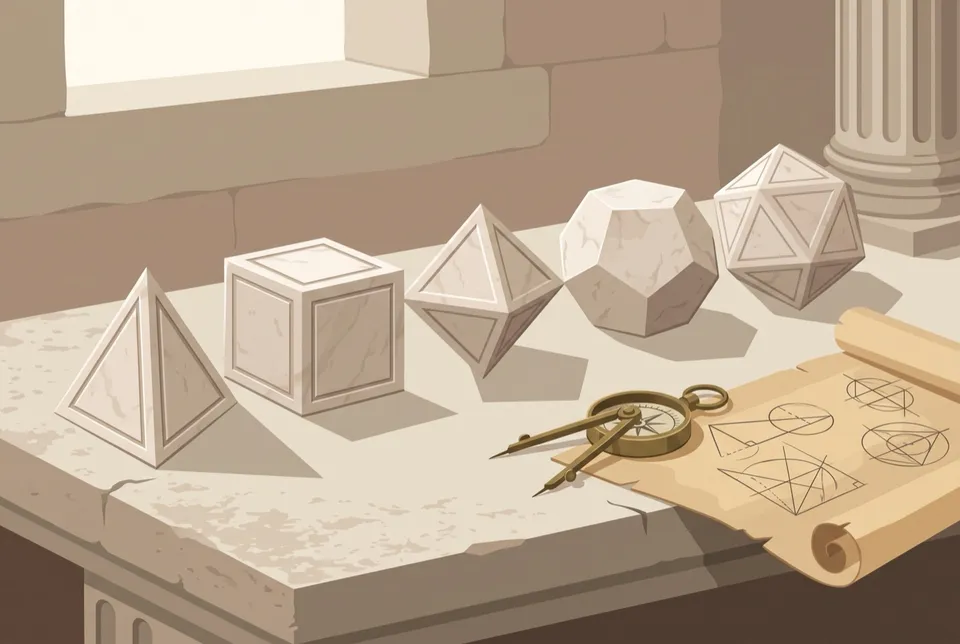
In short. The Platonic solids are the five regular 3D shapes: tetrahedron, cube, octahedron, dodecahedron and icosahedron. Why only five exist, and how Plato built the world from them.
The Platonic solids are the five regular convex polyhedra: three-dimensional shapes whose faces are all the same regular polygon, with the same number of faces meeting at every corner. They are the tetrahedron, cube, octahedron, dodecahedron and icosahedron, and there are exactly five of them. No sixth one is possible.
They are named after Plato because in the Timaeus, written around 360 BC, he made them the building blocks of the physical world. Mathematicians had studied the shapes before him, but after Plato they were his.
The five Platonic solids at a glance
| Solid | Faces | Face shape | Edges | Vertices | Faces at each vertex | Plato’s element |
|---|---|---|---|---|---|---|
| Tetrahedron | 4 | Triangle | 6 | 4 | 3 | Fire |
| Octahedron | 8 | Triangle | 12 | 6 | 4 | Air |
| Icosahedron | 20 | Triangle | 30 | 12 | 5 | Water |
| Cube (hexahedron) | 6 | Square | 12 | 8 | 3 | Earth |
| Dodecahedron | 12 | Pentagon | 30 | 20 | 3 | The cosmos as a whole |
Each one obeys Euler’s formula: vertices minus edges plus faces equals 2. For the cube, 8 − 12 + 6 = 2; for the icosahedron, 12 − 30 + 20 = 2.
Why are there only five Platonic solids?
The proof is old, simple and beautiful. It is the final result of Euclid’s Elements (XIII.18), which ends with the five solids as if they were the goal of the whole book.
The key fact is about corners. To make a solid corner, at least three faces have to meet at a point, and the angles of those faces must add up to less than 360°. At exactly 360° the faces lie flat, like floor tiles, and there is no corner. Now check each regular polygon:
- Triangles (60° each): three at a corner make 180°, four make 240°, five make 300°. Those give the tetrahedron, octahedron and icosahedron. Six triangles make 360°, which is flat.
- Squares (90° each): three make 270°. That is the cube. Four make 360°, flat.
- Pentagons (108° each): three make 324°. That is the dodecahedron. Four would make 432°, too many.
- Hexagons (120° each): three already make 360°, flat. Every polygon with more sides has even larger angles, so nothing else works.
That leaves exactly five possibilities, and each one really does close up into a solid. The number five is a fact about space itself, not a gap in anyone’s imagination, which is exactly the kind of truth Plato thought the mind could grasp and the senses could not.
How did Plato use the Platonic solids in the Timaeus?
In the Timaeus, a divine craftsman, the Demiurge, shapes the world out of chaos using mathematics. The four traditional elements of Greek science (earth, water, air and fire) turn out to be made of tiny invisible solids (53c–56c), each suited to how that element behaves:
- Fire is the tetrahedron. It is the smallest, lightest and sharpest of the shapes, with the most pointed corners. That is why fire burns and cuts.
- Earth is the cube. It sits firmly on its square faces and is the hardest shape to move, which is why earth is solid and stable.
- Water is the icosahedron. With twenty faces it is the roundest and rolls most easily, so water flows.
- Air is the octahedron, in between fire and water in size and mobility.
The fifth solid was left over. Of the dodecahedron Plato says only that “the god used it for the whole, decorating it with figures” (55c), usually read as the twelve constellations of the zodiac. Later writers linked it with the heavens and with the “fifth element”, or quintessence.
Why could Plato’s elements change into each other?
This is the cleverest part of the theory. Plato went one level deeper than the solids. Every face, he said, is built from two kinds of right-angled triangle: the square’s faces from isosceles right triangles, and the equilateral triangles of the other three from a different right triangle, half an equilateral triangle (53c–55c).
Because fire, air and water are all made of the same triangles, their particles can break apart and reassemble. One particle of water, with 20 faces, can split into one of fire (4 faces) and two of air (8 faces each): 4 + 8 + 8 = 20 (56d). Earth, built from the other kind of triangle, cannot turn into the rest. Plato had invented a kind of atomic chemistry, with conservation of its basic units, more than two thousand years before modern chemistry.
The details are wrong, of course, but the idea behind them was not: that the physical world is built from invisible units whose mathematical structure explains how matter behaves. That is still the working assumption of physics.
Did Plato discover the Platonic solids?
No. The cube, tetrahedron and octahedron are simple enough that people must have known them long before, and the Pythagoreans studied the dodecahedron. An ancient note on Euclid credits Plato’s friend and fellow mathematician Theaetetus with the first full study of the octahedron and icosahedron, and with being the first to write about all five. Theaetetus worked alongside Plato at the Academy, and Plato named a dialogue after him.
Plato’s own contribution was to make the solids matter. In the Republic he complains that the study of solid geometry has been neglected and ought to be taken up (528b), and in the Timaeus he made it the key to nature.
Duals: how the solids pair up
The five solids come in matched pairs. Put a point at the centre of each face of a cube and join them up, and you get an octahedron; do the same to an octahedron and you get a cube. The two are duals: the cube has 6 faces and 8 vertices, the octahedron 8 faces and 6 vertices. The dodecahedron and icosahedron are duals in the same way (12 and 20). The tetrahedron is its own dual.
Kepler’s nested solids
Two thousand years after Plato, the astronomer Johannes Kepler tried to use the solids to explain the solar system. In Mysterium Cosmographicum (1596) he nested the five solids inside one another, with spheres between them, and argued that the gaps matched the distances of the six planets then known. The fit was only approximate, and his own later discovery that planetary orbits are ellipses undermined it, though he never entirely let the idea go. It remains the most ambitious attempt since Plato to find the Platonic solids in the design of the heavens.
Where do you see Platonic solids today?
- Dice. A standard role-playing dice set includes all five: the d4, d6, d8, d12 and d20. They make fair dice because every face is identical.
- Viruses. Many viruses, including herpesviruses, adenoviruses and the rhinoviruses behind most colds, have protein shells built on icosahedral symmetry, the most efficient way to enclose space with identical parts.
- Crystals and molecules. Table salt crystallises in cubes, the mineral fluorite forms octahedra, and the methane molecule has the shape of a tetrahedron.
Plato would not have been surprised to find his five shapes in viruses and crystals. His bet was that the physical world is a copy of mathematical order, and the Platonic solids are still the clearest example anyone has found of that order showing through.
Keep reading