What Is the Demiurge? Plato's Divine Craftsman and the Gnostic False God
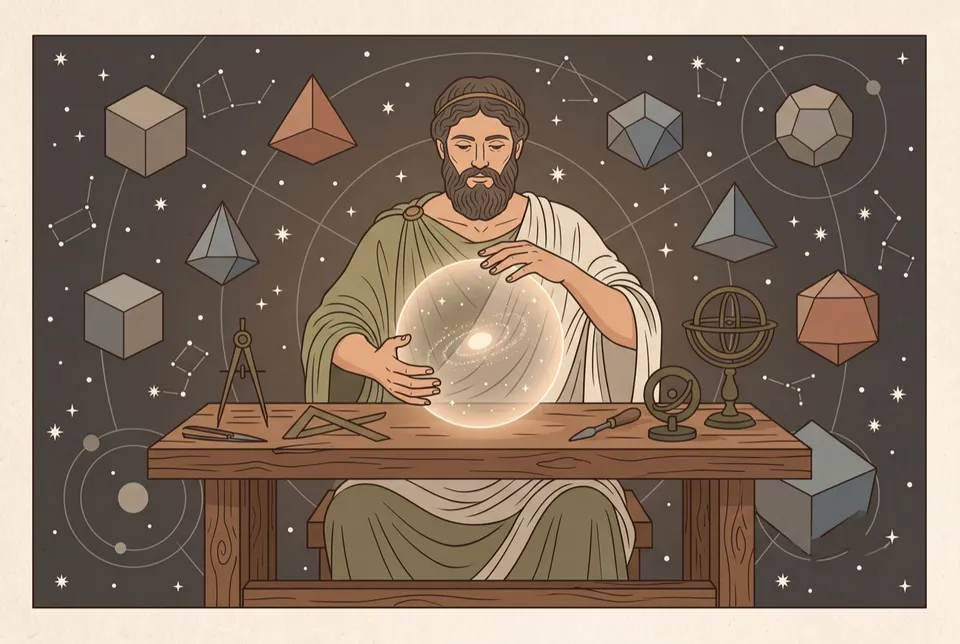
In short. The Demiurge is the divine craftsman of Plato's Timaeus who shapes the cosmos on the model of the Forms. Later Gnostics turned him into an ignorant false god.
The Demiurge is the divine craftsman in Plato’s Timaeus: a good god who looks to the eternal Forms as his model and shapes a chaotic, pre-existing material into an ordered, beautiful cosmos. He does not create the world out of nothing. He is a maker, not a creator, and he works with materials he did not invent.
The same word later took on almost the opposite meaning. In the Gnostic movements of the second century AD, the Demiurge became a lesser, ignorant or even malevolent god who made the flawed material world and wrongly believed he was the only god there is. Most modern uses of the word, in fantasy fiction, games and online culture, draw on that second, darker figure. This essay explains both, and why they should not be confused.
What does the word “demiurge” mean?
The Greek word dēmiourgos is built from dēmos (the people) and ergon (work). It originally meant a public worker: anyone whose skill served the community, such as a carpenter, potter, doctor or herald. By Plato’s time it was the ordinary word for a craftsman or artisan. In some Greek cities it was also the title of a public official, which fits the root sense of someone who works for the people.
Plato takes this everyday word and gives it a cosmic job. In the Republic he uses the same term for the carpenter who makes a bed by looking to the Form of the bed (596b). The Demiurge of the Timaeus is that carpenter on the scale of the universe. English borrowed the word through Latin demiurgus, and it is usually written with a capital letter when it refers to Plato’s god or the Gnostic one.
Who is the Demiurge in Plato’s Timaeus?
The Timaeus, written around 360 BC, is Plato’s account of how the physical world came to be. The main speaker, Timaeus of Locri, is an astronomer with Pythagorean leanings, and he tells the story in one long speech. (For the dialogue as a whole, see our guide to Plato’s Timaeus and cosmology.)
Timaeus begins with a principle: everything that comes to be must have a cause. The visible world changes, so it came to be, so something made it. But he admits at once that “to find the maker and father of this universe is hard, and having found him, to declare him to everyone is impossible” (28c). That humility matters for everything that follows.
The account then runs through a series of steps:
- The maker looked to a model. A craftsman can copy something eternal or something that has itself come to be. Because the world is beautiful and its maker good, he must have looked to the eternal (29a). The eternal model is what Plato elsewhere calls the Forms. For more on these, see our critical analysis of the theory of Forms.
- He made the world because he was good. This is the heart of the story. The Demiurge “was good, and in the good no envy ever arises about anything” (29e). Being without envy, he wanted everything to be as like himself as possible (29e–30a).
- He brought order out of disorder. He took over everything visible, which was “not at rest but moving without harmony or order”, and led it from disorder into order, judging order better in every way (30a).
- He made the cosmos a living being. Reasoning that a thing with intelligence is finer than one without, and that intelligence cannot exist apart from soul, he put intelligence in soul and soul in body. So the cosmos is “a living creature, truly endowed with soul and intelligence” (30b). This World Soul stretches through the whole universe and moves the heavens.
- He made time. Since the eternal model could not be copied perfectly into a changing world, the Demiurge made “a moving image of eternity” (37d): time, measured out by the turning of the sun, moon and planets. (See the concept of time in Plato’s philosophy.)
- He handed some of the work to lesser gods. The Demiurge makes the star gods and the traditional gods, then gives them a speech (41a–d). He himself will provide the immortal, divine part of the human soul. The younger gods must weave mortal bodies around it, because anything made directly by him would be immortal.
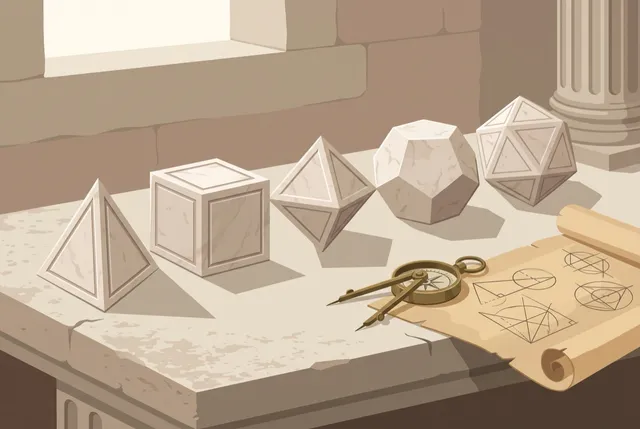
Later in the dialogue, Timaeus explains how the four elements are built from triangles arranged into regular solids, fire as the tetrahedron, earth as the cube and so on. That geometry is the Demiurge’s handiwork at the smallest scale: see what are the Platonic solids.
Is Plato’s Demiurge a creator god?
No, and this is the point most often missed. Plato’s Demiurge differs from the God of Genesis, as later Christian theology understood him, in at least four ways.
- He does not create from nothing. The material was already there. Timaeus later calls the underlying medium the receptacle (hupodochē), a kind of space or “nurse of becoming” in which the elements appear. It was full of disordered motion before the craftsman arrived.
- He is not all-powerful. The world is made by intellect working together with necessity (anankē). Intellect rules necessity “by persuading it” to bring most things toward the best (48a). The craftsman persuades his material. He cannot simply command it, so the world is as good as it can be, not perfect.
- He does not invent the model. The Forms are eternal and independent of him. He contemplates them the way a builder reads a plan he did not draw.
- He is good, but he is not the Good. In the Republic the summit of reality is the Form of the Good. The Demiurge is good, and he wants his work to share in goodness, but Plato never says he is goodness itself. How the two relate is one of the open questions in Plato’s thought.
Is the Timaeus creation story meant literally?
Plato calls his account a “likely story” (eikōs muthos, 29d). Since the visible world is only an image of the eternal model, an account of it can only be probable, not certain. Timaeus asks his listeners to be content with a story that is as likely as any other.
This opened one of the oldest debates in the history of philosophy. Did the world really have a beginning in time, with a craftsman stepping in at a certain moment?
- Aristotle read it literally. In On the Heavens he criticises Plato for saying the world was generated and yet will last forever, which Aristotle thought impossible.
- Xenocrates, who later led Plato’s Academy, and most ancient Platonists after him read it as a teaching device. On this view the “before” and “after” are like the steps of a geometry diagram drawn one line at a time: a way of showing the structure of something that is in fact eternal. The world has always depended on intelligence, and the story separates out what is really a permanent relationship.
- A minority of Platonists, including Plutarch and Atticus, sided with a literal beginning.
Modern scholars are still divided. The honest summary is that Plato gives us a myth with serious philosophical content, and he warns us himself not to press every detail.
What happened to the Demiurge in later Platonism?
Later Platonists kept the craftsman but moved him within a larger system. In Neoplatonism, the highest principle is the One, beyond all thought. Below it comes Intellect (nous), which contains the Forms, and below that Soul, which animates the physical world. These levels are the “hypostases” (see what is hypostasis for Plato and Aristotle).
Plotinus, writing in the third century AD, identified the craftsman role mainly with Intellect, the divine mind that holds the eternal patterns, while Soul does the hands-on work of shaping bodies. The world no longer comes from a single act of making. It flows out, eternally, from higher principles, like light from the sun. The Demiurge becomes a function within the system rather than a character in a story.
Christian readers went another way. Philo of Alexandria, a Jewish thinker of the first century AD, had already read the Timaeus alongside Genesis, and many Church Fathers saw the dialogue as a pagan glimpse of creation. They made two key changes: God creates from nothing, and the Forms become ideas in the mind of God. For much of the Latin Middle Ages, a partial Latin translation of the Timaeus was nearly the only Plato that Western readers could study, so the Demiurge shaped the medieval picture of Plato.
What is the Gnostic Demiurge?
Gnosticism is a modern umbrella term for a range of religious movements that flourished in the second and third centuries AD, mostly on the edges of early Christianity. They taught that salvation comes through gnōsis, a secret, saving knowledge of the true God and of the divine spark trapped inside human beings. Much of what we know comes from their opponents, such as Irenaeus of Lyon, and from the Coptic texts found at Nag Hammadi in Egypt in 1945.
In these systems, the true God is utterly remote and good, surrounded by a realm of divine beings. The material world was not made by this God at all. It was made by a lower being, the Demiurge, who is the product of a fall or error in the divine realm.
- In Sethian texts such as the Apocryphon of John, the Demiurge is called Yaldabaoth (also Saklas or Samael). He is born from a mistake by the divine being Sophia, Wisdom, is ignorant of the realm above him, and fashions the material world and its rulers. He boasts that he is a jealous god and that there is no other god beside him. The texts treat this as a proof of his ignorance.
- In Valentinian teaching, the Demiurge is less sinister. He is ignorant rather than evil: a lower god who does his work without understanding the higher realm he is unknowingly copying. Some Valentinians identified him with the God of the Old Testament, whom they saw as just in a limited way but not the highest good.
Either way, the physical world is not a home but something close to a prison, and the goal of the knower is to escape it.
How is the Gnostic Demiurge different from Plato’s?
The Gnostics kept Plato’s word and much of his structure: a higher, eternal realm and a lower, copied world, with a maker in between. But they reversed its values. Plato’s craftsman is defined by his freedom from envy; Yaldabaoth announces that he is jealous. Plato’s craftsman looks to the eternal model and knows it; the Gnostic maker does not know what lies above him. Plato’s cosmos is a blessed god and a work of reason; the Gnostic cosmos is a mistake.
| Plato’s Demiurge | Gnostic Demiurge | |
|---|---|---|
| Source | Plato’s Timaeus, c. 360 BC | Sethian and Valentinian texts, 2nd–3rd century AD |
| Character | Good, without envy | Ignorant, arrogant, sometimes malevolent |
| Knowledge | Looks to the eternal Forms | Ignorant of the true God above him |
| Rank | Highest divine maker in the story | A lesser being born of a fall or error |
| Name | Unnamed, “maker and father” | Often Yaldabaoth, also Saklas or Samael |
| Why he makes the world | To make it as good as possible | From ignorance, pride or desire to rule |
| Status of the world | A beautiful, living, divine cosmos | A flawed prison for divine sparks |
| Human goal | Understand the cosmos and imitate its order | Escape the material world through gnosis |
Why did Plotinus attack the Gnostics?
Plotinus met Gnostic ideas at close range: he says some of his own friends in Rome held them. He wrote a treatise against them, known as Against the Gnostics (Ennead II.9). His complaint was that they had taken Plato’s ideas and turned them upside down.
His main points are easy to state. The cosmos is an image of the intelligible world, and an image of something beautiful cannot be contemptible. To despise the world is to despise its source. The Gnostics claim to be above the stars and the World Soul while living in bodies and showing no more virtue than anyone else. And inventing new layers of divine beings, with a maker produced by a fall, is bad metaphysics that multiplies causes without reason.
The treatise matters because it shows a Platonist defending Plato’s Demiurge against its most famous distortion, from within the ancient world itself.
How is “demiurge” used today?
Outside philosophy, “demiurge” has become a general word for a world-maker: any figure, divine or human, who shapes a world. Writers describe an author who builds an imaginary world, or a powerful founder or architect, as a demiurge.
In fantasy fiction, tabletop role-playing and video games, the word is common, and most of these uses borrow from the Gnostic version: a false or flawed god, a hidden maker behind a corrupted world, a being who must be exposed or overthrown. Stories built on the idea that our world is a false construction run by an ignorant or controlling power echo Gnostic themes, whether or not they use the word. If you met the Demiurge in a game or a novel, you were most likely meeting a descendant of Yaldabaoth, not of Plato’s craftsman.
Why does Plato’s Demiurge still matter?
The Demiurge answers a question the theory of Forms leaves open. If the real patterns are eternal and changeless, how did the changing world come to resemble them at all? Plato’s answer is intelligence at work: a mind that wanted the world to be good and shaped it accordingly.
That picture carries a claim that science still relies on, that the universe has a rational order that the human mind can grasp. Plato also refuses to make the world perfect. Necessity resists, the craftsman persuades rather than commands, and the result is the best world possible, not a flawless one. The Gnostics saw the same flaws and concluded that the maker was ignorant or wicked. Plato saw them and concluded that goodness had done all it could with difficult material. The disagreement between the two Demiurges is, in the end, a disagreement about whether the world deserves our love.
Keep reading