Who Was Parmenides? The Philosopher Who Said Only Being Is
In short. Parmenides of Elea (born c. 515 BC) founded the Eleatic school and argued in verse that only unchanging being truly exists. Who he was and why he mattered.
Parmenides of Elea (born c. 515 BC) was a Greek philosopher who founded the Eleatic school and argued, in a single poem now called On Nature, that reality is one, unchanging, and eternal, and that the changing, plural world reported by the senses is not to be trusted. He wrote in verse, cast as a chariot journey to a goddess who reveals the truth to him, and his surviving fragments, roughly 160 lines out of what was probably a much longer work, are some of the most argued-over lines in the history of philosophy. Parmenides mattered enormously to Plato, who named a dialogue after him, has him appear in person to challenge a young Socrates, and later has one of his own characters describe a critical move against Parmenides’ philosophy as an act of “parricide” against a philosophical father (Sophist 241d). This essay covers the historical Parmenides and his poem; for Plato’s dialogue built around a fictionalised meeting between Parmenides and Socrates, see Plato’s Parmenides and its paradoxes and why would Plato write Parmenides.
Who was Parmenides?
Parmenides was born in Elea, a Greek colony on the coast of southern Italy, probably around 515 BC; the date rests mainly on a remark in Plato that is itself disputed, so it should be treated as approximate. Almost nothing about his life is independently confirmed beyond the fact that he wrote the poem and founded, or at least inspired, a philosophical circle at Elea that later writers call the Eleatic school. Later biographical tradition adds details, such as a claim that he helped draft laws for Elea, that are plausible but not well attested. What survives with much more confidence is the poem itself, preserved in quotations by later ancient writers, especially the commentator Simplicius, who quotes long stretches of it directly and is the main reason any of it survives at all.
What does Parmenides’ poem say?
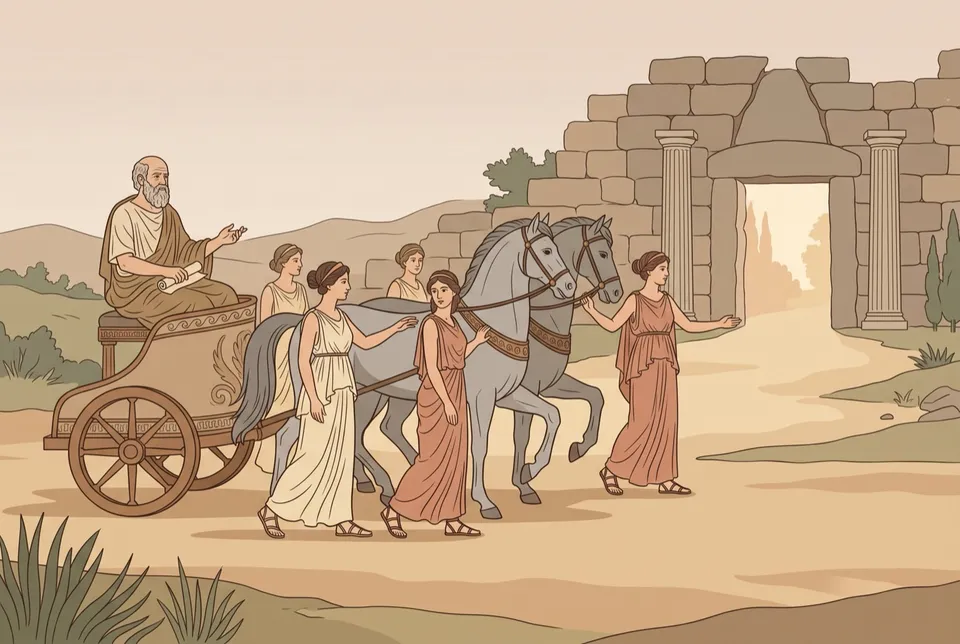
The poem, conventionally called On Nature though that title was probably added later, opens with a striking scene: a young man, usually taken to be Parmenides himself, is carried in a chariot by the daughters of the Sun, through the gates that divide night from day, to meet an unnamed goddess (DK 28 B1). The goddess greets him kindly and tells him he must learn two things: the unshakeable heart of well-rounded truth, and the beliefs of mortals, in which there is no genuine reliability. That framing sets up the poem’s two main parts.
What is the Way of Truth?
The first and philosophically central part of the poem is usually called the Way of Truth. The goddess tells Parmenides there are only two paths of inquiry that can be thought: the path that “is” and cannot not be, and the path that “is not” and necessarily must not be (B2). The second path, she says, is not one anyone can actually travel, because you cannot know or say what is not: “for the same thing is for thinking and for being” (B3), and thinking and saying always require something that is there to be thought or said (B6). On this reasoning, “what is not” collapses as an object of thought before you can even get started with it, which leaves only “what is” as a coherent subject for inquiry.
From that starting point the goddess derives, step by step, a set of properties that whatever truly is must have (B8). It cannot have come into being, because it would have to have come from what is not, which is not available to come from. It cannot perish, for the same reason in reverse. It cannot change, because change would mean it was one thing and becomes another, which again smuggles in not-being. It cannot be many, or have parts, or here-and-not-there, because any distinction of one part from another requires a boundary where one part is not the other, and Parmenides’ logic will not tolerate not-being anywhere in the picture. The result is a single, whole, unchanging, ungenerated, imperishable being, which the poem describes, in its most quoted image, as complete on every side, “like the bulk of a well-rounded sphere” (B8).
What is the Way of Opinion?
The second part of the poem, the Way of Opinion (doxa), sets out a cosmology built on two basic principles, usually understood as light and night, and describes the ordinary world of change, plurality, and the senses that most people take for granted. The goddess is explicit that this part contains no genuine reliability. Scholars disagree sharply over why Parmenides included it at all if he thought it was false: some read it as a deliberately persuasive but mistaken account of how ordinary mortals do in fact picture the world, a kind of “here is the best wrong theory available” exercise; others think it preserves some value as natural philosophy in its own right, alongside the metaphysical argument of the Way of Truth. Far less of the Way of Opinion survives than of the Way of Truth, which makes the debate hard to settle from the fragments alone.
Why was this revolutionary?
Before Parmenides, Greek philosophers who asked what the world is fundamentally made of, figures such as Thales, Anaximander, and Heraclitus, mostly reasoned from observation and speculation about a material basis for change: water, air, fire, or some indefinite substance underlying everything. Parmenides did something different. He argued from pure logical necessity about what can and cannot be thought or said, and concluded that the entire world of change, motion, and multiplicity that the senses report is, strictly speaking, illusion or error. That is a startling claim to defend by argument rather than mysticism, and it forced everyone who came after him to either answer his logic directly or build a physical theory that could survive it. Rational argument, not the senses, becomes the authority for what is real, a move that shapes the rest of Greek philosophy.
| Claim | Fragment | What it means |
|---|---|---|
| Only two paths of inquiry exist, and “is not” cannot be known or said | B2 | Frames the whole argument as a choice between two ways of thinking about reality |
| Thinking and being are the same thing | B3 | You cannot think or speak of what has no being; “what is not” cannot be an object of thought |
| What can be spoken of and thought must be | B6 | Rules out non-being as a coherent object of thought, so inquiry must start from what is |
| What is cannot have come to be or perish | B8 | Denies genuine coming-into-being and destruction, since both would require not-being |
| What is is one, whole, unchanging, and complete, like a well-rounded sphere | B8 | The positive picture of true reality: a single, motionless, perfect whole |
How did Zeno defend Parmenides?
Zeno of Elea, a younger associate of Parmenides, is best known for a set of paradoxes arguing that motion and plurality lead to contradictions, such as the puzzle of Achilles never catching a tortoise given a head start, or an arrow in flight that is, at every instant, at rest. Zeno did not simply repeat Parmenides’ conclusions; he attacked the opposite position, showing that assuming the world is genuinely many and genuinely in motion produces absurdities just as severe as the ones critics raised against Parmenides’ claim that reality is one and unchanging. Aristotle later credited Zeno with something like the invention of dialectic, the method of arguing by drawing out the consequences of an opponent’s position, precisely because of this strategy. The effect was to make the Eleatic position harder to dismiss: if the ordinary, common-sense view of a plural, moving world also collapses into contradiction, then Parmenides’ strange conclusion no longer looks like the only theory in trouble.
How did Parmenides influence Plato?
Parmenides’ account of eternal, unchanging, single being sits directly behind Plato’s Theory of Forms, the idea that true reality consists of unchanging, eternal objects of thought, such as the Form of Beauty or the Form of Justice, that ordinary changing things only imperfectly resemble; see what is being according to Plato and what is the nature of reality for Plato for how that theory develops. Plato borrows Parmenides’ central intuition, that genuine reality must be stable and unchanging rather than in flux, and applies it to a plurality of Forms rather than to a single undifferentiated being, which is itself a departure from Parmenides that later needed defending.
Plato engaged with Parmenides directly and repeatedly. In the Theaetetus, Socrates calls Parmenides “venerable and awesome,” a man he met when young and felt possessed a “certain depth” entirely admirable (183e). In the dialogue named after him, the Parmenides, Plato imagines an aged Parmenides visiting Athens and subjecting a young Socrates’ theory of Forms to a battery of hard questions, including the regress problem later scholars call the Third Man argument and the puzzle of how a single Form can be wholly present in many separate things (132a–b); the historical accuracy of this scene is doubtful, since Plato’s own dramatic dating in the dialogue puts Parmenides’ visit to Athens at about sixty-five years old (127b), and most historians think the meeting, as staged, is very unlikely to have actually happened, a fictional device for putting Plato’s own theory under the sternest scrutiny he could imagine. Later, in the Sophist, Plato has the Eleatic Stranger describe the move needed to make sense of falsehood and not-being, against Parmenides’ flat denial that not-being can be spoken of at all, as committing “parricide” against “father Parmenides” (241d), a vivid admission that correcting Parmenides meant attacking a position Plato’s own philosophy had grown up inside.
What came after Parmenides?
Later Presocratic philosophers largely accepted Parmenides’ logical challenge and tried to build physical theories that could survive it. Empedocles proposed four eternal, unchanging root elements, earth, water, air, and fire, that mix and separate under the forces of Love and Strife, so that nothing genuinely comes into being or perishes, only the elements’ arrangements change. Anaxagoras proposed an infinite variety of eternal, unchanging basic ingredients, mixed in different proportions in everything, again avoiding real coming-into-being or destruction. The atomists, Leucippus and Democritus, granted Parmenides that true being must be ungenerated and indestructible, and simply multiplied being into countless tiny, indivisible atoms moving in a void, treating the void itself, controversially, as a kind of not-being that nonetheless had to exist for motion to be possible at all. Each of these theories can be read as an attempt to have change and plurality back, in some form, while conceding Parmenides’ core point that whatever really exists cannot itself come to be or pass away.
Why does Parmenides still matter?
Parmenides is usually credited with turning philosophy toward rigorous, premise-based argument as the test of what is real, rather than observation or traditional cosmology, a shift that shapes the entire later history of metaphysics and logic. His insistence that being and thinking are bound together, and his refusal to let not-being count as a coherent subject, still surface in debates about existence, identity, and change today. For Plato in particular, Parmenides is less a distant predecessor than an argument Plato had to keep answering: the Forms are Plato’s way of keeping Parmenidean stability while still explaining a world that plainly does change, a compromise Parmenides himself would likely not have accepted, and one Plato tests most severely in the dialogue that bears Parmenides’ own name.
Keep reading